Collabtunes · Memorabilia
ESSAYS AND OTHER WRITINGS (NOT LYRICS) - PAGE 2 OF 4
30 pieces on this page · every one an original · every photograph, nothing hidden · dashed lines are yours to fill
TOM JENSEN - COLLEGE ESSAY
Item 1870
Feature Piece - She sits in the doctor's office (November 12, 1999)
In one sentence: Another printing of Tom's feature story of November 12, 1999 about a young woman with hearing loss waiting at the doctor's office, stamped Scanned, from 1999.
Item type
WRITINGS · TOM JENSEN · COLLEGE ESSAY
UNPUBLISHED
Another printing of Tom's feature story from November 12, 1999 about a young woman with hearing loss at the doctor's office, stamped Scanned.
- Why it matters
- Another printing of Tom's feature story DOCTOR'S OFFICE (November 12, 1999) about a young woman with hearing loss, ending There is finally hope - the prose he wrote in the college years of his first poems.
- Type
- Printed page
- Collection
- College writings ; Writings (non-lyric) ; Feature writing ; Inspiring
- Published in
- PREVIOUSLY UNPUBLISHEDSearched against the 34 albums, every book and Poems By Tom - found in none of them
- Age when written
- made at age 21proved: the feature piece is dated November 12, 1999 - typed off its photo
- Same words
- also written out as number 1867matched on the words by machine - Tom confirms
- On the site
- Tom's Story: 1999
Price · Tier · Tom fills these
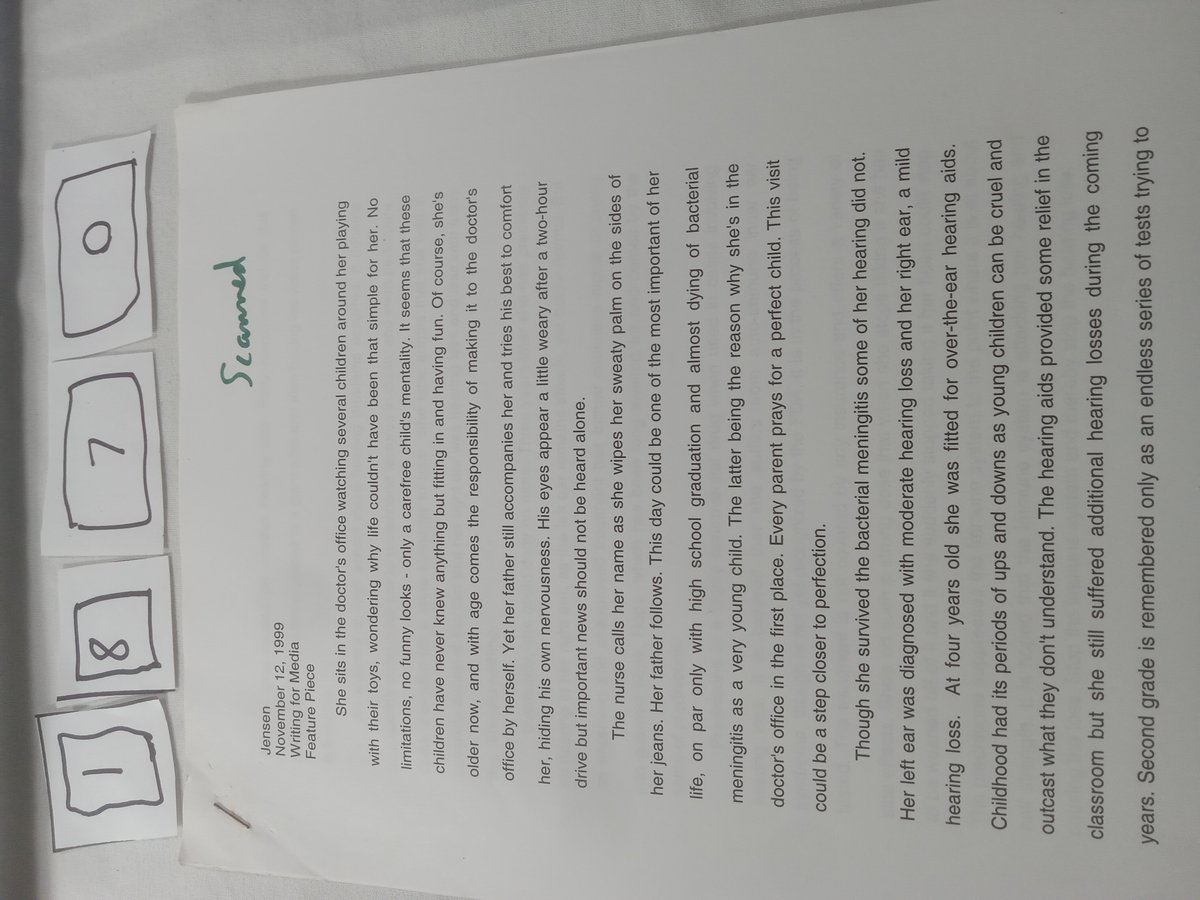
Picture 1 of 3
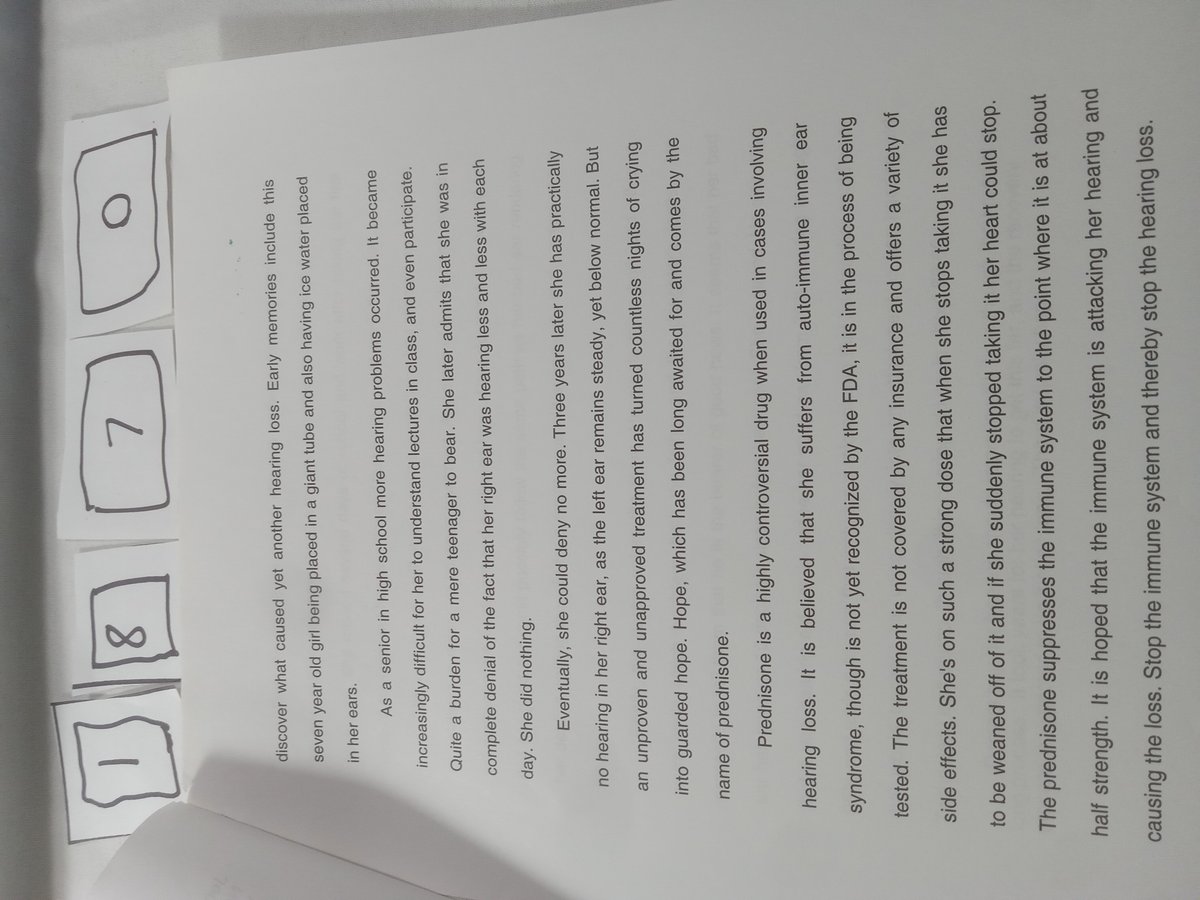
Picture 2 of 3
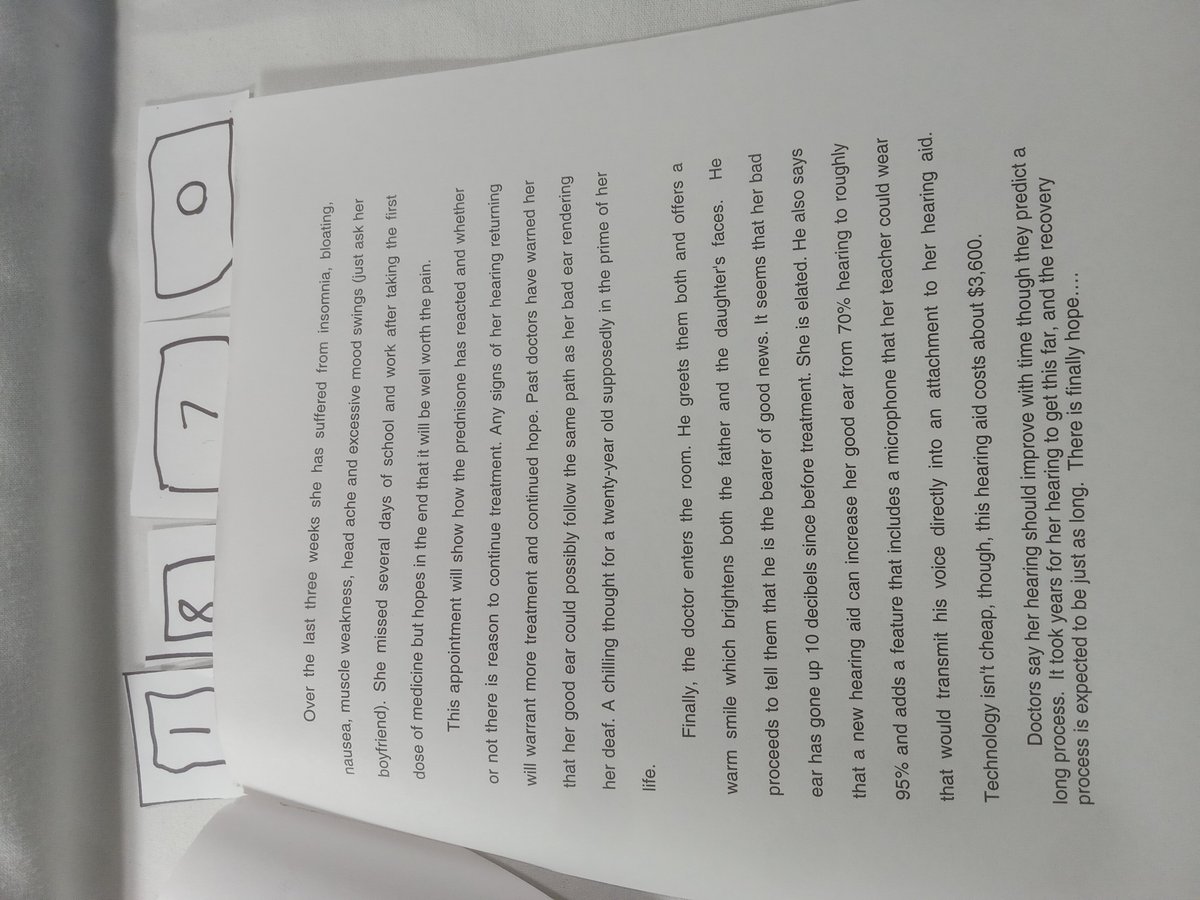
Picture 3 of 3
The words on this page
Jensen
November 12, 1999
Writing for Media
Feature Piece
Scanned
She sits in the doctor's office watching several children around her playing
with their toys, wondering why life couldn't have been that simple for her. No
limitations, no funny looks - only a carefree child's mentality. It seems that these
children have never knew anything but fitting in and having fun. Of course, she's
older now, and with age comes the responsibility of making it to the doctor's
office by herself. Yet her father still accompanies her and tries his best to comfort
her, hiding his own nervousness. His eyes appear a little weary after a two-hour
drive but important news should not be heard alone.
The nurse calls her name as she wipes her sweaty palm on the sides of
her jeans. Her father follows. This day could be one of the most important of her
life, on par only with high school graduation and almost dying of bacterial
meningitis as a very young child. The latter being the reason why she's in the
doctor's office in the first place. Every parent prays for a perfect child. This visit
could be a step closer to perfection.
Though she survived the bacterial meningitis some of her hearing did not.
Her left ear was diagnosed with moderate hearing loss and her right ear, a mild
hearing loss. At four years old she was fitted for over-the-ear hearing aids.
Childhood had its periods of ups and downs as young children can be cruel and
outcast what they don't understand. The hearing aids provided some relief in the
classroom but she still suffered additional hearing losses during the coming
years. Second grade is remembered only as an endless series of tests trying to
---
discover what caused yet another hearing loss. Early memories include this seven year old girl being placed in a giant tube and also having ice water placed in her ears.
As a senior in high school more hearing problems occurred. It became increasingly difficult for her to understand lectures in class, and even participate. Quite a burden for a mere teenager to bear. She later admits that she was in complete denial of the fact that her right ear was hearing less and less with each day. She did nothing.
Eventually, she could deny no more. Three years later she has practically no hearing in her right ear, as the left ear remains steady, yet below normal. But an unproven and unapproved treatment has turned countless nights of crying into guarded hope. Hope, which has been long awaited for and comes by the name of prednisone.
Prednisone is a highly controversial drug when used in cases involving hearing loss. It is believed that she suffers from auto-immune inner ear syndrome, though is not yet recognized by the FDA, it is in the process of being tested. The treatment is not covered by any insurance and offers a variety of side effects. She's on such a strong dose that when she stops taking it she has to be weaned off of it and if she suddenly stopped taking it her heart could stop. The prednisone suppresses the immune system to the point where it is at about half strength. It is hoped that the immune system is attacking her hearing and causing the loss. Stop the immune system and thereby stop the hearing loss.
---
Over the last three weeks she has suffered from insomnia, bloating, nausea, muscle weakness, head ache and excessive mood swings (just ask her boyfriend). She missed several days of school and work after taking the first dose of medicine but hopes in the end that it will be well worth the pain.
This appointment will show how the prednisone has reacted and whether or not there is reason to continue treatment. Any signs of her hearing returning will warrant more treatment and continued hope. Past doctors have warned her that her good ear could possibly follow the same path as her bad ear rendering her deaf. A chilling thought for a twenty-year old supposedly in the prime of her life.
Finally, the doctor enters the room. He greets them both and offers a warm smile which brightens both the father and the daughter's faces. He proceeds to tell them that he is the bearer of good news. It seems that her bad ear has gone up 10 decibels since before treatment. She is elated. He also says that a new hearing aid can increase her good ear from 70% hearing to roughly 95% and adds a feature that includes a microphone that her teacher could wear that would transmit his voice directly into an attachment to her hearing aid. Technology isn't cheap, though, this hearing aid costs about $3,600.
Doctors say her hearing should improve with time though they predict a long process. It took years for her hearing to get this far, and the recovery process is expected to be just as long. There is finally hope....
TOM JENSEN - SPORTS
Item 1873
Will Elway retire? Try asking Jordan
In one sentence: Tom's typewritten two-page sports column 'Will Elway Retire? Try Asking Jordan', comparing John Elway and Michael Jordan, stamped Scanned, about 1999.
Item type
WRITINGS · TOM JENSEN · SPORTS
UNPUBLISHED
Tom's typewritten sports column WILL ELWAY RETIRE? TRY ASKING JORDAN, comparing John Elway and Michael Jordan, stamped Scanned, two pages.
- Why it matters
- Tom's typewritten sports column WILL ELWAY RETIRE? TRY ASKING JORDAN - the sportswriting side of the writer who wrote the songs.
- Type
- Printed page
- Collection
- Writings (non-lyric) ; Sportswriting ; Sports
- Published in
- PREVIOUSLY UNPUBLISHEDSearched against the 34 albums, every book and Poems By Tom - found in none of them
- Age when written
- made at age 20best guess - not yet proved: the column describes Elway just named Super Bowl MVP with Denver holding Atlanta to 19 points and Elway not yet retired - Super Bowl XXXIII was January 31, 1999 and Elway retired May 2, 1999 (outside sports facts)
- On the site
- Tom's Story: 1999
Price · Tier · Tom fills these
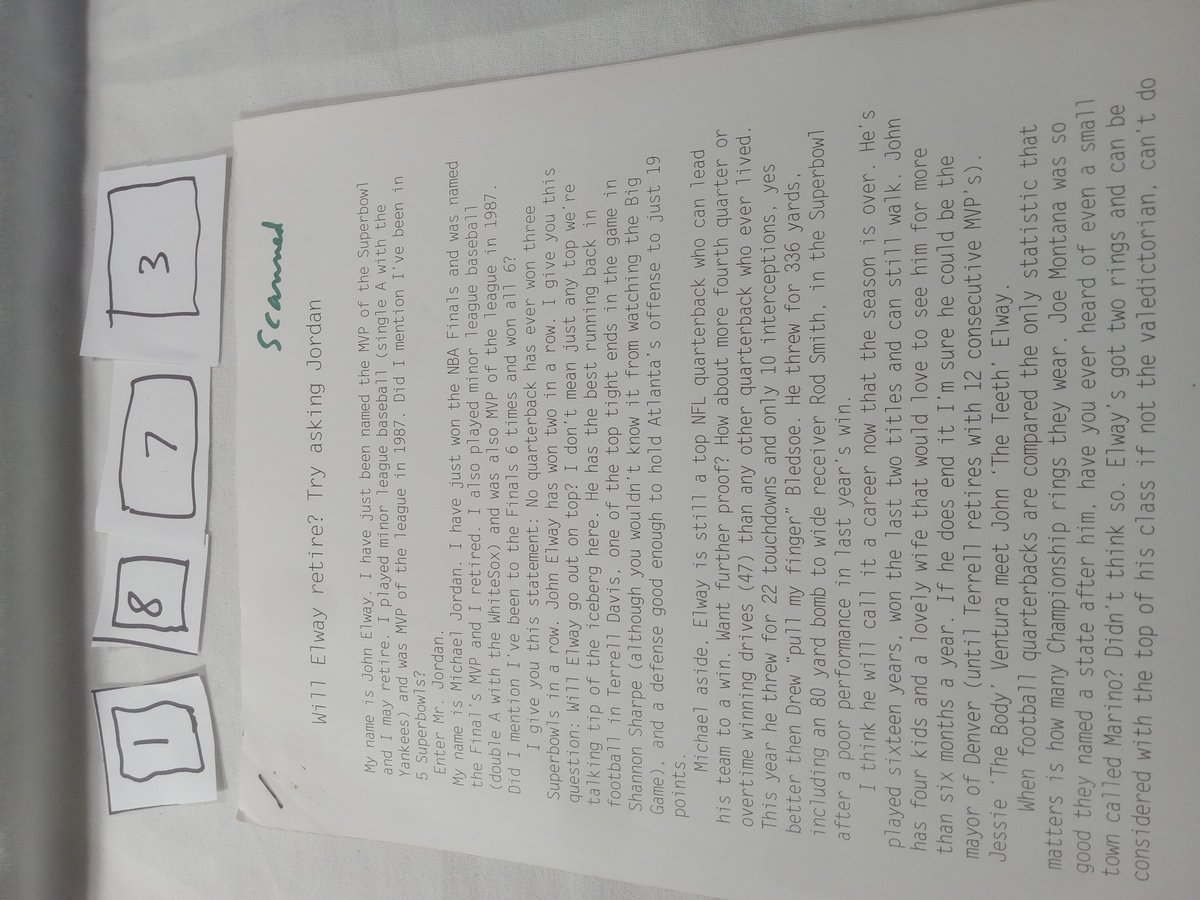
Picture 1 of 2
Picture 2 of 2
The words on this page
My name is John Elway. I have just been named the MVP of the Superbowl and I may retire. I played minor league baseball (single A with the Yankees) and was MVP of the League in 1987. Did I mention I've been in 5 Superbowls?
Enter Mr. Jordan.
My name is Michael Jordan. I have just won the NBA Finals and was named the Final's MVP and I retired. I also played minor league baseball (double A with the WhiteSox) and was also MVP of the league in 1987. Did I mention I've been to the Finals 6 times and won all 6?
I give you this statement: No quarterback has ever won three Superbowls in a row. John Elway has won two in a row. I give you this question: Will Elway go out on top? I don't mean just any top we're talking tip of the iceberg here. He Has the best running back in football in Terrell Davis, one of the top tight ends in the game in Shannon Sharpe (although you wouldn't know it from watching the Big Game), and a defense good enough to hold Atlanta's offense to just 19 points.
Michael aside, Elway is still a top NFL quarterback who can lead his team to a win. Want further proof? How about more fourth quarter or overtime winning drives (47) than any other quarterback who ever lived. This year he threw for 22 touchdowns and only 10 interceptions, yes better then Drew "pull my finger" Bledsoe. He threw for 336 yards, including an 80 yard bomb to wide receiver Rod Smith, in the Superbowl after a poor performance in last year's win.
I think he will call it a career now that the season is over. He's played sixteen years, won the last two titles and can still walk. John has four kids and a lovely wife that would love to see him for more than six months a year. If he does end it I'm sure he could be the mayor of Denver (until Terrell retires with 12 consecutive MVP's).
Jessie 'The Body' Ventura meet John 'The Teeth' Elway.
When football quarterbacks are compared the only statistic that matters is how many Championship rings they wear. Joe Montana was so good they named a state after him, have you ever heard of even a small town called Marino? Didn't think so. Elway's got two rings and can be considered with the top of his class if not the valedictorian, can't do
---
much better than that can you? Unless of course you're name is Michael Jordan.
Do you have a scoop? If so contact me: [private detail]
TOM JENSEN - COLLEGE ESSAY
Item 1875
A HARD RAIN'S GONNA FALL
In one sentence: Tom's typed two-page story 'A Hard Rain's Gonna Fall', January 27, 1999, a night in a songwriter's room told by his guitar, notebook, chair and razor, from 1999.
Item type
WRITINGS · TOM JENSEN · COLLEGE ESSAY
UNPUBLISHEDbest guess - not yet proved
Tom's typed Creative Writing story A HARD RAIN'S GONNA FALL, dated January 27, 1999, on two printed pages - a night in the room of a songwriter called the master, told by his guitar, notebook, chair and razor, ending as he falls asleep on the Bob Dylan album SELF PORTRAIT.
- Why it matters
- Tom's typed college Creative Writing story A HARD RAIN'S GONNA FALL (January 27, 1999, age 19 or 20) - a tribute to Bob Dylan told by the objects in his room, written in the same years Tom was filling his binder with poems.
- Type
- Printed page
- Collection
- College writings ; Writings (non-lyric) ; Short stories ; Creative Writing class ; Bob Dylanbest guess - not yet proved
- Published in
- not checked yetthis essay has not been searched against the 34 albums and the books - the old book list belonged to ODE TO COREY, now on 1845
- Age when written
- written at age 19 or 20from the date typed on the piece, January 27, 1999
- On the site
- Tom's Story: 1999
Price · Tier · Tom fills these
Picture 1 of 2
Picture 2 of 2
These words are a machine reading of the photograph, not a clean transcription. Read the picture.
The words on this page
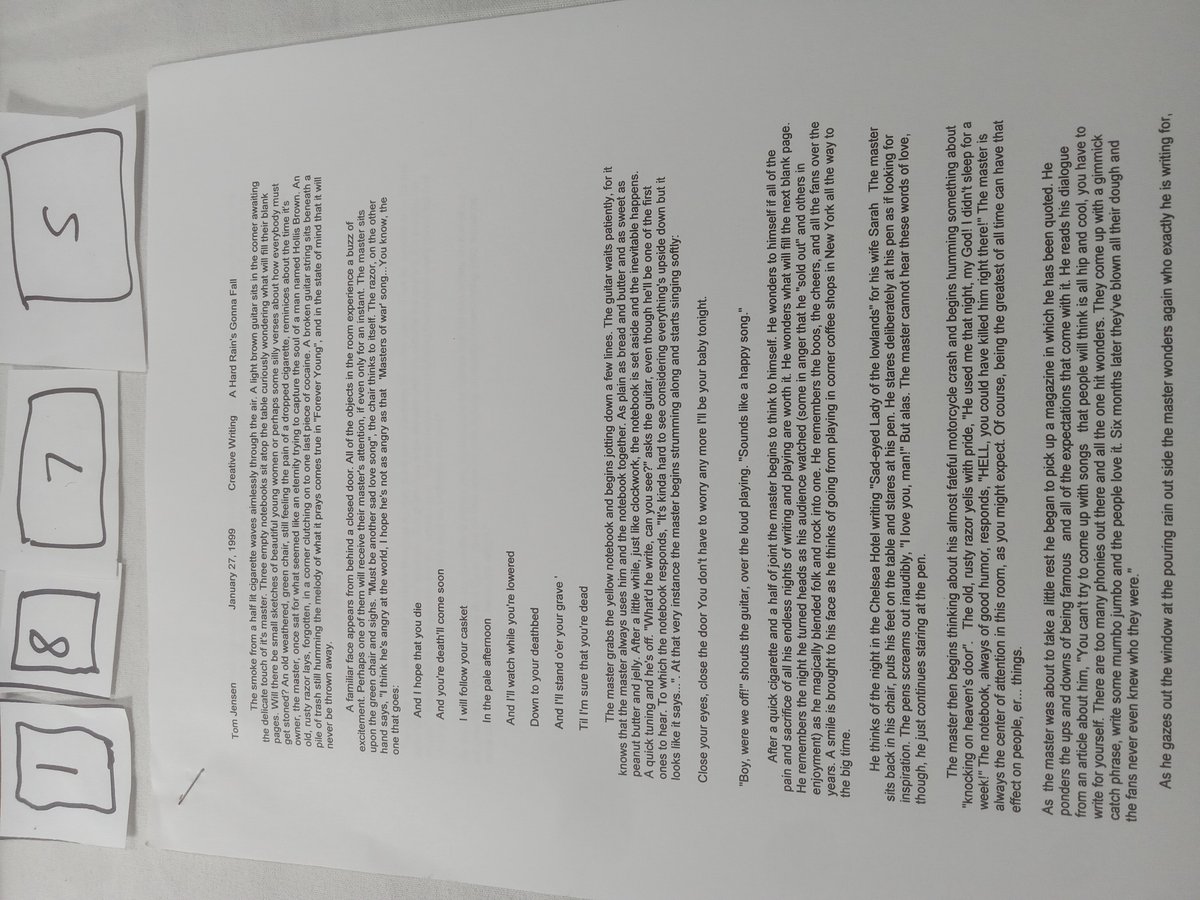
Tom Jensen January 27, 1999 Creative Writing A Hard Rain's Gonna Fall
The smoke from a half lit cigarette waves aimlessly through the air. A light brown guitar sits in the corner awaiting the delicate touch of its master. Three empty notebooks sit atop the table curiously wondering what will fill their blank pages. Will there be small sketches of beautiful young women or perhaps some silly verses about how everybody must get stoned? An old weathered, green chair, still feeling the pain of a dropped cigarette, reminisces about the time it's owner, the master, once sat for what seemed like an eternity trying to capture the soul of a man named Hollis Brown. An old, rusty razor lays, forgotten, in a corner clutching on to one piece of cocaine. A broken guitar string sits beneath a pile of trash still humming the melody of what it prays comes true in "Forever Young", and in the state of mind that it will never be thrown away.
A familiar face appears from behind a closed door. All of the objects in the room experience a buzz of excitement. Perhaps one of them will receive their master's attention, if even only for an instant. The master sits upon the green chair and sighs. "Must be another sad love song", the chair thinks to itself. The razor, on the other hand says, "I think he's angry at the world, I hope he's not as angry as that 'Masters of war' song...You know, the one that goes:
And I hope that you die
And you're death'll come soon
I will follow your casket
In the pale afternoon
And I'll watch while you're lowered
Down to your deathbed
And I'll stand o'er your grave '
Til I'm sure that you're dead
The master grabs the yellow notebook and begins jotting down a few lines. The guitar waits patiently, for it knows that the master always uses him and the notebook together. As plain as bread and butter and as sweet as peanut butter and jelly. After a little while, just like clockwork, the notebook is set aside and the inevitable happens. A quick tuning and he's off. "What'd he write, can you see?" asks the guitar, even though he'll be one of the first ones to hear. To which the notebook responds, "It's kinda hard to see considering everything's upside down but it looks like it says..." At that very instance the master begins strumming along and starts singing softly:
"Boy, were we off!" shouts the guitar, over the loud playing. "Sounds like a happy song."
After a quick cigarette and a half of joint the master begins to think to himself. He wonders to himself if all the pain and sacrifice of all his endless nights of writing and playing are worth it. He wonders what will fill the next blank page. He remembers the night he turned heads as his audience watched (some in anger that he "sold out" and others in enjoyment) as he magically blended folk and rock into one. He remembers the boos, the cheers, and all the fans over the years. A smile is brought to his face as he thinks of going from playing in corner coffee shops in New York all the way to the big time.
He thinks of the night in the Chelsea Hotel writing "Sad-eyed Lady of the lowlands" for his wife Sarah The master sits back in his chair, puts his feet on the table and stares at his pen as stares deliberately at his pen as if looking for inspiration. The pens screams out inaudibly, "I love you, man!" But alas. The master cannot hear these words of love, though, he just continues staring at the pen.
The master then begins thinking about his almost fateful motorcycle crash and begins humming something about "knocking on heaven's door". The old, rusty razor yells with pride, "He used me that night, my God! I didn't sleep for a week!" The notebook, always of good humor, responds, "HELL, you could have killed him right there!" The master is always the center of attention in this room, as you might expect. Of course, being the greatest of all time can have that effect on people, er... things.
As the master sits about to take a little rest he began to pick up a magazine in which he has been quoted. He ponders the ups and downs of being famous and all of the expectations that come with it. He reads his dialogue from an article about him, "You can't try to come up with songs that people will think is all hip and cool, you have to write for yourself. There are too many phonies out there and all the one hit wonders. They come up with a gimmick catch phrase, write some mumbo jumbo and the people love it. Six months later they've blown all their dough and the fans never even knew who they were."
As he gazes out the window at the pouring rain out side the master wonders again who exactly he is writing for,
---
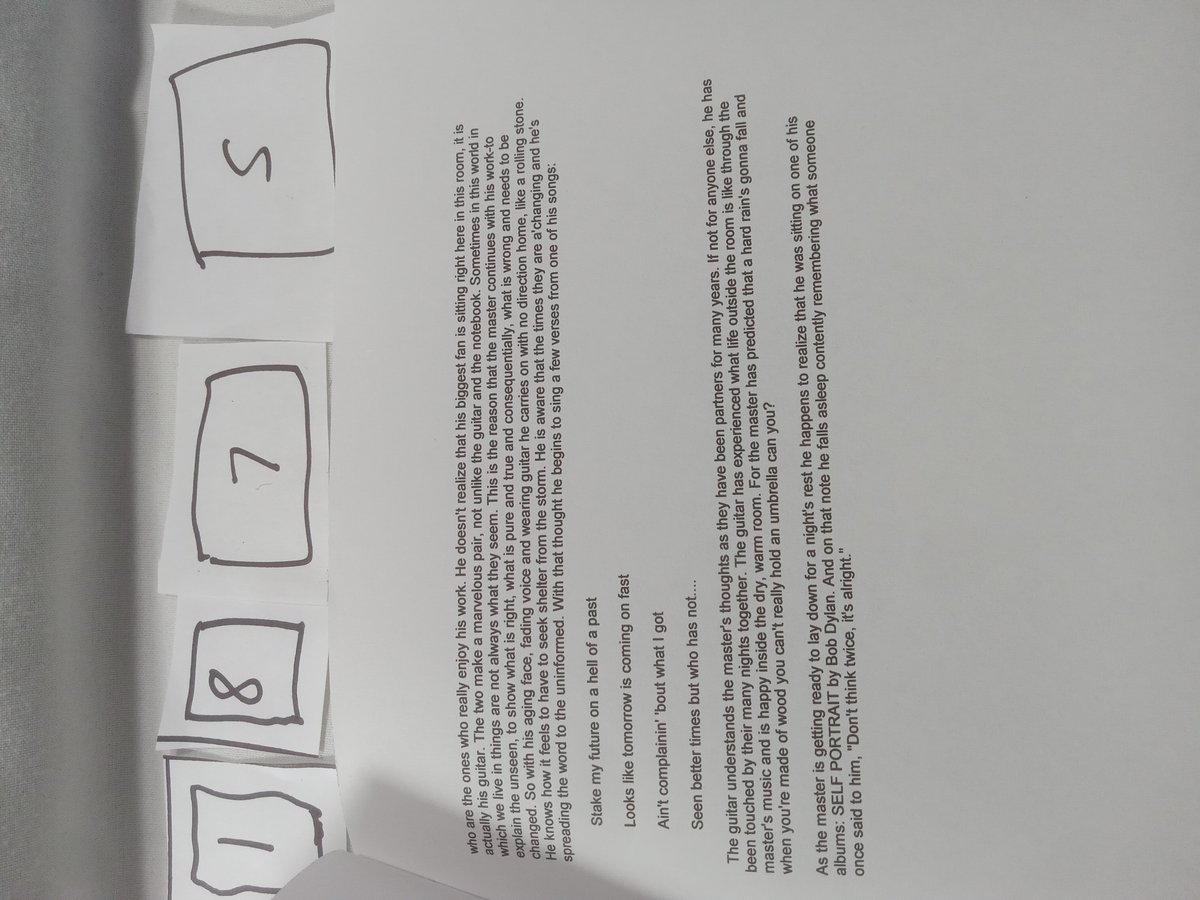
who are the ones who really enjoy his work. He doesn't realize that his biggest fan is sitting right here in this room, it is
actually his guitar. The two make a marvelous pair, not unlike the guitar and the notebook. Sometimes in this world in
which we live in things are not always what they seem. This is the reason that the master continues with his work-to
explain the unseen, to show what is right, what is pure and true and consequentially, what is wrong and needs to be
changed. So with his aging face, fading voice and wearing guitar he carries on with no direction home, like a rolling stone.
He knows how it feels to have to seek shelter from the storm. He is aware that the times they are a'changing and he's
spreading the word to the uninformed. With that thought he begins to sing a few verses from one of his songs:
Stake my future on a hell of a past
Looks like tomorrow is coming on fast
Ain't complainin' 'bout what I got
Seen better times but who has not....
The guitar understands the master's thoughts as they have been partners for many years. If not for anyone else, he has
been touched by their many nights together. The guitar has experienced what life outside the room is like through the
master's music and is happy inside the dry, warm room. For the master has predicted that a hard rain's gonna fall and
when you're made of wood you can't really hold an umbrella can you?
As the master is getting ready to lay down for a night's rest he happens to realize that he was sitting on one of his
albums: SELF PORTRAIT by Bob Dylan. And on that note he falls asleep contently remembering what someone
once said to him, "Don't think twice, it's alright."
Item 1879
Television Violence Causes Violent Behavior in Children
In one sentence: Tom's typed nine-page research paper 'Television Violence Causes Violent Behavior In Children', December 15, 1999, from TV wrestling to cartoons, with references, from 1999.
Item type
WRITINGS · TOM JENSEN · COLLEGE ESSAY
UNPUBLISHED
Tom's typed English composition research paper TELEVISION VIOLENCE CAUSES VIOLENT BEHAVIOR IN CHILDREN (December 15, 1999), nine pages from wrestling on TV to cartoons, with references.
- Why it matters
- Tom's English composition research paper TELEVISION VIOLENCE CAUSES VIOLENT BEHAVIOR IN CHILDREN (December 15, 1999) - his college prose on a society theme that also runs through his poems.
- Type
- Printed page
- Collection
- College writings ; Writings (non-lyric) ; Society
- Published in
- PREVIOUSLY UNPUBLISHEDSearched against the 34 albums, every book and Poems By Tom - found in none of them
- Age when written
- made at age 21proved: the paper's date line reads December 15, 1999 - typed off its photo
- On the site
- Tom's Story: 1999
Price · Tier · Tom fills these
Picture 1 of 9
Picture 2 of 9
Picture 3 of 9
Picture 4 of 9
Picture 5 of 9
Picture 6 of 9
Picture 7 of 9
Picture 8 of 9

Picture 9 of 9
The words on this page
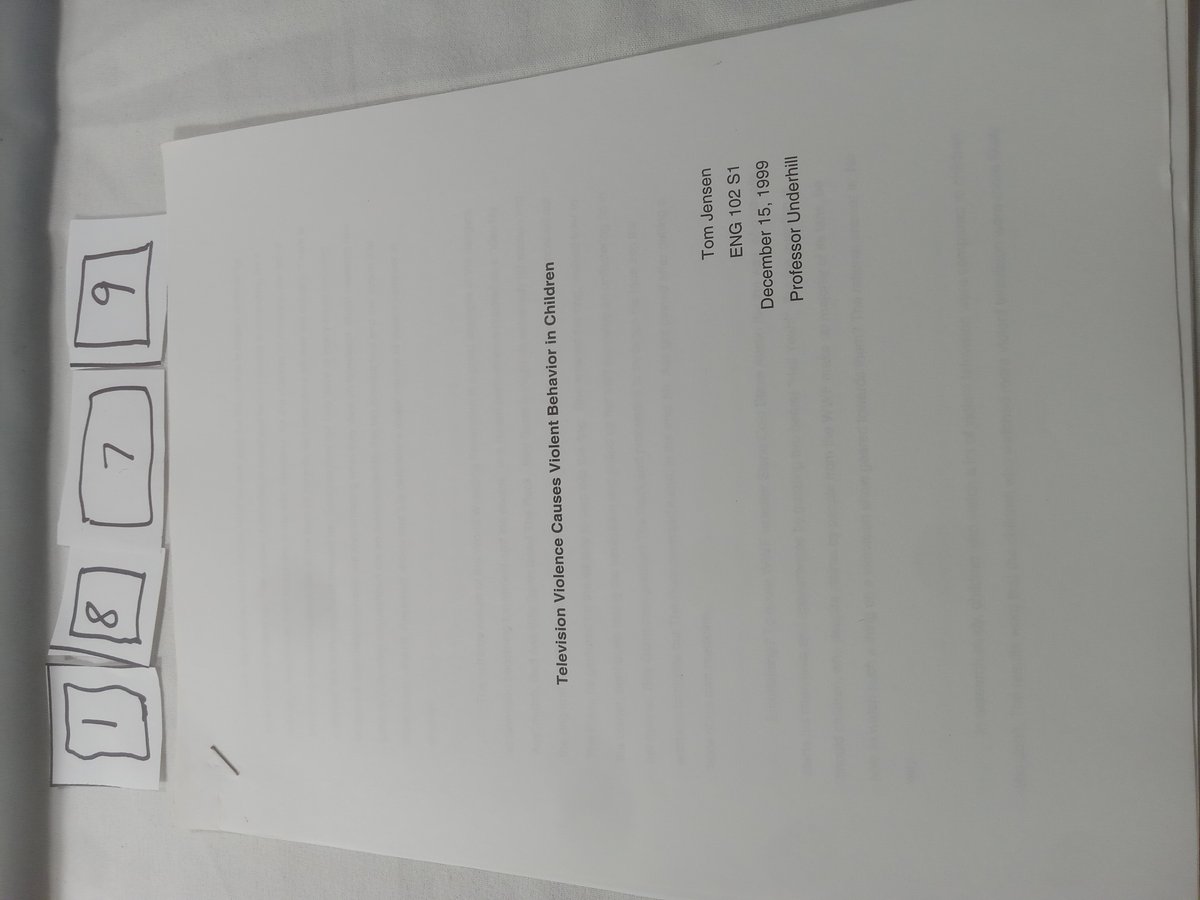
[TITLE PAGE]
Television Violence Causes Violent Behavior in Children
Tom Jensen
ENG 102 S1
December 15, 1999
Professor Underhill
---
[PAGE 2]
[first page may not be photographed - the photos go from the title page to the page numbered 2]
We, as humans, tend to imitate what we see, and the life we live is largely dictated by what happens around us. This nature of imitation is beneficial for all species of creatures, for it acts as a blueprint on how to survive in the wild. However, for the children of America, the act of imitation brings about great fear in the eyes of parents and educators all over the country. There is a greater risk to the youths of present day because they not only have to worry about imitating violence in their neighborhood, but also imitating what they view on television. Much research has gone into showing why children are so mesmerized by this big glowing box and the action that takes place within it. Research shows that it is definitely a major source of violent behavior in children.
The extreme nature of the World Wrestling Federation is a great example of the dangers of television becoming too violent and too risque. In a recent performance dubbed as a "Kiss My Ass" match, Bad Ass Billy Gunn faced The Rock. Billy Gunn brought an extremely fat woman into the ring and told The Rock that he would have to kiss her ass. As Billy Gunn almost knocked out The Rock, he gestured for the fat lady to step into the ring. She entered the ring, walked over to the corner, bent down facing the turnbuckle and pulled up her skirt exposing an unflattering rip in her nylons. Billy Gunn then grabbed The Rock and proceeded to try to run his face into the woman's backside but The Rock reversed it and, in the end, Mr. Ass got pinned after getting a taste of his own medicine.
Entertaining? To quote WWF wrestler Stone Cold Steve Austin (by the way, who usually starts his interviews and appearances by guzzling two beers) "Hell Yeah!" But the question is should children, who despite claims by people from the WWF make up majority of its fans, be able to watch such a thing on a television show geared towards them? The rational answer is: No way.
In research study, children who watch a lot of violent television were compared to children who don't. The results were that the children who watched more violent television were more likely
---
[PAGE 3]
to agree that it's okay to hit someone if you're mad at them for a good reason. The other group learned that problems can be solved passively, through discussion and authority (Cheyney 46).
Television violence can cause actual violence in a number of ways. After viewing television violence the world becomes bland in comparison. The child needs to create violence to keep himself satisfied (Dorr 127). Also the children find the violent characters on television fun to imitate. Children do imitate the behavior of models such as those portrayed in television, movies, etc. They do so because the ideas that are shown to them on television are more attractive to the viewer than those that the viewer can think up himself. This has been widely seen lately with the advent of the Mighty Morphin Power Rangers. Young children cannot seem to get enough of these fictional characters and will portray them often. For older children, the Mighty Morphin Power Rangers will be replaced by wrestlers like Mr. Ass and the Rock.
The information can't be ignored. Violent television viewing does affect children. The effects have been seen in a number of cases. In New York, a 16-year-old boy broke into a cellar. When the police caught him and asked him why he was wearing gloves he replied that he had learned to do so to not leave fingerprints and that he discovered this on television. In Alabama, a nine-year-old boy received a bad report card from his teacher. He suggested sending the teacher poisoned candy as revenge as he had seen on television the night before. In California, a seven-year-old boy sprinkled ground-up glass into the lamb stew the family was to eat for dinner. When asked why he did it he replied that he wanted to see if the results would be the same in real life as they were on television (Howe 72). These are certainly startling examples of how television can affect the child. It must be pointed out that children watching violent television directly caused all of these situations.
The government also did research in this area. They conducted an experiment where children were left alone in a room with a monitor playing videotape of other children at play. Soon, things got out of hand and progressive mayhem began to take place. Children who had just seen
---
[PAGE 4]
commercial violence accepted much higher levels of aggression than other children did. The results were published as a Surgeon General's report found some preliminary indications of a casual relationship between television viewing and aggressive behavior in children. (Langone 50).
In other research among U.S. children, it was discovered that aggression, academic problems, unpopularity with peers and violence feed off each other. This promotes violent behavior in the children (Huesmann 166). The child watches violence, which causes aggression. The combination of aggression and continued television viewing lead to poor academic standings as well as unpopularity. These can cause more aggression and a vicious cycle begins to spin.
The research proves time and time again that aggression and television viewing do go hand in hand. The truth about television violence and children has been shown. Some are trying to fight this problem. Others are ignoring it and hoping it will go away. Still others don't even seem to care. However, the facts are undeniable. The studies have been carried out and all the results point to one conclusion: Television violence causes children to become violent and the effects can be life-long.
Not only does television violence affect the child's youth, but it can also affect his or her adulthood. Some psychologists and psychiatrists feel that continued exposure to such violence might unnaturally speed up the impact of the adult world on the child. This can force the child into a kind of premature maturity. As the child matures into an adult, he can become bewildered, have a greater distrust towards others, a superficial approach to adult problems, and even an unwillingness to become an adult (Carter 14).
Today, the media is providing children with many, perhaps most, of their role models. With the lowering of their sensitivity to violence, children tend to seek violent role models through television. The typical child will watch "8,000 murders and 100,000 acts of violence" (Clark, 1993, p.167) before finishing elementary school. Add to that, the fact that the average child watches an
---
[PAGE 5]
average of "27 hours of television a week" (Clark, 1993, p.167). It is easy to understand the importance of decreasing the amount of violence available to them. Considering the amount of stations now available, television is dangerous at almost every hour of everyday and through almost every venue. The effect of television violence on children brings about fear by every parent and educator.
Why do children like the violence that they see on television? Since media violence is much more vicious than that which children normally experience, real-life aggression appears bland by comparison (Dorr 127). The violence on television is able to be more exciting and enthralling than the violence that is normally viewed on the streets. Instead of just seeing a police officer handing a ticket to a speeding violator, he can beat the offender bloody on television. However, children don't always realize this is not the way thing are handled in real life. They come to expect it, and when they don't see it the world becomes bland and in need of violence. The children then can create the violence that their mind craves.
Imitation of violence is a main fear of viewing television violence, but it is not the only concern. A psychology professor at the University of Michigan and a long time researcher on TV violence says:
The child who has been watching programs with primarily aggressive content comes away with the impression that the world is a jungle fraught with dangerous threats, and the only way to survive is to be on the attack (Clark, 1993, p.167).
In reality the world can be a tough place to live. If the television viewer is only focusing in on the negatives (which are mostly what are shown on television), then of course their perspective on life is pessimistic. They do feel like they have to be on the attack - an "eat or be eaten" approach to life. The dilemma becomes that the children become the problem by being in 'attack mode' all the
---
[PAGE 6]
time. They become influenced by television so much that they further society from a solution to violence.
The flip side to this is when the child undergoes what University of Pennsylvania researcher George Gerbner calls "mean world syndrome" (Clark, 1995, p.1021). Mean world syndrome is the spread of unnecessary fear that may lead a child to have nightmares after watching a violent show, news broadcast, or even a cartoon. The world becomes a frightening place for a ten year-old child who is constantly being reminded of fighting, murdering, and killing with every channel he/she changes.
The dangers of simulated violence on television can also include desensitization of the violence. The saying goes that if you see enough of something then you begin to become immune to it. The desensitization of violence can also include the bystander effect, in which the child pays little or no attention to violence happening around them because it is so common. No child should be desensitized to violence due to television of a graphic nature. The unfortunate reality is that there aren't many channels left to escape from violence.
The problem is so widespread that even cartoons are guilty of adding to the problem of TV violence. Numerous studies have been conducted comparing the reactions of children's aggressiveness after they have been shown cartoon combat featuring Bugs Bunny, Woody Woodpecker and Tom and Jerry compared to gentler shows such as Casper the friendly ghost. The result has been "an overwhelming consensus of some casual effect, with measurable increases of 3-15 percent" (Clark, 1993, p.169). Multiply that percent by the total number of children watching violent cartoons and the relatively small increase becomes a cause for great concern.
The reinforcement that violence is acceptable through television has many ramifications on the children who watch it with the most threatening being imitation and copycatting. A child
---
[PAGE 7]
who sees Jerry light Tom on fire in a cartoon may laugh and then go chase Fluffy with a lighter, not understanding the ramifications of such actions.
A national survey of elementary school teachers found that the popular "Teenage Mutant Ninja Turtles" causes confusion between fantasy and reality. "Several children really thought it was OK to use physical violence because [the turtles] do that," a teacher reported (Clark, 1993, p.167).
The dangers of the news often get forgotten as far as its relationship with children and teenagers.
Research in the 1970's demonstrated the existence of "cluster suicides" in which the local TV reporting of teen suicides directly caused numerous copycat suicides by impressionable teenagers. Somewhere in every population there are potentially suicidal kids who will say to themselves, "Well, I'll show all those people who have been mean to me. Then I'll get my picture on TV, too" (Clark, 1993, p.169).
This theory applies in the case of school shootings being televised and, in turn, glamorized. Every high school kid in America knows about Littleton, Colorado and the atrocities that took place there at the hands of two high school students. Afterward there was a rash of similar shootings or threats of shootings. A child who feels like an outcast may watch the school shootings in Littleton, Colorado and decide to attempt to out do them by killing more students. This is only one of the many effects television can have on children.
---
[PAGE 8]
Our society needs to be informed of crimes like these but when the pictures of young killers are shown on every news broadcast and media outlet in the country, they become instant celebrities - role models for teenagers like them who are fed up with their problems. News stations must remember that the goal is to report the news but, for the good of society, not to glorify horrific acts. There is enough glorifying violence done by sitcoms and action series.
In conclusion, due to the fact that there are no absolute safeguards against violent television, the end responsibility lies with the parent. As a whole, the television audience demands violence and the bloodier the better. Because viewers have been so desensitized they have been conditioned to crave violence, regardless of children's presence. Perhaps the most important way to prevent children from watching television violence is to stop it where it starts. The parents should step in and turn the set off when a violent program comes on. The parents are the child's role models from which he learns. If children can learn at an early age that violence on television is bad, then he can turn the set off for himself when he is older. Education should start at home.
References
Carter, Douglass. TV Violence and the Child. New York: Russel Sage Foundation, 1977.
Cheyney, Glenn Alan. Television in American Society. New York: Franklin Watts Co., 1983.
Clark, Charles S. (1993). TV Violence. The CQ Researcher,87, 167, 169, 173.
Clark, Charles S. (1995). Sex, Violence and the Media. The CQ Researcher,160, 1021.
Door, Palmer. Children and the Faces of Television. New York: Academic Press, 1980.
---
[PAGE 9]
Howe, Michael J. A. Television and Children. London: New University Education, 1977.
Husemann, L. Rowell. Social Channels Tune. TV's effects. Science News 14 Sept. 1985: 166.
Kiss My Ass. (1999, August 28) Economist, 22.
Langone, John. Violence. Boston: Little, Brown and Co., 1984.
Item 1855
Disease of Alcoholism
Item type
WRITINGS · TOM JENSEN · COLLEGE ESSAY
UNPUBLISHED
The first and last pages of Tom's typed college essay DISEASE OF ALCOHOLISM (February 25, 2000), written after a rehab stay, closing on Alcoholics Anonymous and the desire to be healed.
- Why it matters
- Tom's typed college essay DISEASE OF ALCOHOLISM (February 25, 2000), written after a rehab stay and closing on Alcoholics Anonymous and the desire to be healed - the recovery that runs through his poems and songs.
- Type
- Printed page
- Collection
- College writings ; Writings (non-lyric) ; Addiction ; Recovery ; Faith
- Published in
- PREVIOUSLY UNPUBLISHEDSearched against the 34 albums, every book and Poems By Tom - found in none of them
- Age when written
- made at age 21proved: the paper's date line reads February 25, 2000 - typed off its photo
- Same words
- also written out as number 1862matched on the words by machine - Tom confirms
- On the site
- Tom's Story: 2000
Price · Tier · Tom fills these
Picture 1 of 2
Picture 2 of 2
Moved here from item 1854 - the number blocks in this photo read 1855
Moved here from item 1854 - the number blocks in this photo read 1855
The words on this page
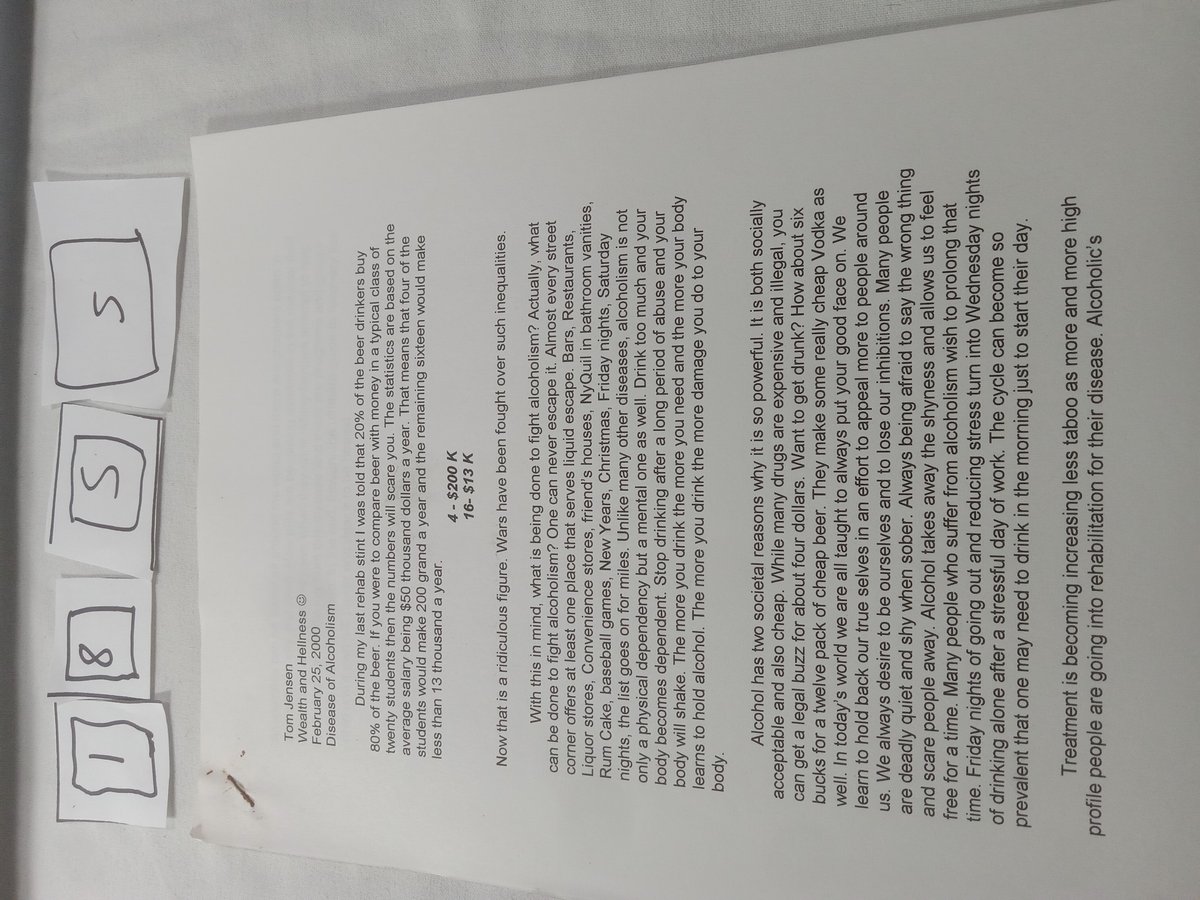
Tom Jensen
Wealth and Hellness ☺
February 25, 2000
Disease of Alcoholism
During my last rehab stint I was told that 20% of the beer drinkers buy 80% of the beer. If you were to compare beer with money in a typical class of twenty students then the numbers will scare you. The statistics are based on the average salary being $50 thousand dollars a year. That means that four of the students would make 200 grand a year and the remaining sixteen would make less than 13 thousand a year.
4 - $200 K
16- $13 K
Now that is a ridiculous figure. Wars have been fought over such inequalities.
With this in mind, what is being done to fight alcoholism? Actually, what can be done to fight alcoholism? One can never escape it. Almost every street corner offers at least one place that serves liquid escape. Bars, Restaurants, Liquor stores, Convenience stores, friend's houses, NyQuil in bathroom vanities, Rum Cake, baseball games, New Years, Christmas, Friday nights, Saturday nights, the list goes on for miles. Unlike many other diseases, alcoholism is not only a physical dependency but a mental one as well. Drink too much and your body becomes dependent. Stop drinking after a long period of abuse and your body will shake. The more you drink the more you need and the more your body learns to hold alcohol. The more you drink the more damage you do to your body.
Alcohol has two societal reasons why it is so powerful. It is both socially acceptable and also cheap. While many drugs are expensive and illegal, you can get a legal buzz for about four dollars. Want to get drunk? How about six bucks for a twelve pack of cheap beer. They make some really cheap Vodka as well. In today's world we are all taught to always put your good face on. We learn to hold back our true selves in an effort to appeal more to people around us. We always desire to be ourselves and to lose our inhibitions. Many people are deadly quiet and shy when sober. Always being afraid to say the wrong thing and scare people away. Alcohol takes away the shyness and allows us to feel free for a time. Many people who suffer from alcoholism wish to prolong that time. Friday nights of going out and reducing stress turn into Wednesday nights of drinking alone after a stressful day of work. The cycle can become so prevalent that one may need to drink in the morning just to start their day.
Treatment is becoming increasing less taboo as more and more high profile people are going into rehabilitation for their disease. Alcoholic's
---
Anonymous can be found all around the world and there are chapters open in almost every city and town. New pills are becoming available in the medical field which make alcoholics very sick when they drink. Many families attempt to help family members suffering from this disease and there are programs and groups available to those in need. In the end, though, the ultimate guide to recovery lies within one's own will power and desire to be healed.
Item 1857
WELLNESS PLANNING - Addiction
In one sentence: Tom's typed 'Wellness Planning - Addiction' paper of February 9, 2001, working on his own recovery and weaving in his lyrics 'Alison's Airplane' and 'Breaking The Chains', about 2000-2001.
Item type
WRITINGS · TOM JENSEN · COLLEGE ESSAY
PUBLISHED
Tom's typed WELLNESS PLANNING - ADDICTION paper (February 9, 2001), in which he works on his own recovery for college credit and weaves in his lyrics ALISON'S AIRPLANE and BREAKING THE CHAINS, with the teacher's notes.
- Why it matters
- Tom's WELLNESS PLANNING - ADDICTION paper (February 9, 2001), where he works on his own recovery for college credit and sets in his lyrics ALISON'S AIRPLANE and BREAKING THE CHAINS - the songs and the struggle behind them on the same pages.
- Type
- Printed page
- Collection
- 34 Albums ; Poems By Tom (2007) ; Finished Song Lyrics (2011) ; Only The Best (2018) ; A Lifetime Of Rhyme (2020) ; College writings ; Addiction ; Recovery ; Inspiringthe old category list says: LONELINESS & SOLITUDE ; STATE OF THE WORLD (not checked by Tom)
- Published in
- IN 34 ALBUMS
IN A BOOKPoems By Tom (2007)
The November 2024 Collection (2024)
Finished Song Lyrics (2011)
Only The Best (2018)
A Lifetime Of Rhyme (2020)
Tom's Anthology, July 25, 2012
Tom's Anthology, September 18, 2011
34 Albums, Books 1 and 2 (2026)
Brian Rainstorm Song Lyric Book (2014)
The November 2012 Anthology (2012)
Revised 31 Albums With Index (2024) - Age when written
- The piece Alison's Airplane: written at age 18 to 23from its place in Tom's yellow binder index (line A17) - the binder held 481 poems by 5 April 2002, when Tom was 23. This binder line dates that piece only; the other pieces on this card: Breaking the chains (binder line B20; no card of its own found - age not worked out)
- On the site
- Tom's Story: 2000
Price · Tier · Tom fills these
Picture 1 of 5
Picture 2 of 5
Picture 3 of 5
Picture 4 of 5
Picture 5 of 5
The words on this page
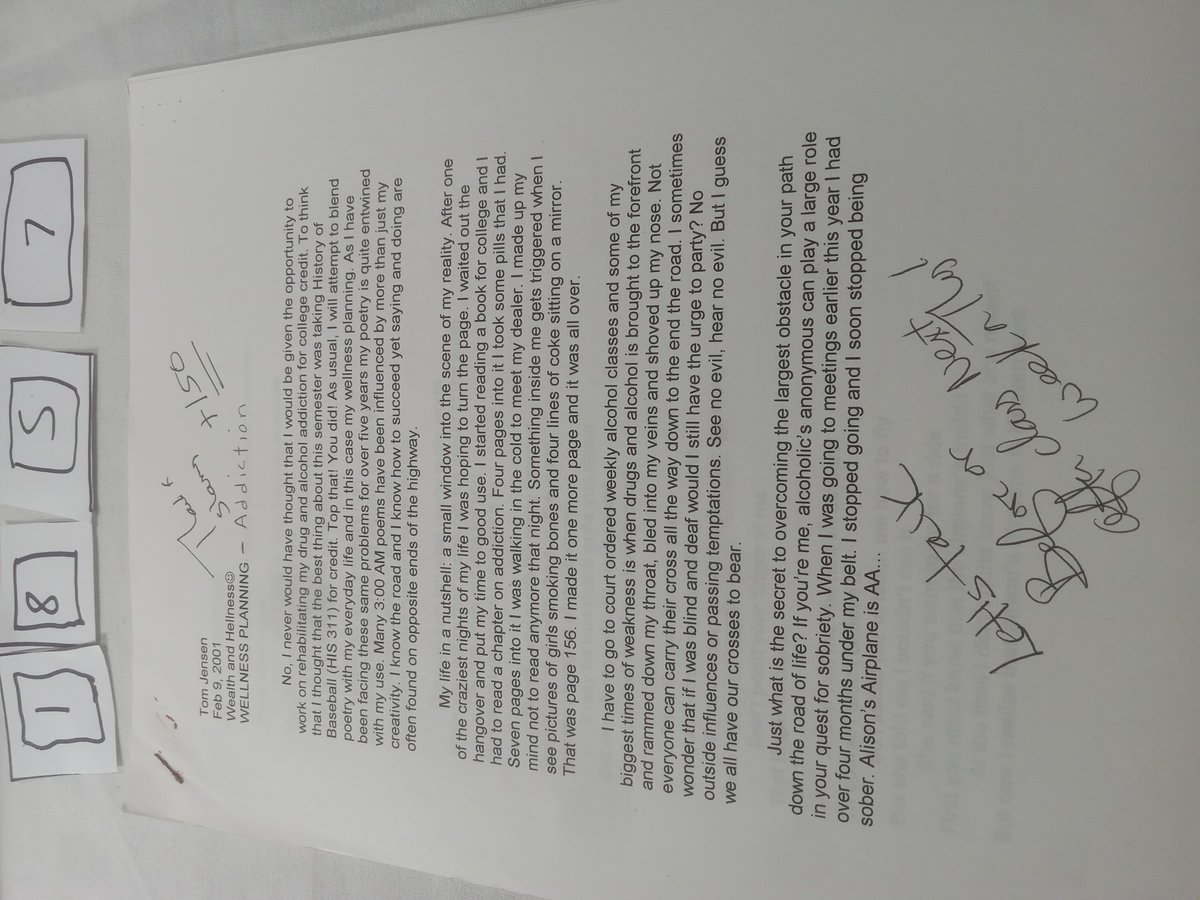
Tom Jensen
Feb 9, 2001
Wealth and Hellness☺
WELLNESS PLANNING - Addiction
No, I never would have thought that I would be given the opportunity to work on rehabilitating my drug and alcohol addiction for college credit. To think that I thought that the best thing about this semester was taking History of Baseball (HIS 311) for credit. Top that! You did! As usual, I will attempt to blend poetry with my everyday life and in this case my wellness planning. As I have been facing these same problems for over five years my poetry is quite entwined with my use. Many 3:00 AM poems have been influenced by more than just my creativity. I know the road and I know how to succeed yet saying and doing are often found on opposite ends of the highway.
My life in a nutshell: a small window into the scene of my reality. After one of the craziest nights of my life I was hoping to turn the page. I waited out the hangover and put my time to good use. I started reading a book for college and I had to read a chapter on addiction. Four pages into it I took some pills that I had. Seven pages into it I was walking in the cold to meet my dealer. I made up my mind not to read anymore that night. Something inside me gets triggered when I see pictures of girls smoking bones and four lines of coke sitting on a mirror. That was page 156. I made it one more page and it was all over.
I have to go to court ordered weekly alcohol classes and some of my biggest times of weakness is when drugs and alcohol is brought to the forefront and rammed down my throat, bled into my veins and shoved up my nose. Not everyone can carry their cross all the way down to the end the road. I sometimes wonder that if I was blind and deaf would I still have the urge to party? No outside influences or passing temptations. See no evil, hear no evil. But I guess we all have our crosses to bear.
Just what is the secret to overcoming the largest obstacle in your path down the road of life? If you're me, alcoholic's anonymous can play a large role in your quest for sobriety. When I was going to meetings earlier this year I had over four months under my belt. I stopped going and I soon stopped being sober. Alison's Airplane is AA...
+150
Lets talk Before or After class Next week Thanks!
---
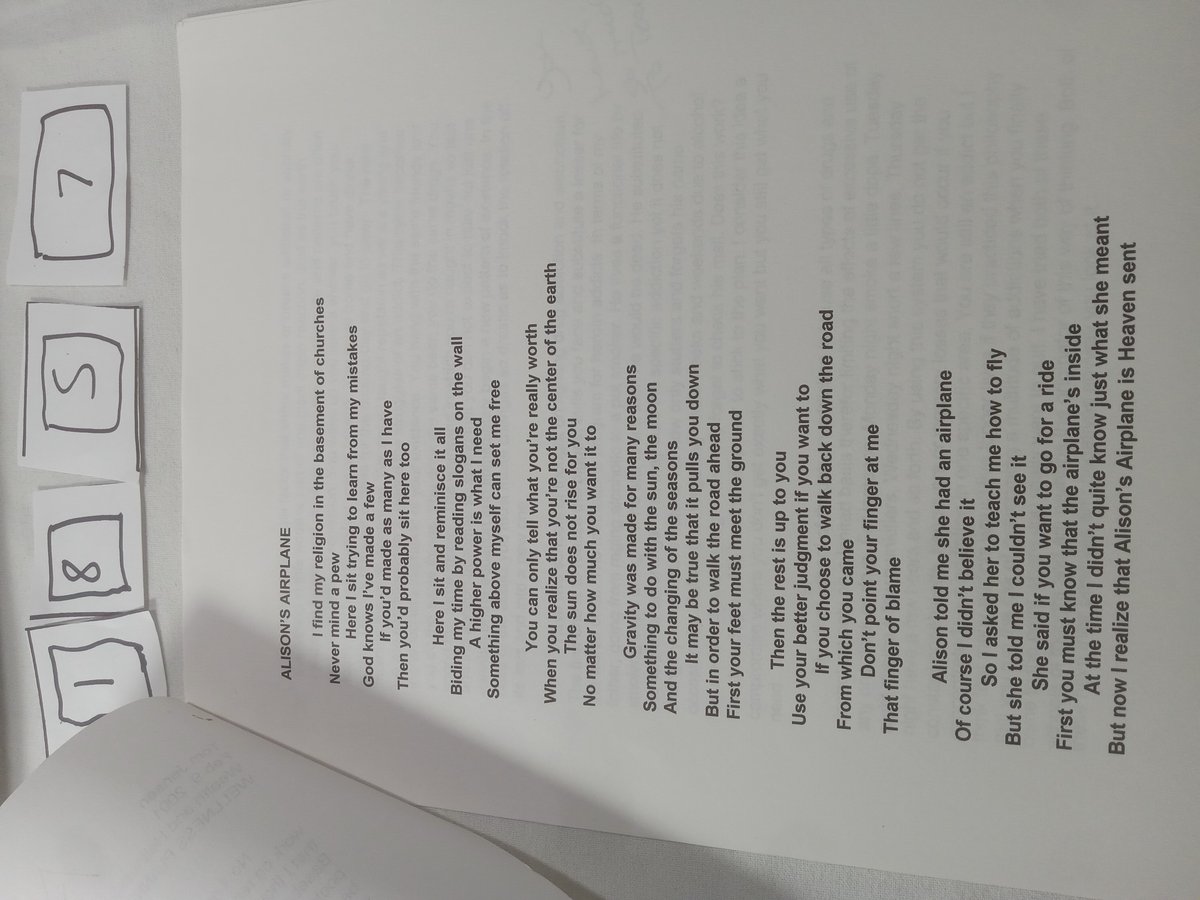
ALISON'S AIRPLANE
I find my religion in the basement of churches
Never mind a pew
Here I sit trying to learn from my mistakes
God knows I've made a few
If you'd made as many as I have
Then you'd probably sit here too
Here I sit and reminisce it all
Biding my time by reading slogans on the wall
A higher power is what I need
Something above myself can set me free
You can only tell what you're really worth
When you realize that you're not the center of the earth
The sun does not rise for you
No matter how much you want it to
Gravity was made for many reasons
Something to do with the sun, the moon
And the changing of the seasons
It may be true that it pulls you down
But in order to walk the road ahead
First your feet must meet the ground
Then the rest is up to you
Use your better judgment if you want to
If you choose to walk back down the road
From which you came
Don't point your finger at me
That finger of blame
Alison told me she had an airplane
Of course I didn't believe it
So I asked her to teach me how to fly
But she told me I couldn't see it
She said if you want to go for a ride
First you must know that the airplane's inside
At the time I didn't quite know just what she meant
But now I realize that Alison's Airplane is Heaven sent
---
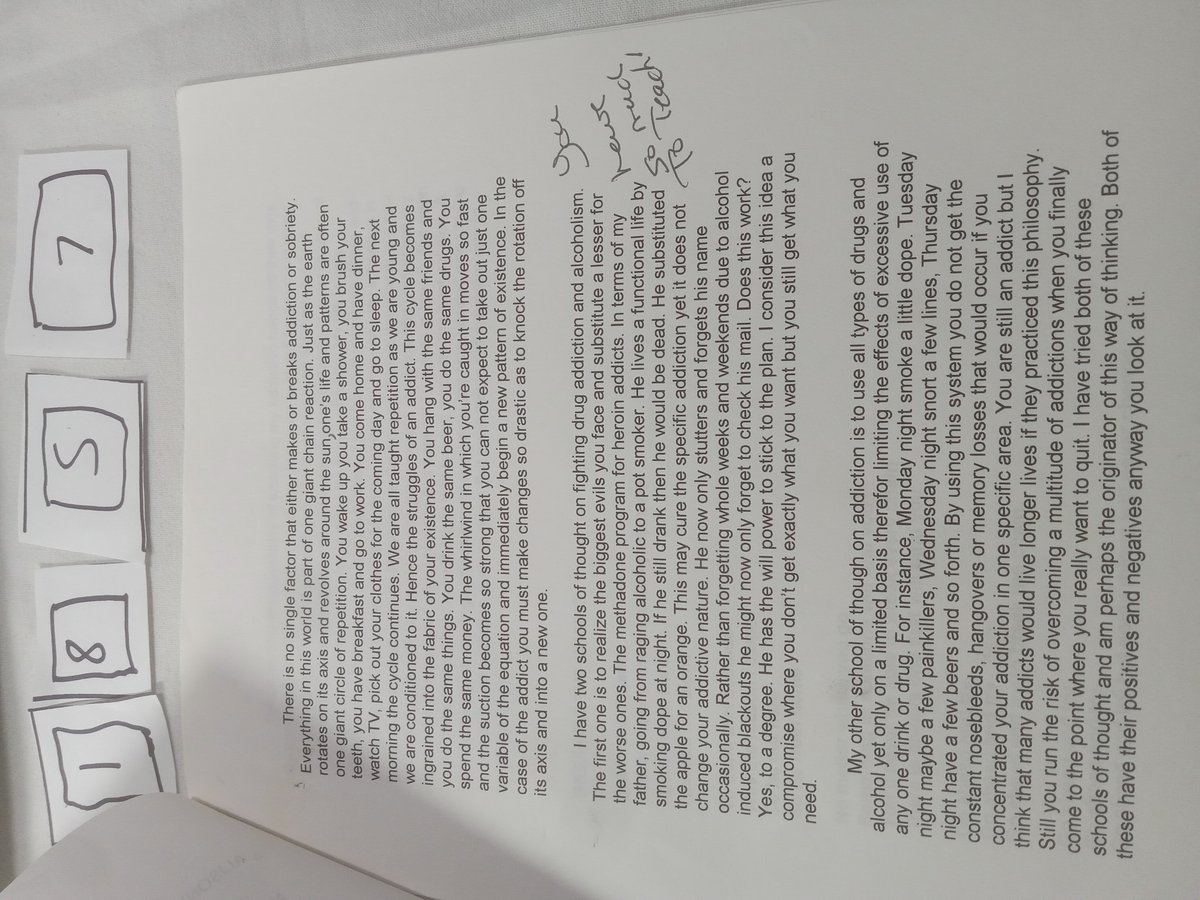
You
have
so much
To Teach!
There is no single factor that either makes or breaks addiction or sobriety. Everything in this world is part of one giant chain reaction. Just as the earth rotates on its axis and revolves around the sun, one's life and patterns are often one giant circle of repetition. You wake up you take a shower, you brush your teeth, you have breakfast and go to work. You come home and have dinner, watch TV, pick out your clothes for the coming day and go to sleep. The next morning the cycle continues. We are all taught repetition as we are young and we are conditioned to it. Hence the struggles of an addict. This cycle becomes ingrained into the fabric of your existence. You hang with the same friends and you do the same things. You drink the same beer, you do the same drugs. You spend the same money. The whirlwind in which you're caught in moves so fast and the suction becomes so strong that you can not expect to take out just one variable of the equation and immediately begin a new pattern of existence. In the case of the addict you must make changes so drastic as to knock the rotation off its axis and into a new one.
I have two schools of thought on fighting drug addiction and alcoholism. The first one is to realize the biggest evils you face and substitute a lesser for the worse ones. The methadone program for heroin addicts. In terms of my father, going from raging alcoholic to a pot smoker. He lives a functional life by smoking dope at night. If he still drank then he would be dead. He substituted the apple for an orange. This may cure the specific addiction yet it does not change your addictive nature. He now only stutters and forgets his name occasionally. Rather than forgetting whole weeks and weekends due to alcohol induced blackouts he might now only forget to check his mail. Does this work? Yes, to a degree. He has the will power to stick to the plan. I consider this idea a compromise where you don't get exactly what you want but you still get what you need.
My other school of though on addiction is to use all types of drugs and alcohol yet only on a limited basis therefor limiting the effects of excessive use of any one drink or drug. For instance, Monday night smoke a little dope. Tuesday night maybe a few painkillers, Wednesday night snort a few lines, Thursday night have a few beers and so forth. By using this system you do not get the constant nosebleeds, hangovers or memory losses that would occur if you concentrated your addiction in one specific area. You are still an addict but I think that many addicts would live longer lives if they practiced this philosophy. Still you run the risk of overcoming a multitude of addictions when you finally come to the point where you really want to quit. I have tried both of these schools of thought and am perhaps the originator of this way of thinking. Both of these have their positives and negatives anyway you look at it.
---
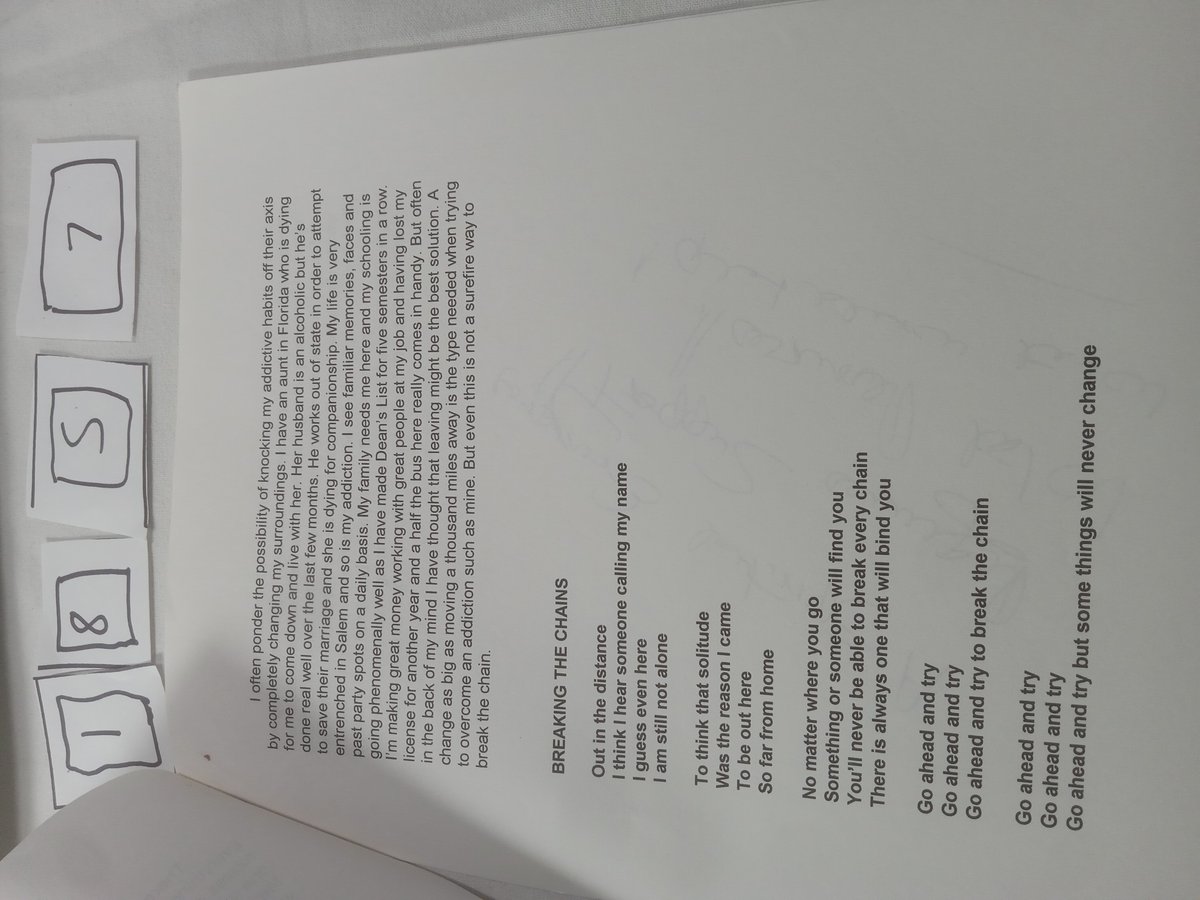
I often ponder the possibility of knocking my addictive habits off their axis by completely changing my surroundings. I have an aunt in Florida who is dying for me to come down and live with her. Her husband is an alcoholic but he's done real well over the last few months. He works out of state in order to attempt to save their marriage and she is dying for companionship. My life is very entrenched in Salem and so is my addiction. I see familiar memories, faces and past party spots on a daily basis. My family needs me here and my schooling is going phenomenally well as I have made Dean's List for five semesters in a row. I'm making great money working with great people at my job and having lost my license for another year and a half the bus here really comes in handy. But often in the back of my mind I have thought that leaving might be the best solution. A change as big as moving a thousand miles away is the type needed when trying to overcome an addiction such as mine. But even this is not a surefire way to break the chain.
BREAKING THE CHAINS
Out in the distance
I think I hear someone calling my name
I guess even here
I am still not alone
To think that solitude
Was the reason I came
To be out here
So far from home
No matter where you go
Something or someone will find you
You'll never be able to break every chain
There is always one that will bind you
Go ahead and try
Go ahead and try
Go ahead and try to break the chain
Go ahead and try
Go ahead and try
Go ahead and try but some things will never change
---
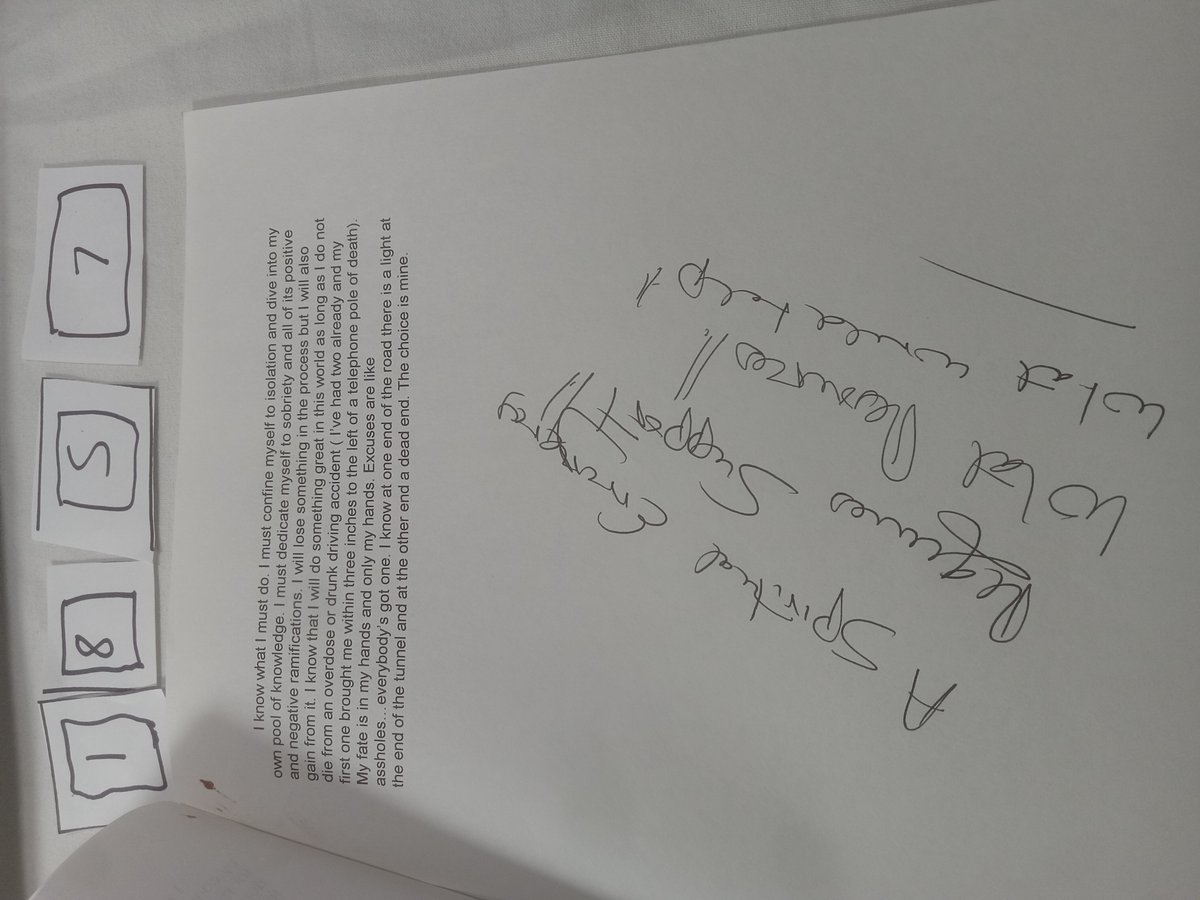
I know what I must do. I must confine myself to isolation and dive into my own pool of knowledge. I must dedicate myself to sobriety and all of its positive and negative ramifications. I will lose something in the process but I will also gain from it. I know that I will do something great in this world as long as I do not die from an overdose or drunk driving accident ( I've had two already and my first one brought me within three inches to the left of a telephone pole of death). My fate is in my hands and only my hands. Excuses are like assholes... everybody's got one. I know at one end of the road there is a light at the end of the tunnel and at the other end a dead end. The choice is mine.
A Spiritual Energy
Requires Support
What Resources!!
What would help?!
Item 1862
Disease of Alcoholism
Item type
WRITINGS · TOM JENSEN · COLLEGE ESSAY
UNPUBLISHED
Tom's typed college essay DISEASE OF ALCOHOLISM (February 25, 2000), written after a rehab stay, first and last pages.
- Why it matters
- Tom's typed college essay DISEASE OF ALCOHOLISM (February 25, 2000), written after a rehab stay - the recovery that runs through his poems and songs.
- Type
- Printed page
- Collection
- College writings ; Writings (non-lyric) ; Addiction ; Recovery ; Faith
- Published in
- PREVIOUSLY UNPUBLISHEDSearched against the 34 albums, every book and Poems By Tom - found in none of them
- Age when written
- made at age 21proved: the paper's date line reads February 25, 2000 - typed off its photo
- Same words
- also written out as number 1855matched on the words by machine - Tom confirms
- On the site
- Tom's Story: 2000
Price · Tier · Tom fills these
Picture 1 of 2
Picture 2 of 2
The words on this page
Tom Jensen
Wealth and Hellness ☺
February 25, 2000
Disease of Alcoholism
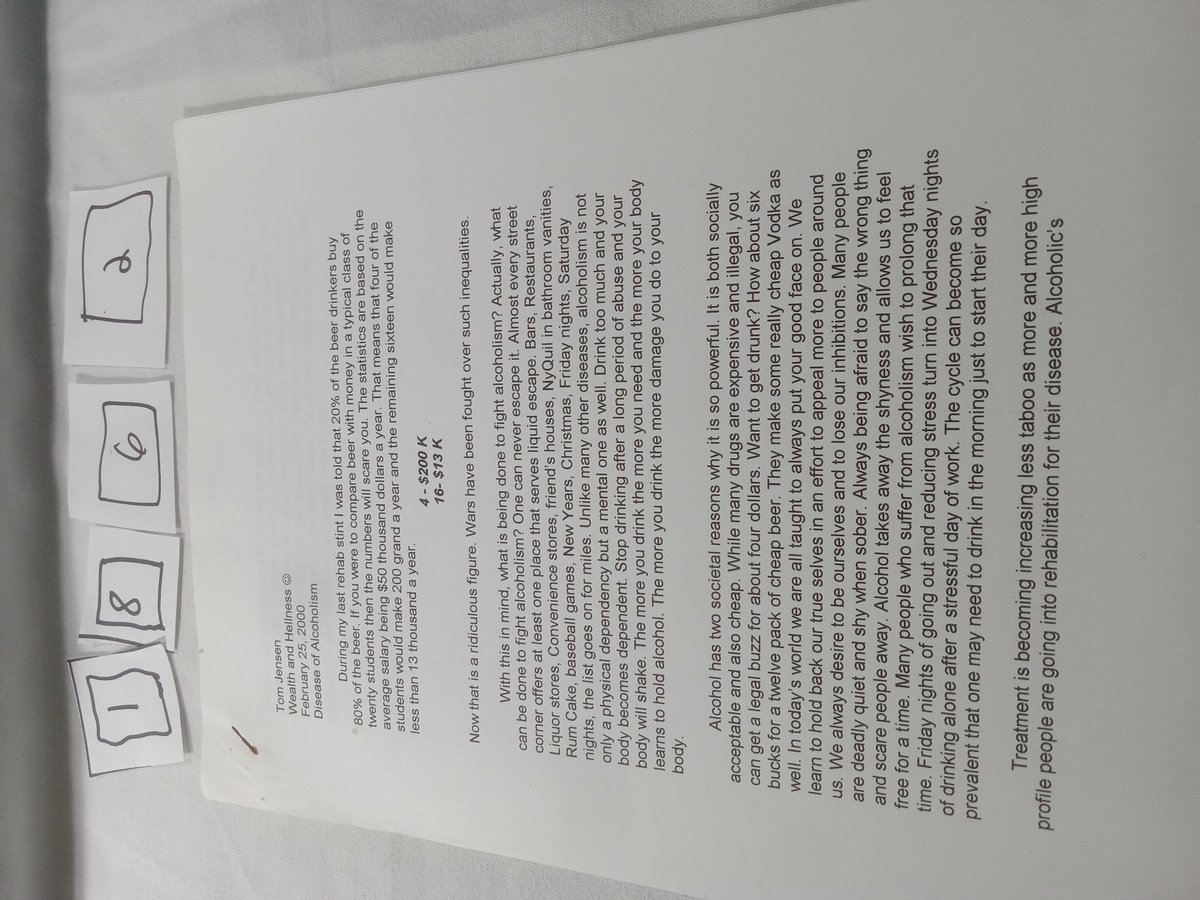
During my last rehab stint I was told that 20% of the beer drinkers buy
80% of the beer. If you were to compare beer with money in a typical class of
twenty students then the numbers will scare you. The statistics are based on the
average salary being $50 thousand dollars a year. That means that four of the
students would make 200 grand a year and the remaining sixteen would make
less than 13 thousand a year.
4 - $200 K
16- $13 K
Now that is a ridiculous figure. Wars have been fought over such inequalities.
With this in mind, what is being done to fight alcoholism? Actually, what
can be done to fight alcoholism? One can never escape it. Almost every street
corner offers at least one place that serves liquid escape. Bars, Restaurants,
Liquor stores, Convenience stores, friend's houses, NyQuil in bathroom vanities,
Rum Cake, baseball games, New Years, Christmas, Friday nights, Saturday
nights, the list goes on for miles. Unlike many other diseases, alcoholism is not
only a physical dependency but a mental one as well. Drink too much and your
body becomes dependent. Stop drinking after a long period of abuse and your
body will shake. The more you drink the more you need and the more your body
learns to hold alcohol. The more you drink the more damage you do to your
body.
Alcohol has two societal reasons why it is so powerful. It is both socially
acceptable and also cheap. While many drugs are expensive and illegal, you
can get a legal buzz for about four dollars. Want to get drunk? How about six
bucks for a twelve pack of cheap beer. They make some really cheap Vodka as
well. In today's world we are all taught to always put your good face on. We
learn to hold back our true selves in an effort to appeal more to people around
us. We always desire to be ourselves and to lose our inhibitions. Many people
are deadly quiet and shy when sober. Always being afraid to say the wrong thing
and scare people away. Alcohol takes away the shyness and allows us to feel
free for a time. Many people who suffer from alcoholism wish to prolong that
time. Friday nights of going out and reducing stress turn into Wednesday nights
of drinking alone after a stressful day of work. The cycle can become so
prevalent that one may need to drink in the morning just to start their day.
Treatment is becoming increasing less taboo as more and more high
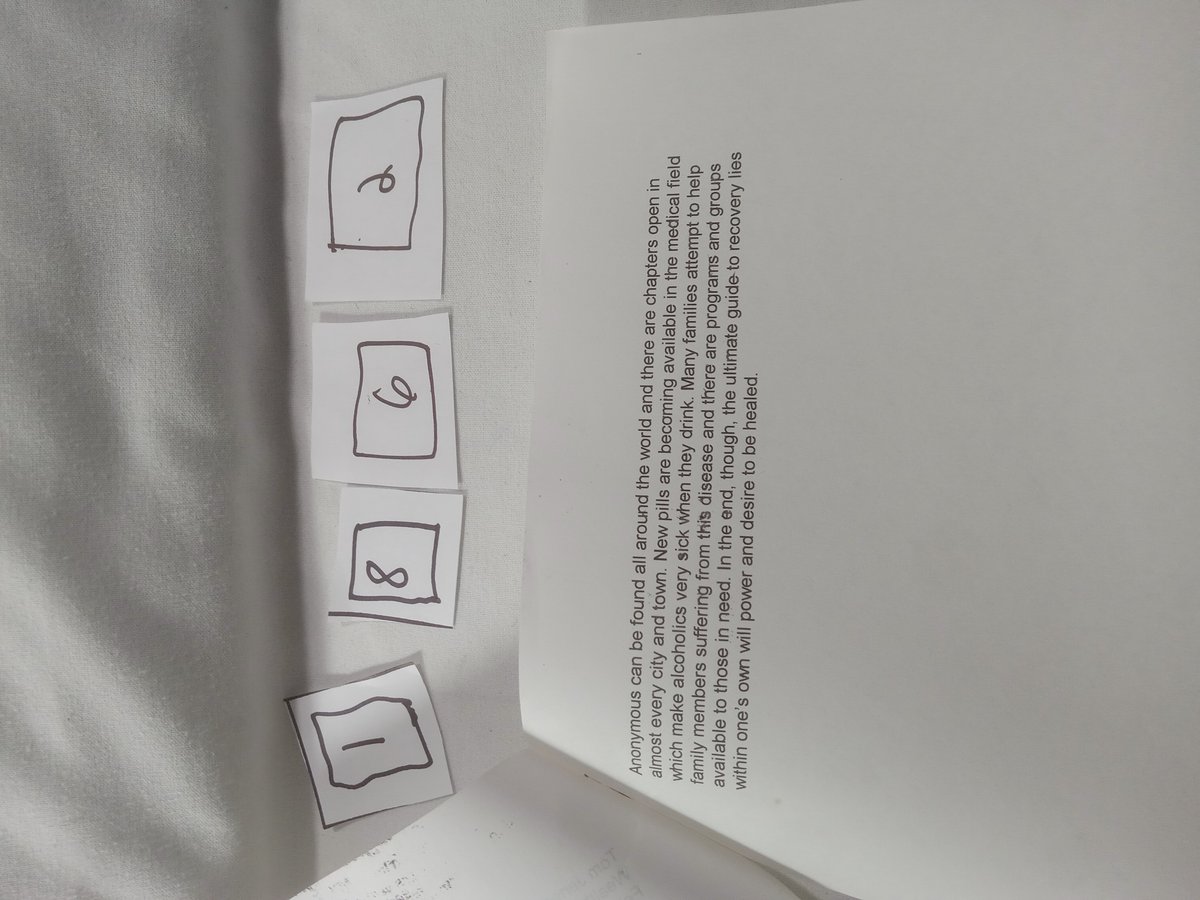
profile people are going into rehabilitation for their disease. Alcoholic's
---
Anonymous can be found all around the world and there are chapters open in
almost every city and town. New pills are becoming available in the medical field
which make alcoholics very sick when they drink. Many families attempt to help
family members suffering from this disease and there are programs and groups
available to those in need. In the end, though, the ultimate guide to recovery lies
within one's own will power and desire to be healed.
TOM JENSEN - MISCELLANEOUS
Item 1896
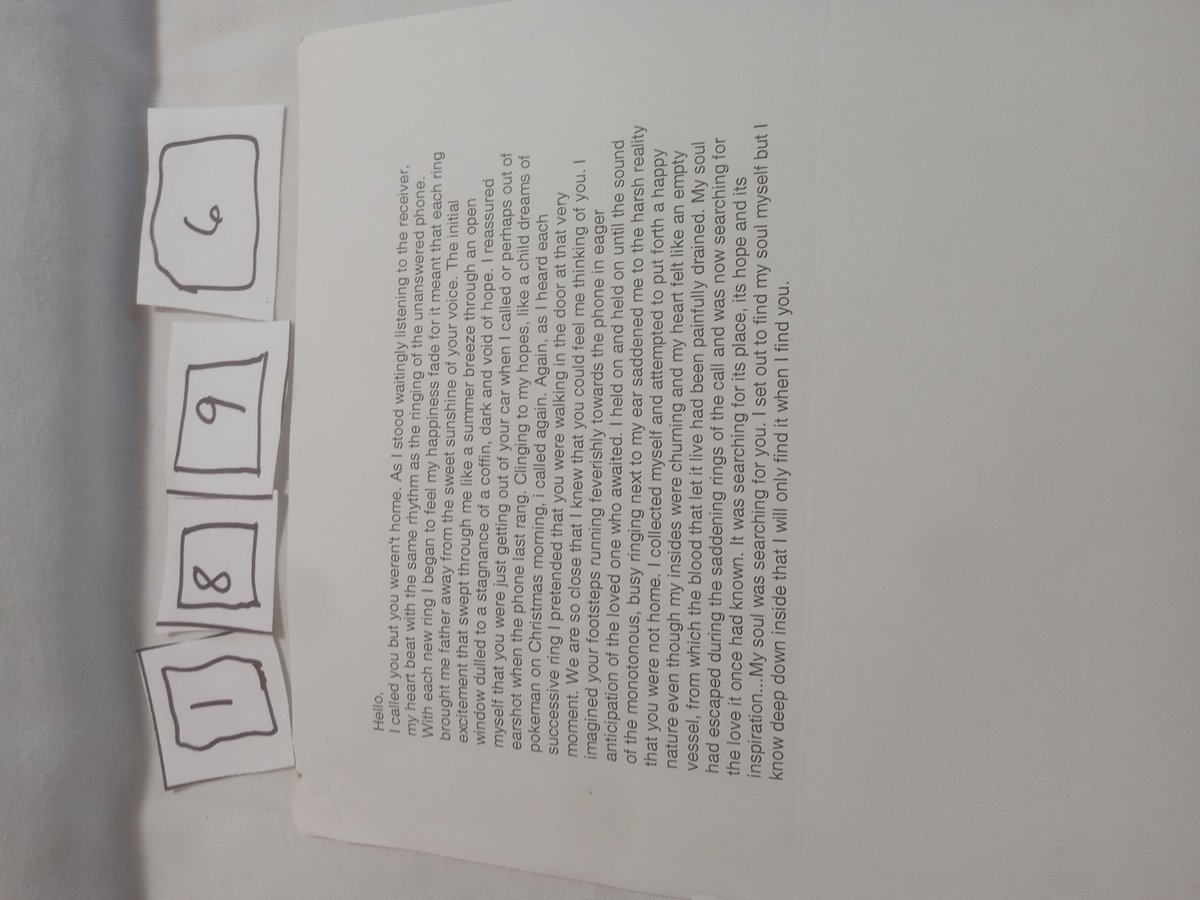
Hello
In one sentence: Tom's typed one-page love letter that begins 'Hello, I called you but you weren't home', comparing his heartbeat to the ringing of an unanswered phone, about 1998-2003.
Item type
WRITINGS · TOM JENSEN · MISCELLANEOUS
UNPUBLISHED
Tom's typed love letter that begins Hello, I called you but you weren't home, comparing his heartbeat to the ringing of an unanswered phone, on a single sheet.
- Why it matters
- Tom's typed love letter that begins Hello, I called you but you weren't home, comparing his heartbeat to an unanswered ringing phone - a love letter written with a songwriter's image.
- Type
- Printed page
- Collection
- Letters ; Writings (non-lyric) ; Love
- Published in
- PREVIOUSLY UNPUBLISHEDSearched against the 34 albums, every book and Poems By Tom - found in none of them
- Age when written
- about 1998-2003 (age 19 to 25)best guess - not yet proved: dated from this piece's own photos and words and the dated books
- On the site
- Tom's Story: 2000
Price · Tier · Tom fills these
The only picture of this piece
The words on this page
Hello,
I called you but you weren't home. As I stood waitingly listening to the receiver, my heart beat with the same rhythm as the ringing of the unanswered phone. With each new ring I began to feel my happiness fade for it meant that each ring brought me father away from the sweet sunshine of your voice. The initial excitement that swept through me like a summer breeze through an open window dulled to a stagnance of a coffin, dark and void of hope. I reassured myself that you were just getting out of your car when I called or perhaps out of earshot when the phone last rang. Clinging to my hopes, like a child dreams of pokeman on Christmas morning, i called again. Again, as I heard each successive ring I pretended that you were walking in the door at that very moment. We are so close that I knew that you could feel me thinking of you. I imagined your footsteps running feverishly towards the phone in eager anticipation of the loved one who awaited. I held on and held on until the sound of the monotonous, busy ringing next to my ear saddened me to the harsh reality that you were not home. I collected myself and attempted to put forth a happy nature even though my insides were churning and my heart felt like an empty vessel, from which the blood that let it live had been painfully drained. My soul had escaped during the saddening rings of the call and was now searching for the love it once had known. It was searching for its place, its hope and its inspiration...My soul was searching for you. I set out to find my soul myself but I know deep down inside that I will only find it when I find you.
I called you but you weren't home. As I stood waitingly listening to the receiver, my heart beat with the same rhythm as the ringing of the unanswered phone. With each new ring I began to feel my happiness fade for it meant that each ring brought me father away from the sweet sunshine of your voice. The initial excitement that swept through me like a summer breeze through an open window dulled to a stagnance of a coffin, dark and void of hope. I reassured myself that you were just getting out of your car when I called or perhaps out of earshot when the phone last rang. Clinging to my hopes, like a child dreams of pokeman on Christmas morning, i called again. Again, as I heard each successive ring I pretended that you were walking in the door at that very moment. We are so close that I knew that you could feel me thinking of you. I imagined your footsteps running feverishly towards the phone in eager anticipation of the loved one who awaited. I held on and held on until the sound of the monotonous, busy ringing next to my ear saddened me to the harsh reality that you were not home. I collected myself and attempted to put forth a happy nature even though my insides were churning and my heart felt like an empty vessel, from which the blood that let it live had been painfully drained. My soul had escaped during the saddening rings of the call and was now searching for the love it once had known. It was searching for its place, its hope and its inspiration...My soul was searching for you. I set out to find my soul myself but I know deep down inside that I will only find it when I find you.
TOM JENSEN - COLLEGE ESSAY
Item 880
BLACK SOX SCANDAL
In one sentence: Tom's typed college history paper 'Black Sox Scandal', dated 2/18/01 and folded in half, with a handwritten lyric and pencilled notes on the back, 2001 or later.
Item type
WRITINGS · TOM JENSEN · COLLEGE ESSAY
UNPUBLISHED
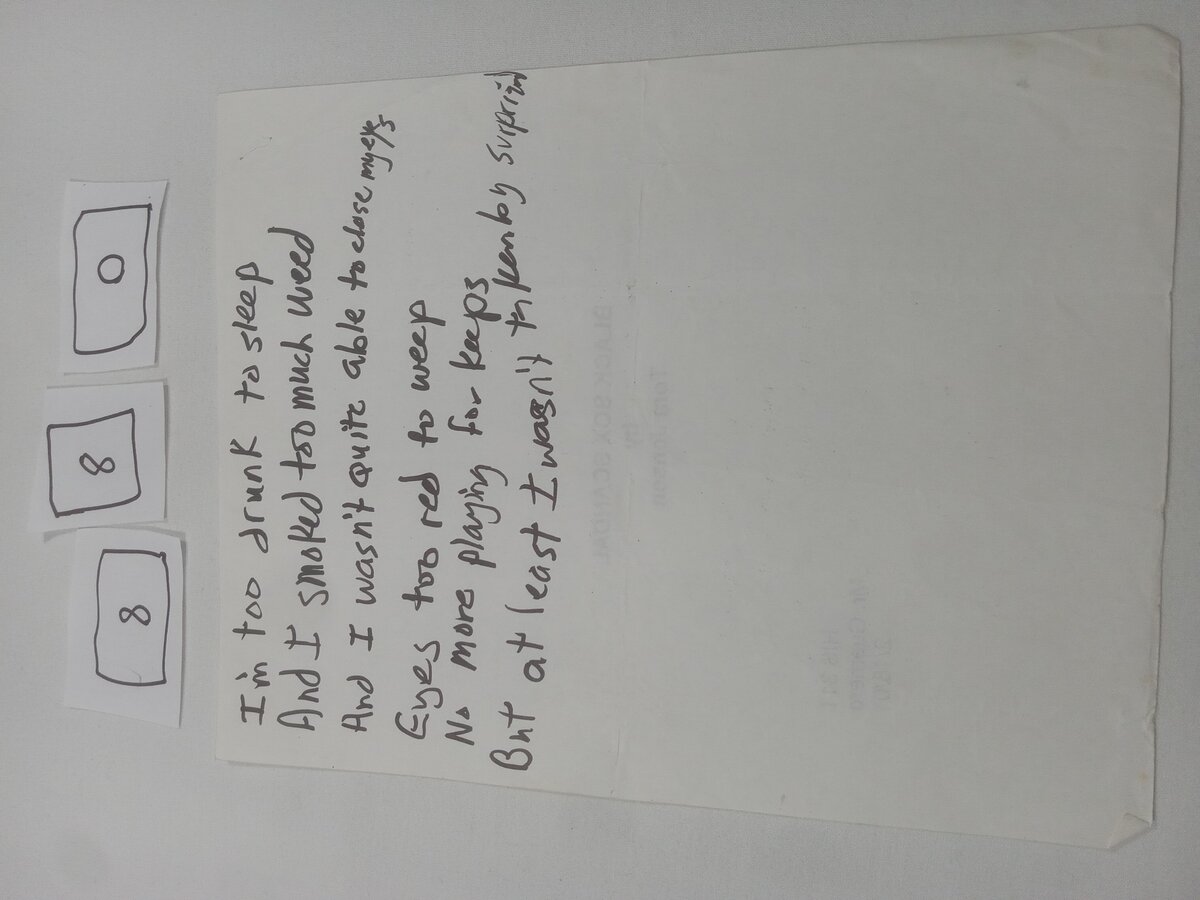
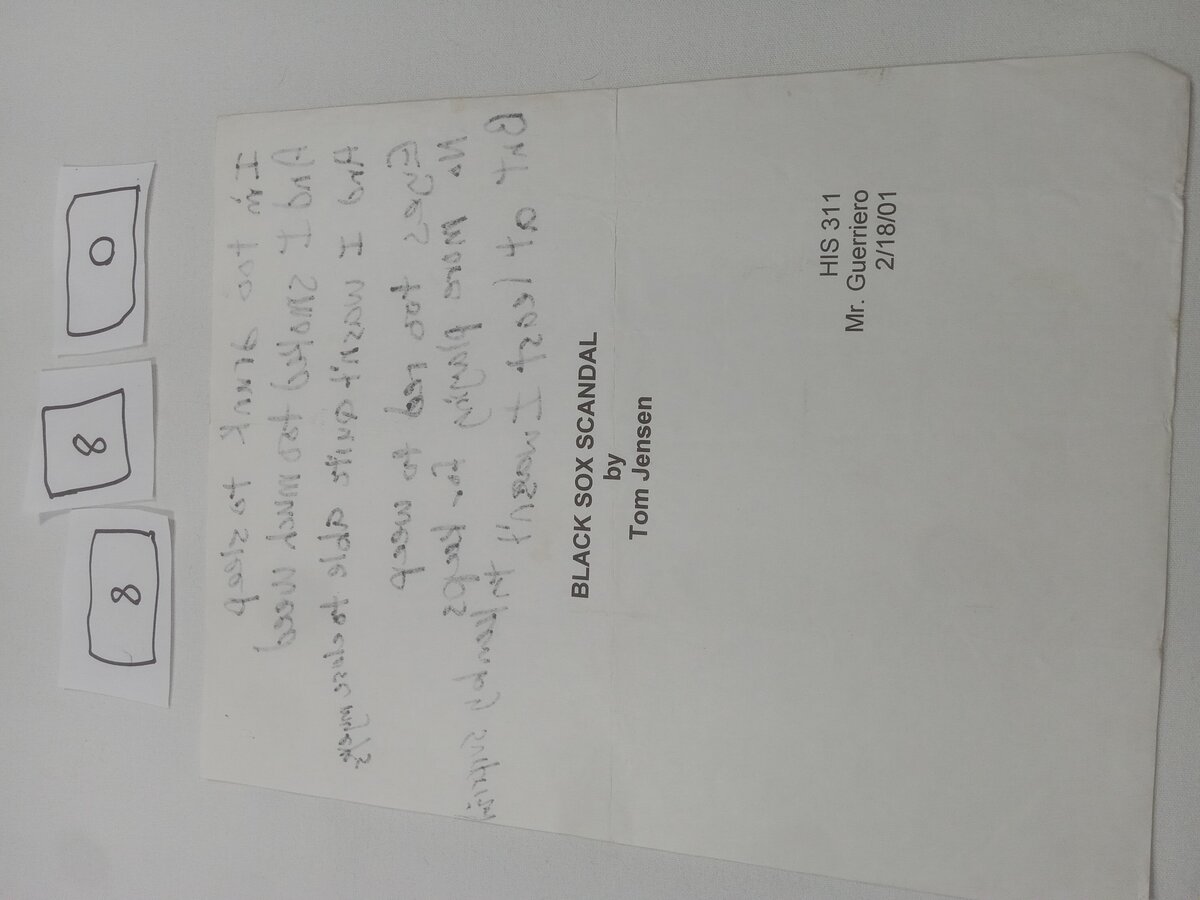
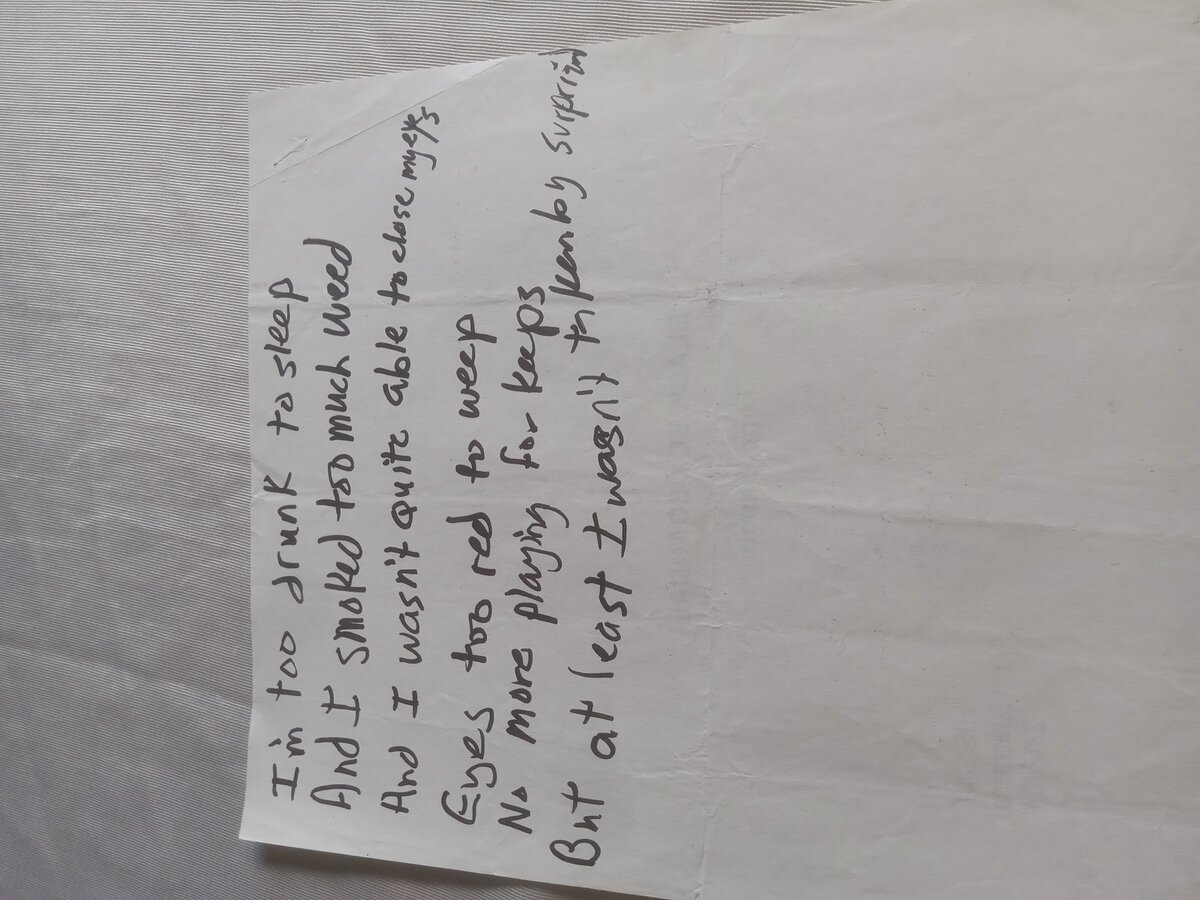
Tom's own typed college history paper BLACK SOX SCANDAL, by Tom Jensen, dated 2/18/01, folded in half, with his handwritten lyric "I'm too drunk to sleep / And I smoked too much weed" and pencilled notes on the baseball scandal on the back.
- Why it matters
- One sheet with both sides of Tom at college: the front is his typed history paper BLACK SOX SCANDAL, dated 2/18/01, and on the back he wrote the lyric I'm too drunk to sleep / And I smoked too much weed - the songwriter writing lyrics on his schoolwork.
- Type
- Typed college paper with a handwritten lyric on the back
- Collection
- College writings ; Writings (non-lyric) ; Previously unpublished lyrics ; Baseball ; Drinking
- Published in
- PREVIOUSLY UNPUBLISHEDSearched against the 34 albums, every book and Poems By Tom - found in none of them
- Age when written
- written at age 22 or laterthe typed paper on the front is dated 2/18/01, when Tom was 22; the lyric is written on its back, so on or after that date
- On the site
- Tom's Story: 2001
Price · Tier · Tom fills these
Picture 1 of 3
Picture 2 of 3
Picture 3 of 3
The words on this page
I'm too drunk to sleep
And I smoked too much weed
And I wasn't quite able to close my eyes
Eyes too red to weep
No more playing for keeps
But at least I wasn't taken by surprise
---
[Handwritten text, rotated 90 degrees left]:
People at first did not
believe that some I had
thrown games with the
rest of the team. A
great of baseball had
cheated, I may at [?] to the
[Typed text]:
BLACK SOX SCANDAL
by
Tom Jensen
HIS 311
Mr. G.
2/18/01
TOM JENSEN - SPORTS
Item 1819
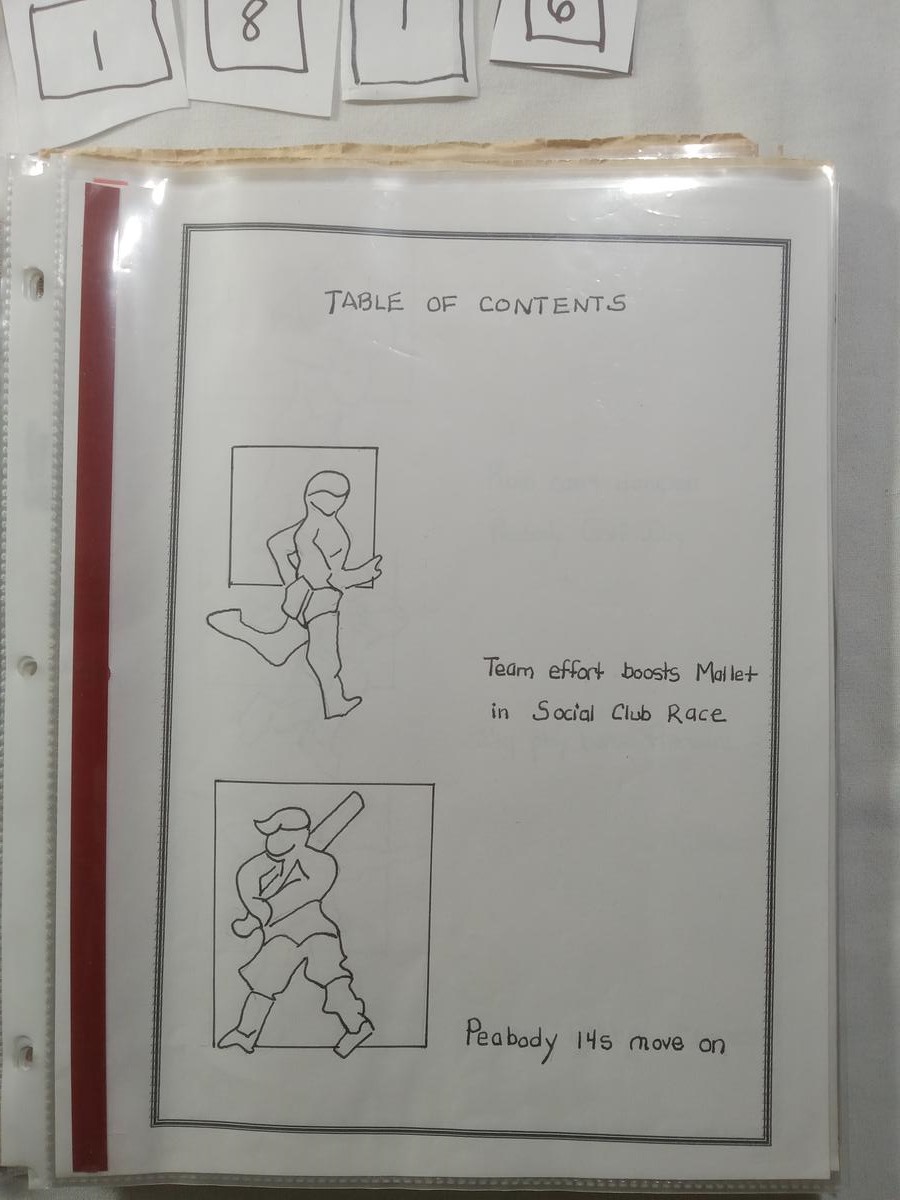
TABLE OF CONTENTS
In one sentence: A binder section of Tom's sports writing in sheet protectors, with his hand-drawn 'Table Of Contents' and runner drawings, kept with his typed 1999 story, about 1999-2003.
Item type
WRITINGS · TOM JENSEN · SPORTS
UNPUBLISHED
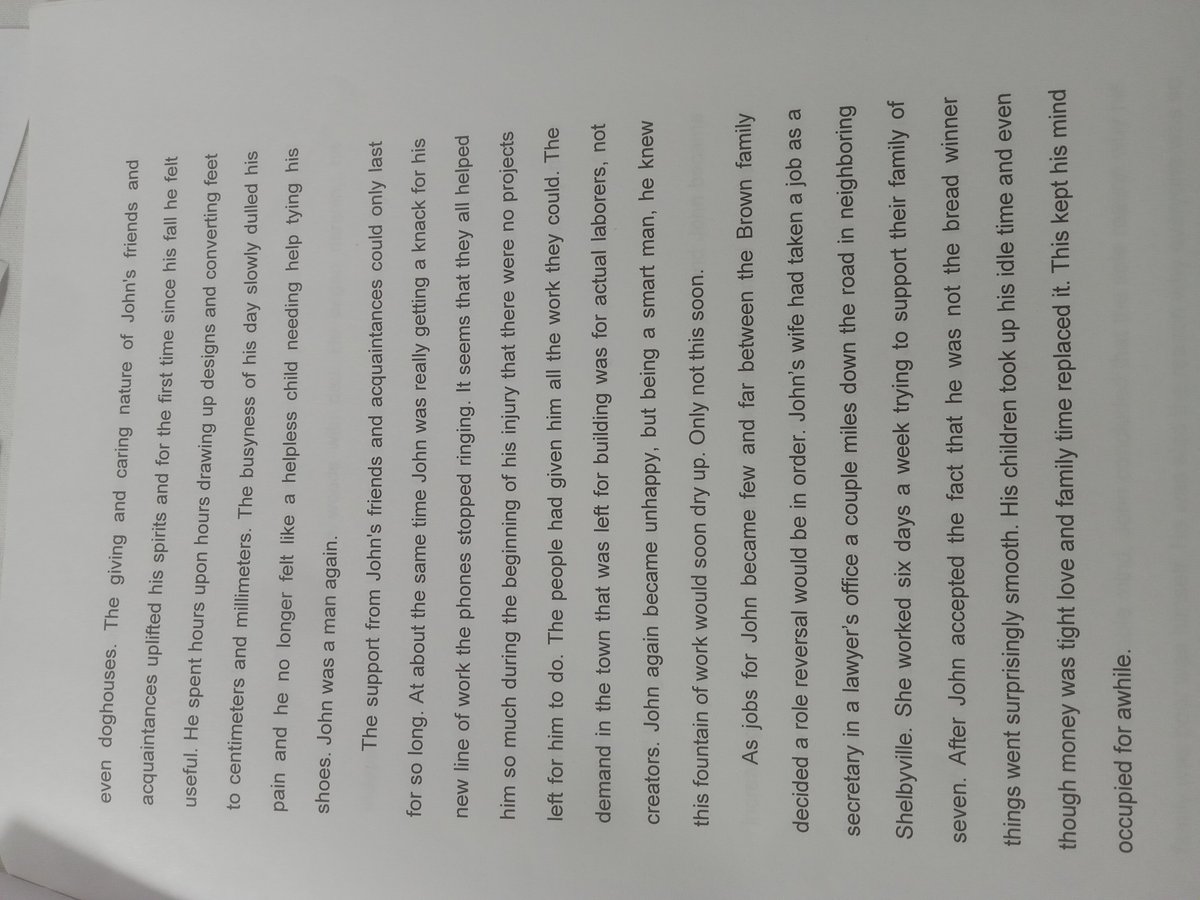
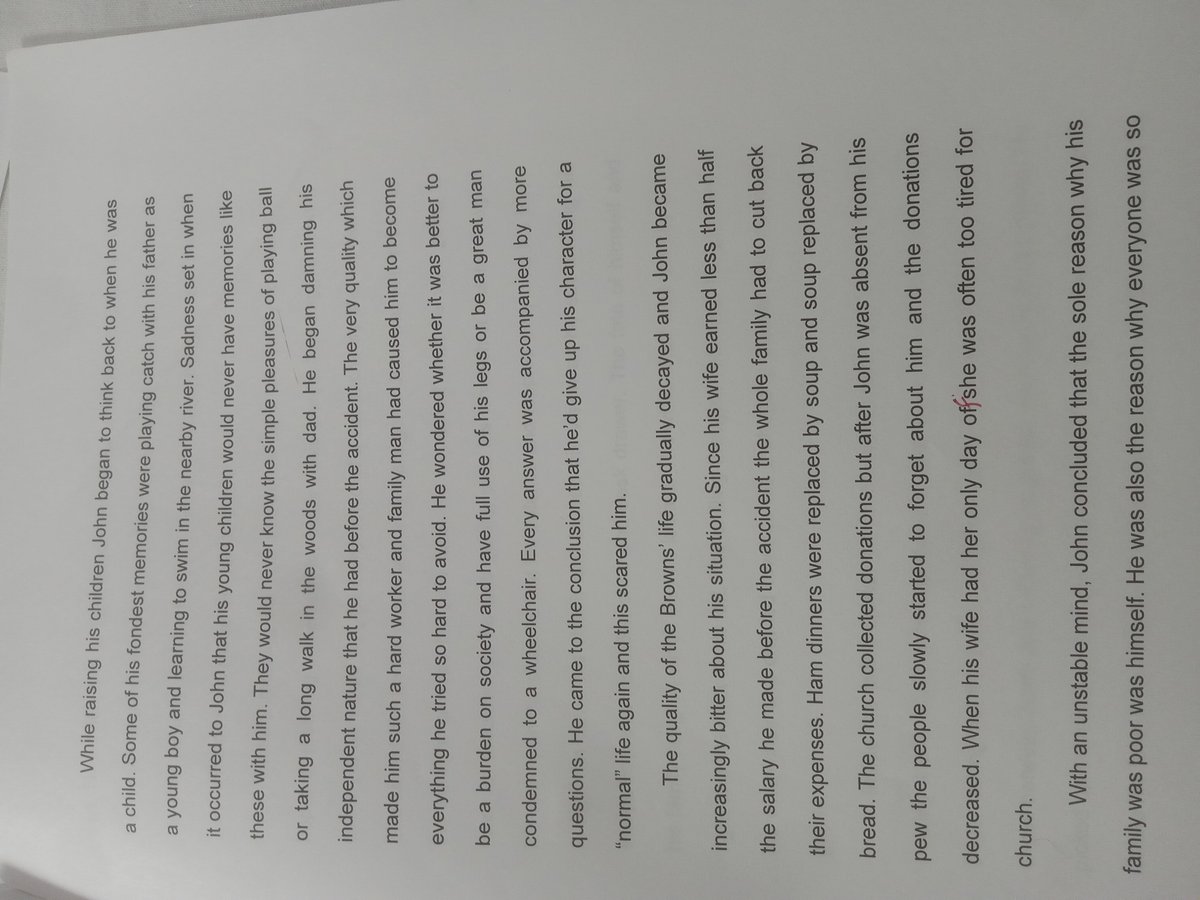
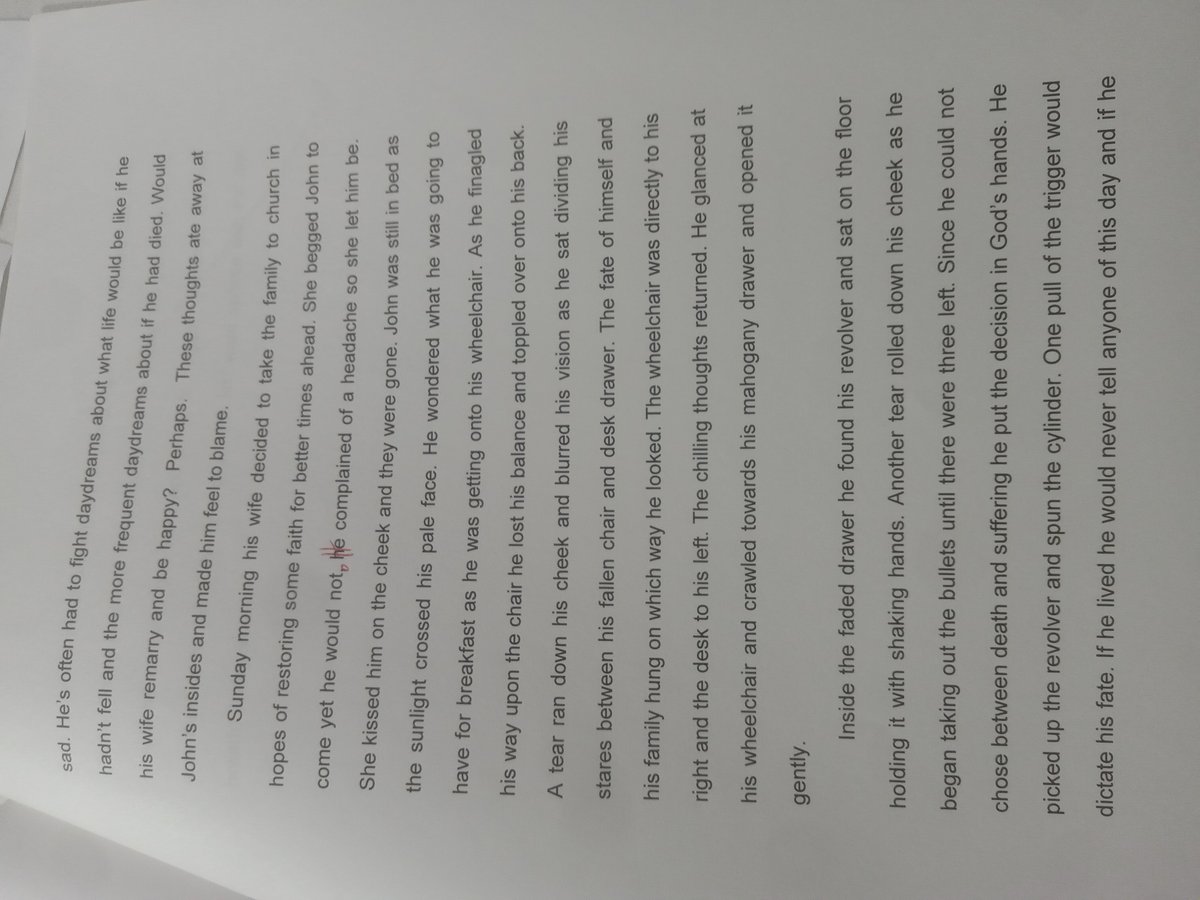
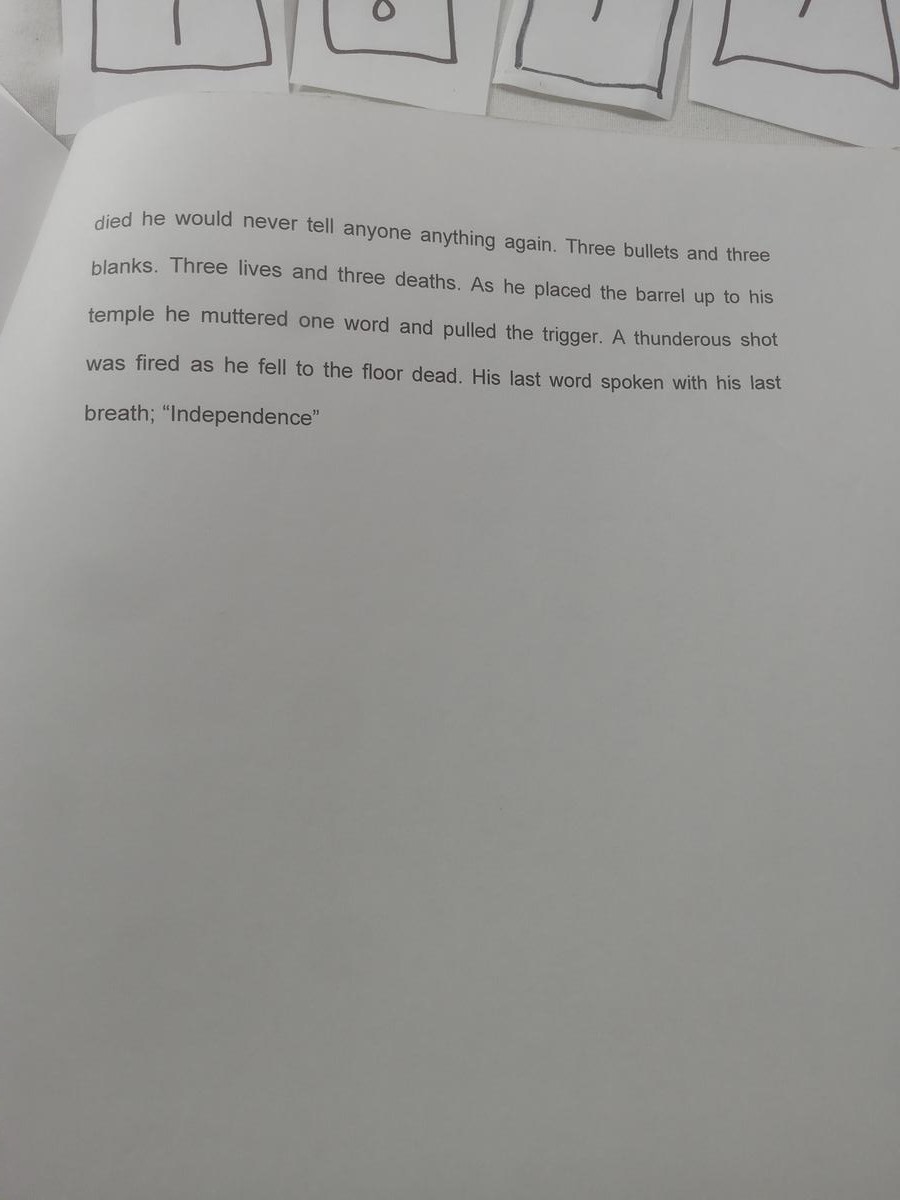
A binder section of Tom's sports writing in sheet protectors - his hand-drawn TABLE OF CONTENTS and COMMON GROUND pages with runner and batter drawings, and his bylined clipping Team effort boosts Mallett in Social Club Race - kept with his typed 1999 creative writing story THE INDEPENDENCE OF JOHN BROWN.
- Why it matters
- A section of Tom's sports-writing binder with his hand-drawn TABLE OF CONTENTS and COMMON GROUND pages and his bylined clipping on the Lynnfield Social Club Race - the songwriter's newspaper work, kept alongside his 1999 college story.
- Type
- Binder
- Collection
- Writings (non-lyric) ; Newspaper sportswriting ; Peabody and Lynnfield weekly papers ; Sports ; College writings
- Published in
- PREVIOUSLY UNPUBLISHEDSearched against the 34 albums, every book and Poems By Tom - found in none of them
- Age when written
- dated from age 20 to age 24best guess - not yet proved: the John Brown story in it is dated April 29, 1999 and Tom's bylined road-race clipping covers the Independence Day race of 2003 (its page has ads for July 7-13 and July 14, 2003) - read off its photo
- On the site
- Tom's Story: 2001
Price · Tier · Tom fills these
Picture 1 of 14
Picture 2 of 14

Picture 3 of 14

Picture 4 of 14
Picture 5 of 14
Picture 6 of 14
Picture 7 of 14
Picture 8 of 14
Picture 9 of 14
Picture 10 of 14
Picture 11 of 14
Picture 12 of 14
Picture 13 of 14
Picture 14 of 14
Moved here from item 1101 - the number blocks in this photo read 1819 (only their lower edges are in the frame); it is the next frame of this binder's shoot
Moved here from item 1101 - the number blocks in this photo read 1819 (only their lower edges are in the frame); it is the next frame of this binder's shoot
The words on this page
TABLE OF CONTENTS
Team effort boosts Mallet
in Social Club Race
Peabody 14S move on
---
week. Meinelt's motivation for the race was not a selfish one. "[I was running] strictly for my
told him before that I was going to do it twice. I'm thinking of doing a 10-miler so I wanted to
Manett was running the race for a third time. "Last year I was dehydrated and went out the back door," he
ran with my granddaughter, too."
ROAD RACE continued on page 12
lett and Meinelt are two of chors of the cross country
Common Ground
---
LYNNFIELD - Discipline, dedication and self-motivation are usually the words associated with competitive running. Teamwork, however, is a major role that did play a rarity, although it did play a role during last Friday's 36th annual Social Club Scholarship Road Race in Lynnfield.
Peter Mallett, a 20-year-old junior at the University of New Hampshire, recorded the fastest time at 15:41 while his fellow UNH training partner, Steve Meinelt, finished just a second behind at 15:42 in the 3.1-mile race. Mallett willingly acknowledged the part that Meinelt, also 20, played in the race.
"He gave me the win. His job was just to go out there and pull me," said Mallett, a Manchester, N.H. native whose aunt lives in Lynnfield. "He's my training partner and he wanted to do better shape than I am right now."
Mallett and Meinelt are two of the anchors of the cross country team at UNH and generally run about 70 and 100 miles a week, respectively. Over the summer they try to run together twice a week. Meinelt's motivation for the race was not a selfish one.
"[I was running] strictly for my buddy," said Meinelt, who decided to run the route a second time after crossing the finish line. "I was helping him out. I told him before that I was going to do it twice. I'm thinking of doing a 10-miler so I wanted to go a little further. I figured I'll help him and then I'll just do it again."
Mallett was running the race for a third time.
"Last year I was dehydrated and went out the back door," he added. "This year I used it as a tune-up race."
Meinelt's selfless act personified a race in which the overall goal is to raise scholarship money for graduating seniors as much as lowering finishing times.
As for the women's winner, it was up to Amy Wallace to defend her family's name. With a winning time of 20:10, she did just that.
Shawn Wallace, Amy's younger brother, had won the men's division the last two years, but had to sit out this year's race with an injury. Originally from Wakefield, Wallace still had plenty of familiar faces surrounding her during the race, even though her brother was forced to watch from the crowd.
"I'm here cheering on these guys. They're my idols," Shawn said.
Amy's older brother, Bill Wallace, a science teacher at Lynnfield High School, ran the race while pushing his daughter in a stroller. Amy's mother, Judy, also competed this year and said, "I am very proud of her. I am proud of my son who ran with my granddaughter, too."
ROAD RACE
continued on page 12
Peter Mallett, (center in photo on left) gladly accepted the generosity of his UNH teammate, Steve Meinelt (right) (photo at right) made sure her family's name remained in the winner's circle by winning the women's division of the Independence Day 3.1-mile race.
Sports
---
BUS SERVICE TO
HORIZON'S EDGE CASINO CRUISES
FOR DAY CRUISES - STARTING JULY 14, 2003
Departs 7 Days a Week from following pick up locations
STONEHAM 9:00 AM On Rte. 28 Redstone Plaza
in front of Dunkin Donuts
MEDFORD 9:15 AM CVS Medford Square
EAST BOSTON 9:30 AM Liberty Mall near
McDonalds
REVERE 9:50 AM Northshore near Taco Bell
DEPARTS HORIZON'S EDGE AT 5:15 PM
Total cost including transportation, cruise & full gourmet buffet
$25.00 per person
JOSEPH LIMOUSINE SERVICE INC.
[number removed]
Take Your Daughter to the
Course Week July 7-13
All week long, junior girls
(ages 16 and under) will enjoy:
• Free club rentals
• A FREE Round when
accompanied by a paying adult
• Special Free Clinic,
Saturday, July 12, 11:30AM
with Cathy MacPherson,
2003 Golf for Women "Top 50 Teacher"
www.middletongolf.com
MIDDLETON
GOLF COURSE
For more information call [number removed]
or visit Middleton Golf Course • Route 114 • Middleton, MA
36TH ANNUAL SOCIAL CLUB ROAD RACE
1 15:41 Peter Mallett Manchester, NH
2 15:42 Steve Meinelt Topsfield, MA
3 16:42 John Ayers Beverly, MA
4 18:20 Bob Gillon Lynnfield, MA
5 18:33 Tom Church Lynn, MA
6 18:46 Alec Bath
7 18:58 Eric Sachetta Lynnfield, MA
8 19:11 Michael Welshons Lynnfield, MA
9 19:24 Rich Tabbut Beverly, MA
10 19:36 Thomas Ackerman
11 19:45 Paul Donahue
12 19:50 Kevin Scanlon
13 19:54 Brendan Curran Lynnfield,MA
14 20:02 Robert Kennedy Lynnfield, MA
15 20:10 Amy Wallace Allston, MA
16 20:10 Brian Slater Melrose, MA
17 20:10 Christopher Logan Lynnfield, MA
18 20:33 Chuck Connell
19 20:33 Adam Izzicupo Saugus, MA
20 20:36 John Merrill Melrose, MA
21 20:40 Jim Dolan Lynnfield, MA
22 20:47 Dave Weeks Lynnfield, MA
23 20:50 Andrew McDonald
24 20:52 Lee Scantalides Lynnfield, MA
25 20:53 Kim Albanese Lynnfield, MA
26 20:56 Rick P. Lynnfield, MA
27 21:02 Mike Kennedy Lynnfield, MA
28 21:06 Paul Ernest Lynnfield, MA
29 21:09 Brian Depamphillis Lynnfield, MA
30 21:15 James Nolan Lynnfield, MA
31 21:22 Dina Wilkinson Lynnfield, MA
32 21:25 Mike Mayr Saugus, MA
33 21:28 Michael Smith Lynnfield, MA
34 21:34 Sam Oliveri Lynnfield, MA
35 21:41 Josheph Pellegrino
36 21:44 Bill Wallace N. Andover, MA
37 21:47 Christopher Cahill Queens, NY
38 21:50 Timothy Croke Lynnfield, MA
39 21:54 Jeff Permon Lynnfield, MA
40 22:00 Colleen Curran
41 22:06 Joseph McDonald
42 22:10 Jim Gallant Medford, MA
43 22:13 Alan Beaulieu Reading, MA
44 22:16 Mark Lanciani
45 22:19 John Judd
46 22:26 Tom Bogart Lynnfield, MA
47 22:32 Steven Girgliano
48 22:35 Sara Oliveri Lynnfield,MA
49 22:38 Linda Epstein Lynnfield, MA
50 22:42 Kip George Lynnfield, MA
Lynnfield's Eric Sachetta (seventh place)
and fireman Tom Bogart (46th) were
among the Top 50 finishers on Friday.
Lynnfield Social Club Road Race
continued from page 11
This was the second time the
26-year-old Amy Wallace ran
the race.
"I ran faster last time and came
in second," said Wallace, who
graduated from Wake Forest on
a track and cross country schol-
arship in 1999. "This time I ran
slower and came in first."
Wallace, who lives in Allston,
presently works in a pediatri-
six o'clock in the morning,
every morning, and then go to
the gym after work. All you
need to be a runner is tremen-
dous self-discipline."
As for the race itself, "I was
running with a few guys for a
while in a little group. Then for
the last half-mile I was on my
own." Did Wallace ever peek
over her shoulder to size up the
competition?
Beach to Beacon Race in Maine.
With a record 238 runners
competing in this year's race,
Marianne Wronka, a Lynnfield
resident who has worked 10 or
more races as a volunteer, was
all smiles.
"Last year at this time [because
it was so hot] we were hosing
people off [before the race]," she
said. "The beauty of this race is
that you don't need to cross the
---
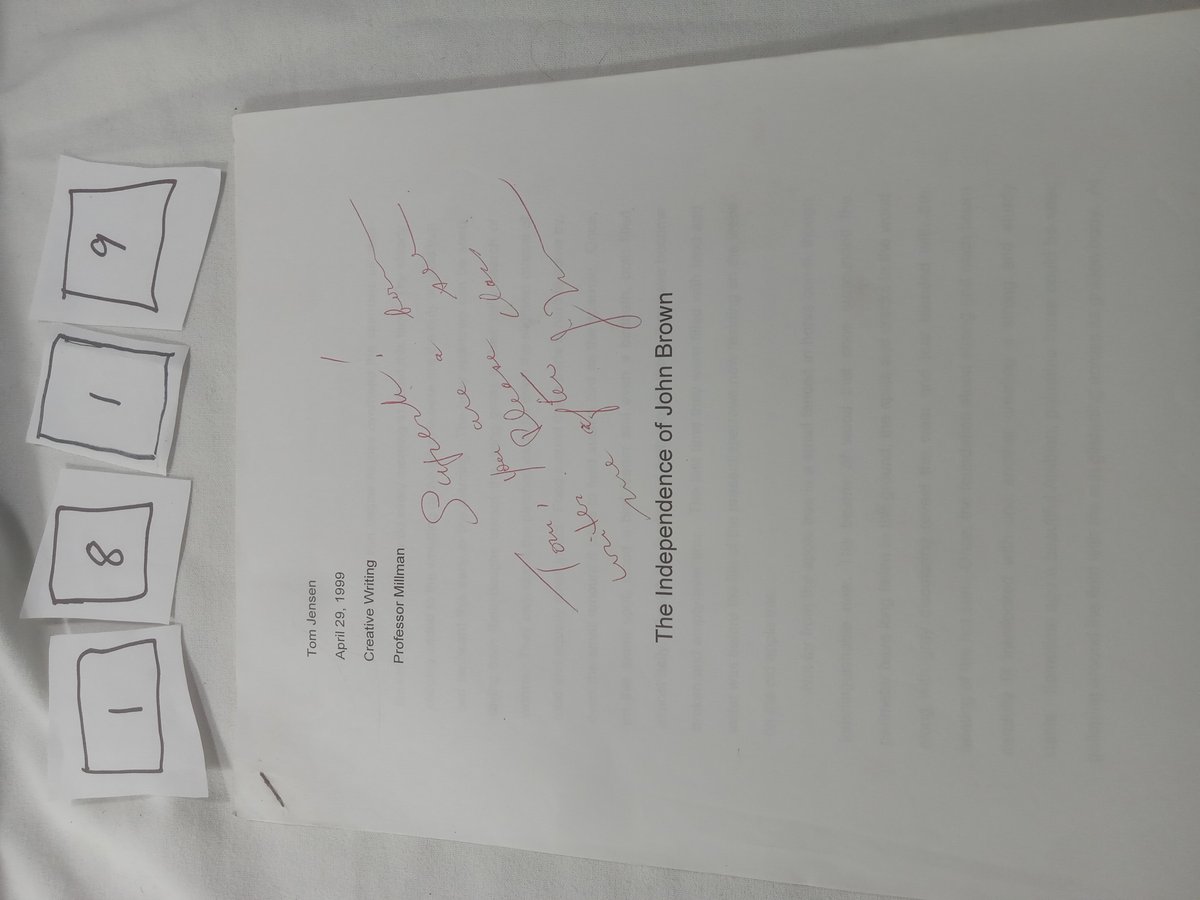
Tom Jensen
April 29, 1999
Creative Writing
Professor M.
Superb! You are a fine writer. Please see me after class.
The Independence of John Brown
---
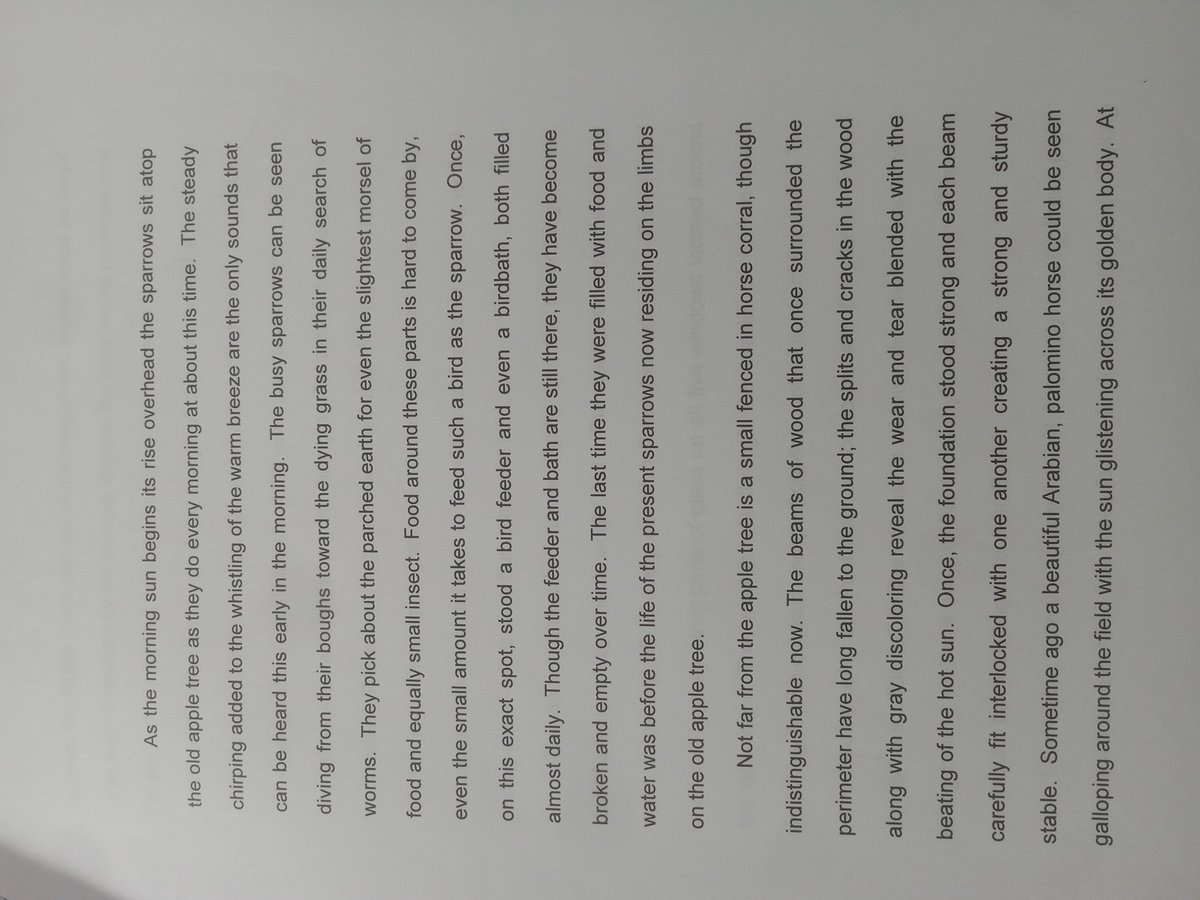
As the morning sun begins its rise overhead the sparrows sit atop
the old apple tree as they do every morning at about this time. The steady
chirping added to the whistling of the warm breeze are the only sounds that
can be heard this early in the morning. The busy sparrows can be seen
diving from their boughs toward the dying grass in their daily search of
worms. They pick about the parched earth for even the slightest morsel of
food and equally small insect. Food around these parts is hard to come by,
even the small amount it takes to feed such a bird as the sparrow. Once,
on this exact spot, stood a bird feeder and even a birdbath, both filled
almost daily. Though the feeder and bath are still there, they have become
broken and empty over time. The last time they were filled with food and
water was before the life of the present sparrows now residing on the limbs
on the old apple tree.
Not far from the apple tree is a small fenced in horse corral, though
indistinguishable now. The beams of wood that once surrounded the
perimeter have long fallen to the ground; the splits and cracks in the wood
along with gray discoloring reveal the wear and tear blended with the
beating of the hot sun. Once, the foundation stood strong and each beam
carefully fit interlocked with one another creating a strong and sturdy
stable. Sometime ago a beautiful Arabian, palomino horse could be seen
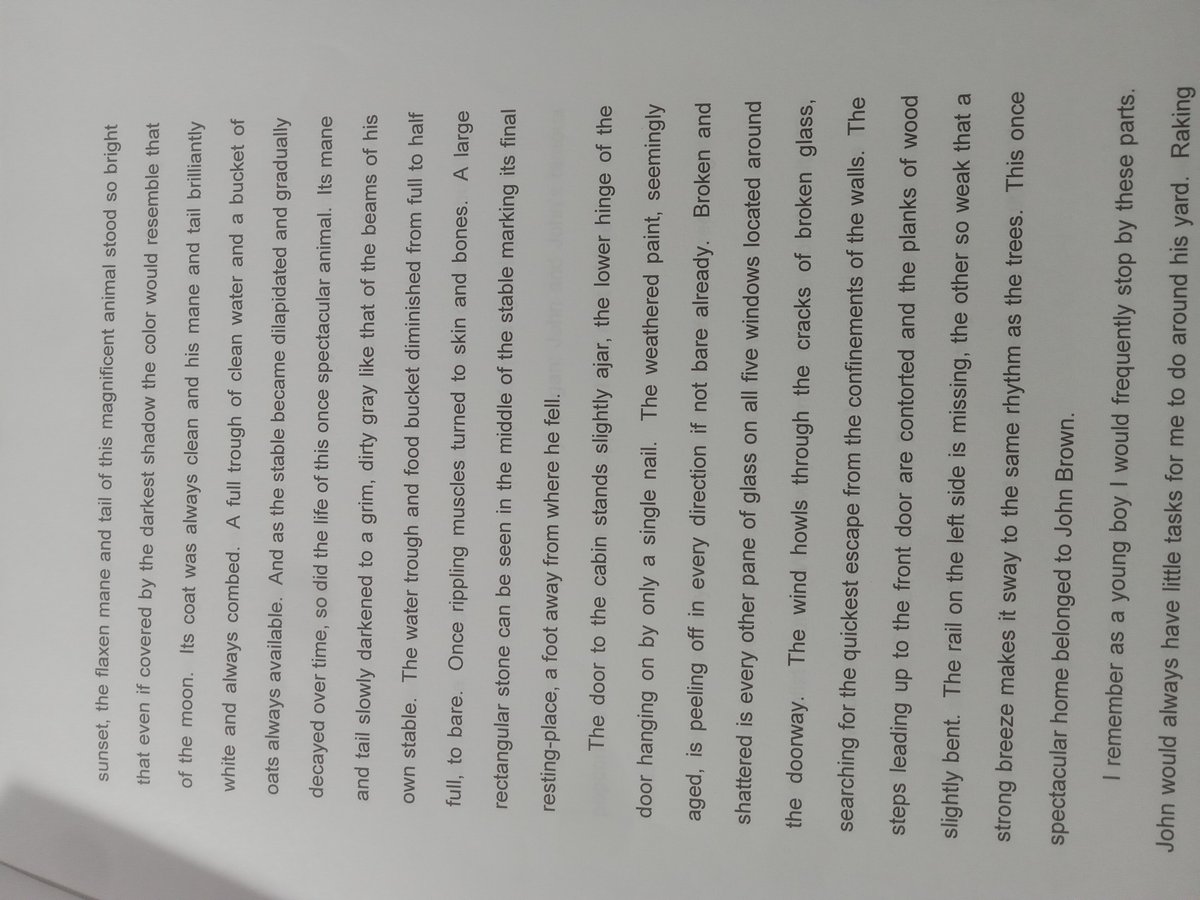
galloping around the field with the sun glistening across its golden body. At
---
sunset, the flaxen mane and tail of this magnificent animal stood so bright
that even if covered by the darkest shadow the color would resemble that
of the moon. Its coat was always clean and his mane and tail brilliantly
white and always combed. A full trough of clean water and a bucket of
oats always available. And as the stable became dilapidated and gradually
decayed over time, so did the life of this once spectacular animal. Its mane
and tail slowly darkened to a grim, dirty gray like that of the beams of his
own stable. The water trough and food bucket diminished from full to half
full, to bare. Once rippling muscles turned to skin and bones. A large
rectangular stone can be seen in the middle of the stable marking its final
resting-place, a foot away from where he fell.
The door to the cabin stands slightly ajar, the lower hinge of the
door hanging on by only a single nail. The weathered paint, seemingly
aged, is peeling off in every direction if not bare already. Broken and
shattered is every other pane of glass on all five windows located around
the doorway. The wind howls through the cracks of broken glass,
searching for the quickest escape from the confinements of the walls. The
steps leading up to the front door are contorted and the planks of wood
slightly bent. The rail on the left side is missing, the other so weak that a
strong breeze makes it sway to the same rhythm as the trees. This once
spectacular home belonged to John Brown.
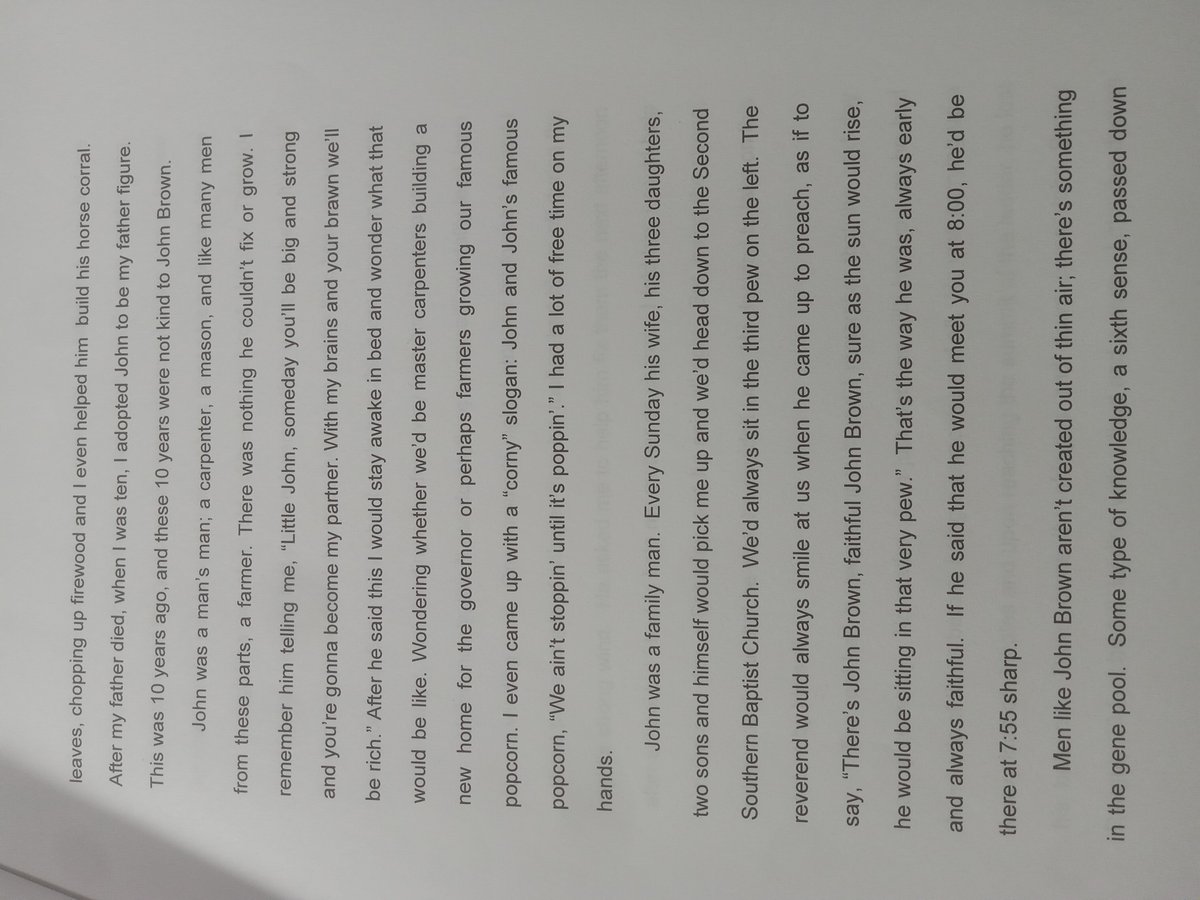
I remember as a young boy I would frequently stop by these parts.
John would always have little tasks for me to do around his yard. Raking
---
leaves, chopping up firewood and I even helped him build his horse corral.
After my father died, when I was ten, I adopted John to be my father figure.
This was 10 years ago, and these 10 years were not kind to John Brown.
John was a man's man; a carpenter, a mason, and like many men
from these parts, a farmer. There was nothing he couldn't fix or grow. I
remember him telling me, "Little John, someday you'll be big and strong
and you're gonna become my partner. With my brains and your brawn we'll
be rich." After he said this I would stay awake in bed and wonder what that
would be like. Wondering whether we'd be master carpenters building a
new home for the governor or perhaps farmers growing our famous
popcorn. I even came up with a "corny" slogan: John and John's famous
popcorn, "We ain't stoppin' until it's poppin'." I had a lot of free time on my
hands.
John was a family man. Every Sunday his wife, his three daughters,
two sons and himself would pick me up and we'd head down to the Second
Southern Baptist Church. We'd always sit in the third pew on the left. The
reverend would always smile at us when he came up to preach, as if to
say, "There's John Brown, faithful John Brown, sure as the sun would rise,
he would be sitting in that very pew." That's the way he was, always early
and always faithful. If he said that he would meet you at 8:00, he'd be
there at 7:55 sharp.
Men like John Brown aren't created out of thin air; there's something
in the gene pool. Some type of knowledge, a sixth sense, passed down
---
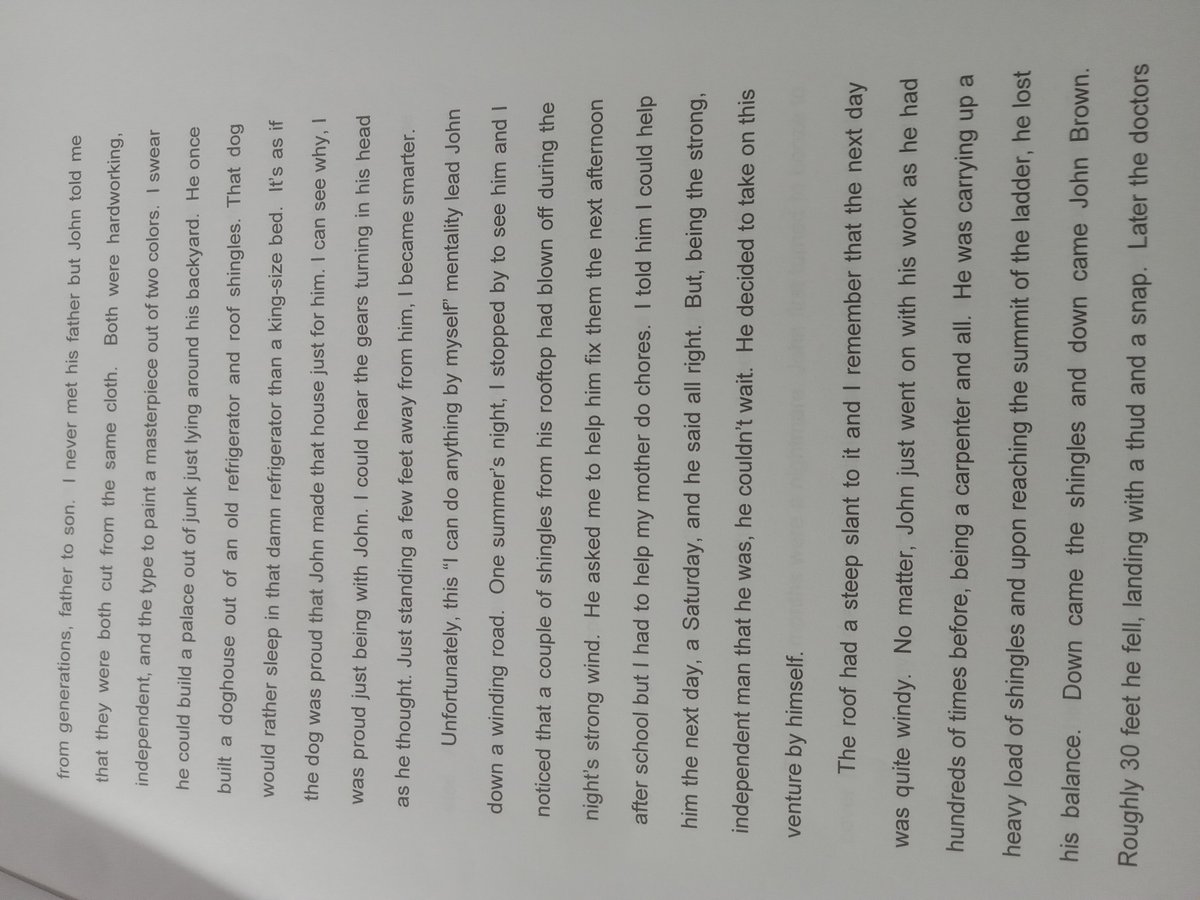
from generations, father to son. I never met his father but John told me that they were both cut from the same cloth. Both were hardworking, independent, and the type to paint a masterpiece out of two colors. I swear he could build a palace out of junk just lying around his backyard. He once built a doghouse out of an old refrigerator and roof shingles. That dog would rather sleep in that damn refrigerator than a king-size bed. It's as if the dog was proud that John made that house just for him. I can see why, I was proud just being with John. I could hear the gears turning in his head as he thought. Just standing a few feet away from him, I became smarter.
Unfortunately, this "I can do anything by myself" mentality lead John down a winding road. One summer's night, I stopped by to see him and I noticed that a couple of shingles from his rooftop had blown off during the night's strong wind. He asked me to help him fix them the next afternoon after school but I had to help my mother do chores. I told him I could help him the next day, a Saturday, and he said all right. But, being the strong, independent man that he was, he couldn't wait. He decided to take on this venture by himself.
The roof had a steep slant to it and I remember that the next day was quite windy. No matter, John just went on with his work as he had hundreds of times before, being a carpenter and all. He was carrying up a heavy load of shingles and upon reaching the summit of the ladder, he lost his balance. Down came the shingles and down came John Brown. Roughly 30 feet he fell, landing with a thud and a snap. Later the doctors
---
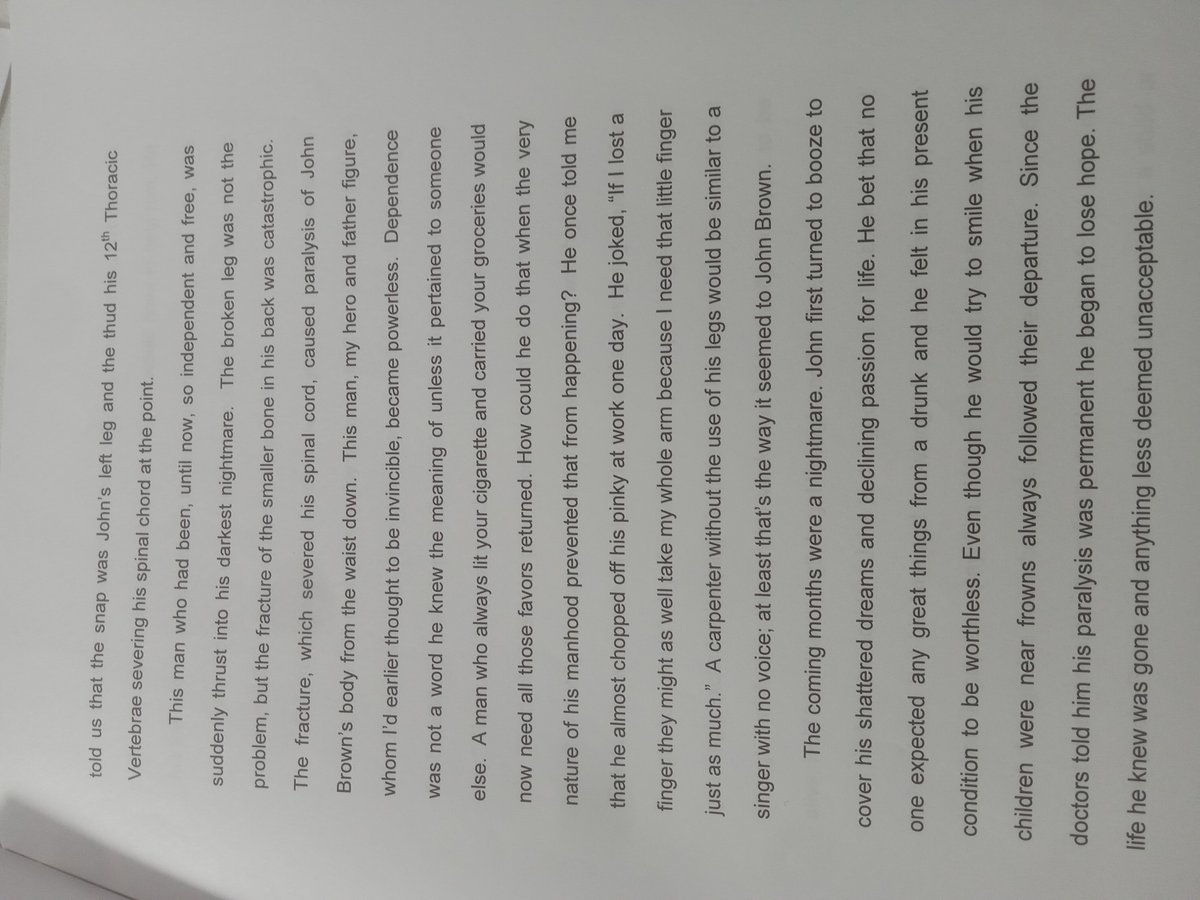
told us that the snap was John's left leg and the thud his 12th Thoracic
Vertebrae severing his spinal chord at the point.
This man who had been, until now, so independent and free, was
suddenly thrust into his darkest nightmare. The broken leg was not the
problem, but the fracture of the smaller bone in his back was catastrophic.
The fracture, which severed his spinal cord, caused paralysis of John
Brown's body from the waist down. This man, my hero and father figure,
whom I'd earlier thought to be invincible, became powerless. Dependence
was not a word he knew the meaning of unless it pertained to someone
else. A man who always lit your cigarette and carried your groceries would
now need all those favors returned. How could he do that when the very
nature of his manhood prevented that from happening? He once told me
that he almost chopped off his pinky at work one day. He joked, "If I lost a
finger they might as well take my whole arm because I need that little finger
just as much." A carpenter without the use of his legs would be similar to a
singer with no voice; at least that's the way it seemed to John Brown.
The coming months were a nightmare. John first turned to booze to
cover his shattered dreams and declining passion for life. He bet that no
one expected any great things from a drunk and he felt in his present
condition to be worthless. Even though he would try to smile when his
children were near frowns always followed their departure. Since the
doctors told him his paralysis was permanent he began to lose hope. The
life he knew was gone and anything less deemed unacceptable.
---
The simplest tasks drove him half-crazy when he couldn't do them
with ease. When tying his shoes his children would have to help him. He
felt the cold irony about this for he was the one who taught his kids to tie
bows. Even though he was a brilliant man he felt as if he was reverting
back to childlike form because of his paralysis.
The drinking eased his mind somewhat yet when he realized he was
drinking more with each passing day he swore it off completely. He told his
wife "This isn't who I am. I'm not the town drunk sitting in his stool yelling at
the bartender to make him another drink. I'll die before that fate comes my
way." The doctor took notice to John's situation and kept a watchful eye on
him. The doctor knew him to be a good man and told John he needed to try
a craft or hobby to occupy his mind. His wife agreed with high optimism.
The decision was made for John to try his hand at designing houses. Even
though he couldn't lay foundations or put up shingles he became
guardingly excited at keeping his trade alive. He hoped that if he could feel
enough satisfaction through his work that he'd actually be happy to be
alive. He'd have the strength to get through another day.
Before the accident John had a good name in the community. Just
as he always lent his time and knowledge to anyone in need they were
more than happy to repay him. When news about John's new hobby
spread through the town he quickly became overwhelmed with offers.
Affluent members of the town finally decided it was time for an extra room
or new porch. Poorer members suddenly found the need for a shed or
---
even doghouses. The giving and caring nature of John's friends and
acquaintances uplifted his spirits and for the first time since his fall he felt
useful. He spent hours upon hours drawing up designs and converting feet
to centimeters and millimeters. The busyness of his day slowly dulled his
pain and he no longer felt like a helpless child needing help tying his
shoes. John was a man again.
The support from John's friends and acquaintances could only last
for so long. At about the same time John was really getting a knack for his
new line of work the phones stopped ringing. It seems that they all helped
him so much during the beginning of his injury that there were no projects
left for him to do. The people had given him all the work they could. The
demand in the town that was left for building was for actual laborers, not
creators. John again became unhappy, but being a smart man, he knew
this fountain of work would soon dry up. Only not this soon.
As jobs for John became few and far between the Brown family
decided a role reversal would be in order. John's wife had taken a job as a
secretary in a lawyer's office a couple miles down the road in neighboring
Shelbyville. She worked six days a week trying to support their family of
seven. After John accepted the fact that he was not the bread winner
things went surprisingly smooth. His children took up his idle time and even
though money was tight love and family time replaced it. This kept his mind
occupied for awhile.
---
While raising his children John began to think back to when he was
a child. Some of his fondest memories were playing catch with his father as
a young boy and learning to swim in the nearby river. Sadness set in when
it occurred to John that his young children would never have memories like
these with him. They would never know the simple pleasures of playing ball
or taking a long walk in the woods with dad. He began damning his
independent nature that he had before the accident. The very quality which
made him such a hard worker and family man had caused him to become
everything he tried so hard to avoid. He wondered whether it was better to
be a burden on society and have full use of his legs or be a great man
condemned to a wheelchair. Every answer was accompanied by more
questions. He came to the conclusion that he'd give up his character for a
"normal" life again and this scared him.
The quality of the Browns' life gradually decayed and John became
increasingly bitter about his situation. Since his wife earned less than half
the salary he made before the accident the whole family had to cut back
their expenses. Ham dinners were replaced by soup and soup replaced by
bread. The church collected donations but after John was absent from his
pew the people slowly started to forget about him and the donations
decreased. When his wife had her only day off she was often too tired for
church.
With an unstable mind, John concluded that the sole reason why his
family was poor was himself. He was also the reason why everyone was so
---
sad. He's often had to fight daydreams about what life would be like if he
hadn't fell and the more frequent daydreams about if he had died. Would
his wife remarry and be happy? Perhaps. These thoughts ate away at
John's insides and made him feel to blame.
Sunday morning his wife decided to take the family to church in
hopes of restoring some faith for better times ahead. She begged John to
come yet he would not, he complained of a headache so she let him be.
She kissed him on the cheek and they were gone. John was still in bed as
the sunlight crossed his pale face. He wondered what he was going to
have for breakfast as he was getting onto his wheelchair. As he finagled
his way upon the chair he lost his balance and toppled over onto his back.
A tear ran down his cheek and blurred his vision as he sat dividing his
stares between his fallen chair and desk drawer. The fate of himself and
his family hung on which way he looked. The chilling thoughts returned. He glanced at
his wheelchair and crawled towards his mahogany drawer and opened it
gently.
Inside the faded drawer he found his revolver and sat on the floor
holding it with shaking hands. Another tear rolled down his cheek as he
began taking out the bullets until there were three left. Since he could not
chose between death and suffering he put the decision in God's hands. He
picked up the revolver and spun the cylinder. One pull of the trigger would
dictate his fate. If he lived he would never tell anyone of this day and if he
---
died he would never tell anyone anything again. Three bullets and three
blanks. Three lives and three deaths. As he placed the barrel up to his
temple he muttered one word and pulled the trigger. A thunderous shot
was fired as he fell to the floor dead. His last word spoken with his last
breath; "Independence"
TOM JENSEN - COLLEGE ESSAY
Item 1822
A battle fatigued U.S. marine in World War II with the Thousand Yard Stare
In one sentence: Tom's college sociology research paper on the thousand yard stare of battle fatigue, graded A, with his typed twenty-step 'Tom's Guide To Not Hating Having To Write A Research Paper', about 1999-2004.
Item type
WRITINGS · TOM JENSEN · COLLEGE ESSAY
UNPUBLISHED
Tom's college sociology research paper on the thousand yard stare of battle fatigue, its title page showing a World War II marine and the teacher's A with comments, together with his own typed TOM'S GUIDE TO NOT HATING HAVING TO WRITE A RESEARCH PAPER in twenty steps.
- Why it matters
- Tom's college sociology paper on the thousand yard stare of battle fatigue, graded A, with his own typed TOM'S GUIDE TO NOT HATING HAVING TO WRITE A RESEARCH PAPER - the writer's prose and humor outside his songs.
- Type
- Printed page
- Collection
- College writings ; Writings (non-lyric) ; War ; Society
- Published in
- PREVIOUSLY UNPUBLISHEDSearched against the 34 albums, every book and Poems By Tom - found in none of them
- Age when written
- about 1999-2004 (age 20 to 26)best guess - not yet proved: dated from this piece's own photos and words and the dated books
- On the site
- Tom's Story: 2001
Price · Tier · Tom fills these
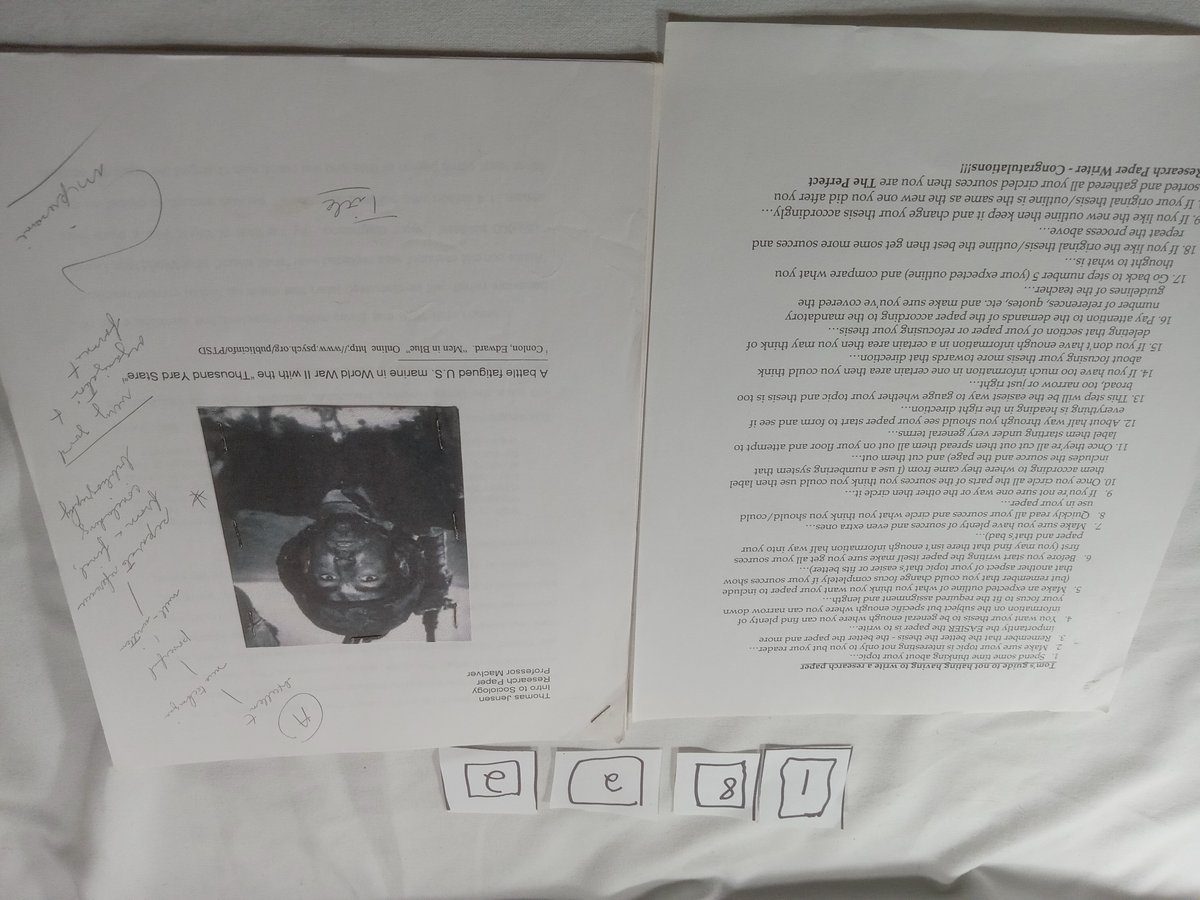
Picture 1 of 3
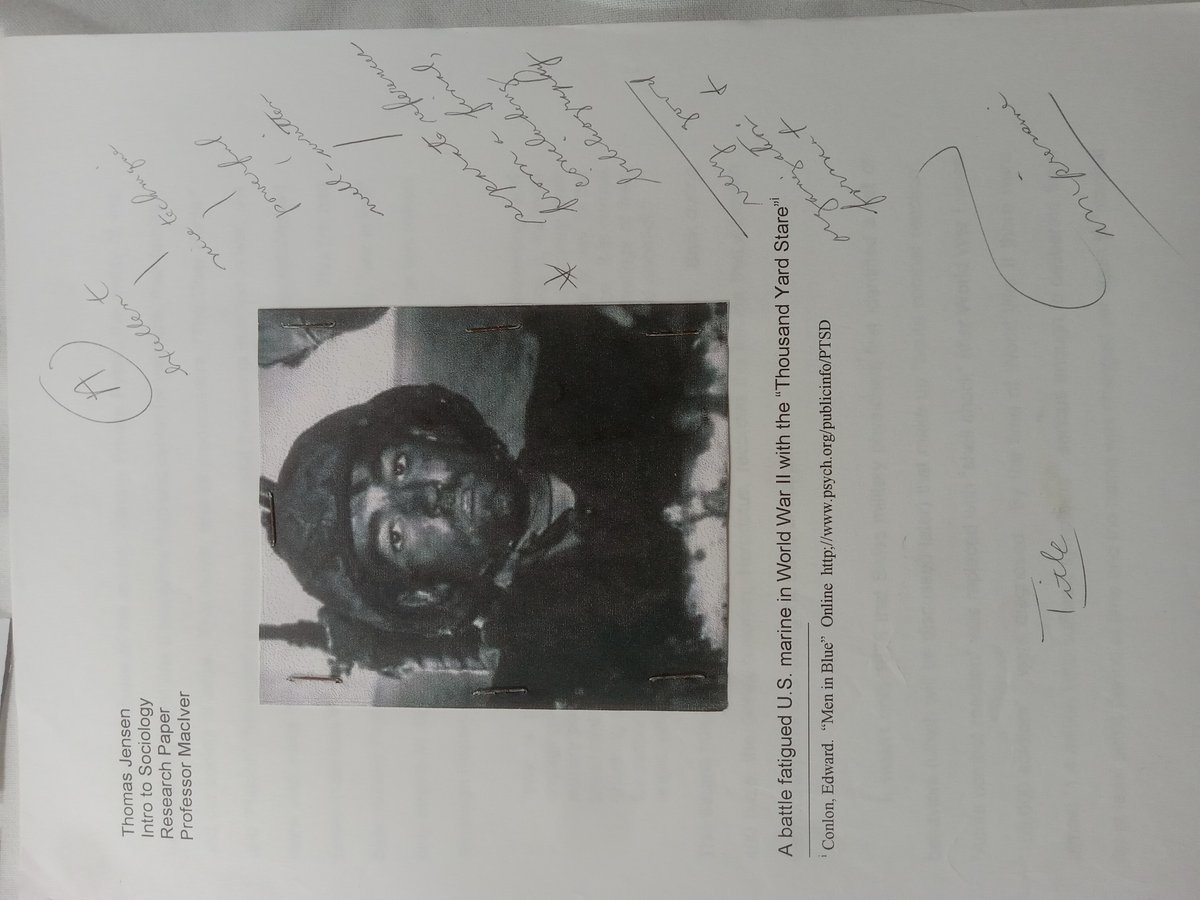
Picture 2 of 3
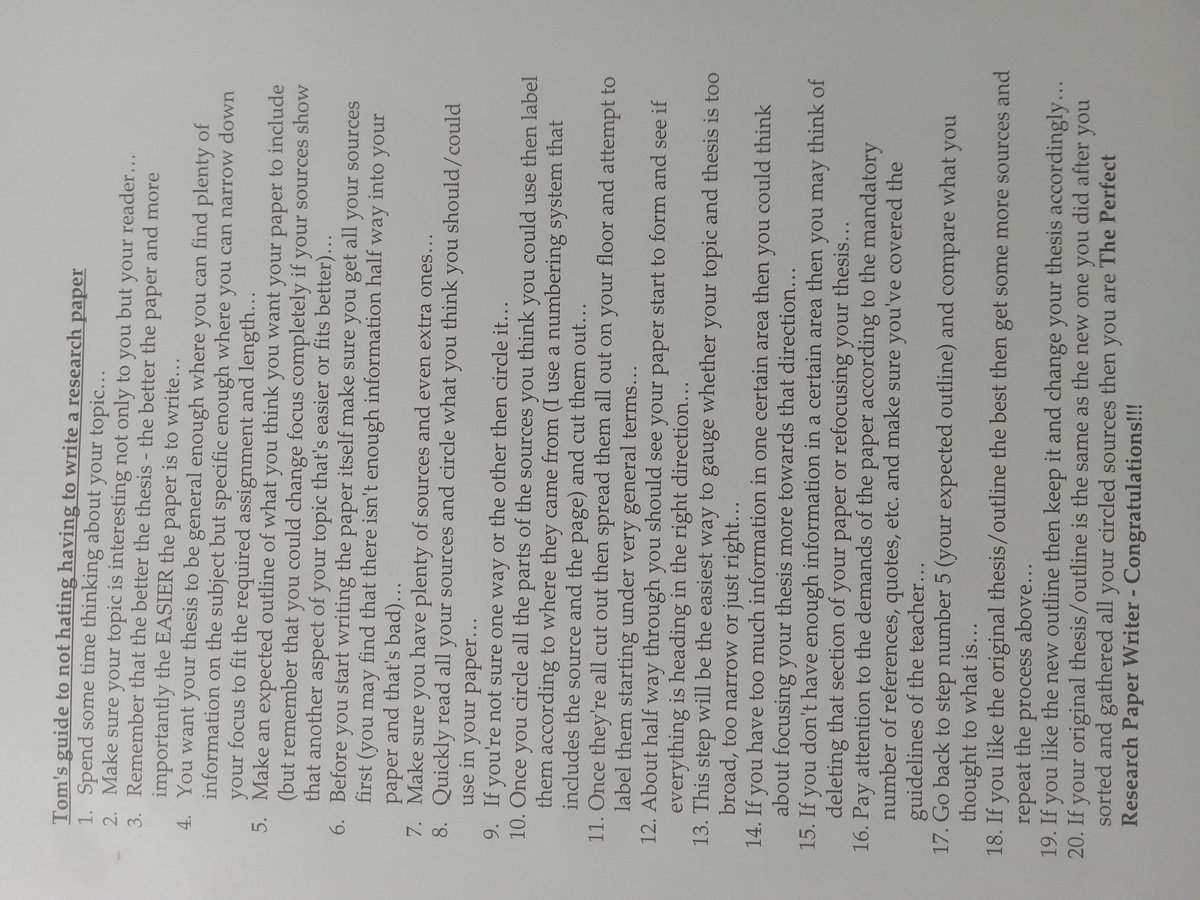
Picture 3 of 3
The words on this page
Thomas Jensen
Intro to Sociology
Research Paper
Professor MacIver
excellent - nice technique
powerful, well-written
separate references from a final concluding bibliography
very good organization & format
A battle fatigued U.S. marine in World War II with the "Thousand Yard Stare"
i Conlon, Edward. "Men in Blue" Online http://www.psych.org/publicinfo/PTSD
Title
impressive
---
Tom's guide to not hating having to write a research paper
1. Spend some time thinking about your topic...
2. Make sure your topic is interesting not only to you but your reader...
3. Remember that the better the thesis - the better the paper and more
importantly the EASIER the paper is to write...
4. You want your thesis to be general enough where you can find plenty of
information on the subject but specific enough where you can narrow down
your focus to fit the required assignment and length...
5. Make an expected outline of what you think you want your paper to include
(but remember that you could change focus completely if your sources show
that another aspect of your topic that's easier or fits better)...
6. Before you start writing the paper itself make sure you get all your sources
first (you may find that there isn't enough information half way into your
paper and that's bad)...
7. Make sure you have plenty of sources and even extra ones...
8. Quickly read all your sources and circle what you think you should/could
use in your paper...
9. If you're not sure one way or the other then circle it...
10. Once you circle all the parts of the sources you think you could use then label
them according to where they came from (I use a numbering system that
includes the source and the page) and cut them out...
11. Once they're all cut out then spread them all out on your floor and attempt to
label them starting under very general terms...
12. About half way through you should see your paper start to form and see if
everything is heading in the right direction...
13. This step will be the easiest way to gauge whether your topic and thesis is too
broad, too narrow or just right...
14. If you have too much information in one certain area then you could think
about focusing your thesis more towards that direction...
15. If you don't have enough information in a certain area then you may think of
deleting that section of your paper or refocusing your thesis...
16. Pay attention to the demands of the paper according to the mandatory
number of references, quotes, etc. and make sure you've covered the
guidelines of the teacher...
17. Go back to step number 5 (your expected outline) and compare what you
thought to what is...
18. If you like the original thesis/outline the best then get some more sources and
repeat the process above...
19. If you like the new outline then keep it and change your thesis accordingly...
20. If your original thesis/outline is the same as the new one you did after you
sorted and gathered all your circled sources then you are The Perfect
Research Paper Writer - Congratulations!!!
Item 1854
HEALTH ASSESSMENT
Item type
WRITINGS · TOM JENSEN · COLLEGE ESSAY
UNPUBLISHED
Tom's typed HEALTH ASSESSMENT for his Health and Wellness class (January 25, 2001), a frank look at his family's struggles and his own drinking, three pages.
- Why it matters
- Tom's typed HEALTH ASSESSMENT (January 25, 2001) for his Health and Wellness class, a frank look at his own drinking - the struggle behind his recovery poems and songs such as MARRIED TO SOMETHING ELSE (1853).
- Type
- Printed page
- Collection
- College writings ; Writings (non-lyric) ; Addiction ; Recovery ; Family
- Age when written
- written at age 22proved: date on the piece
- On the site
- Tom's Story: 2001
Price · Tier · Tom fills these
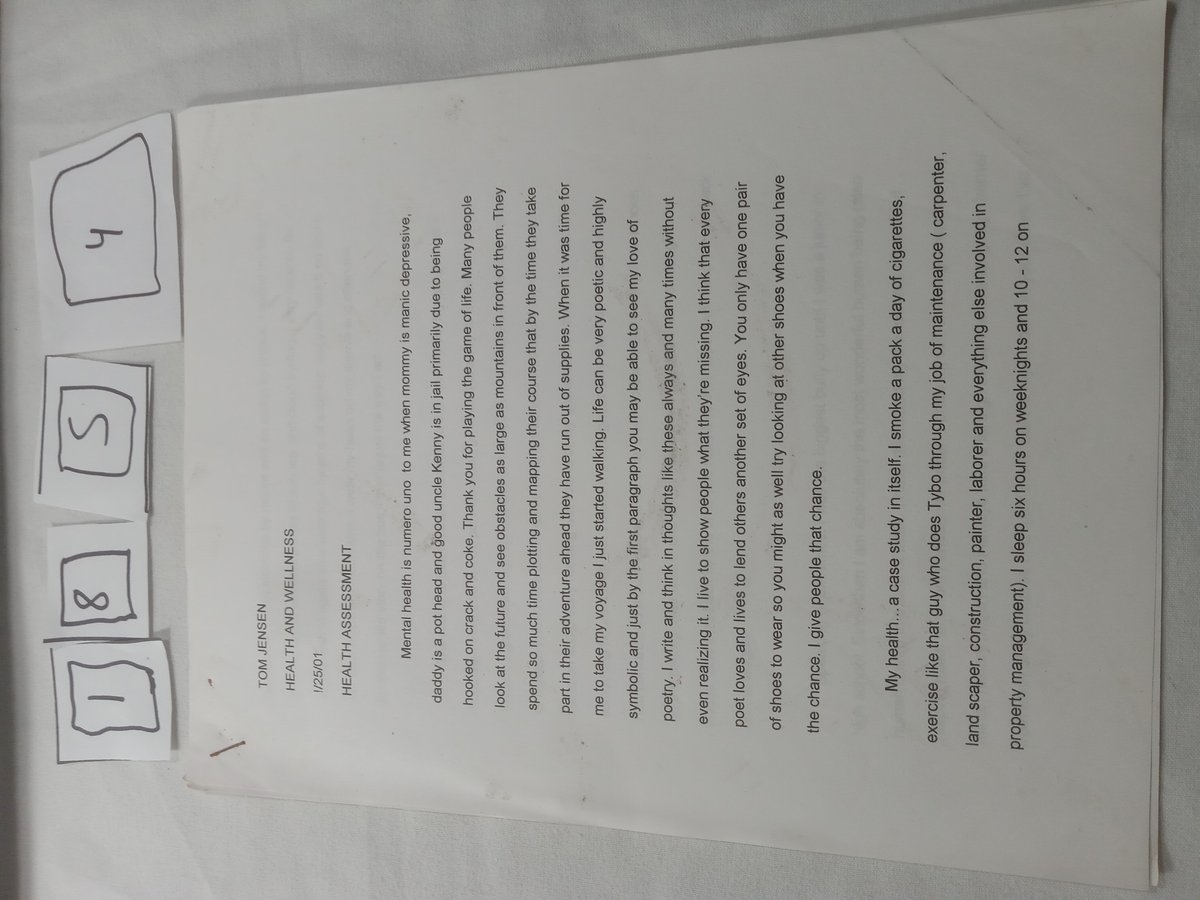
Picture 1 of 3
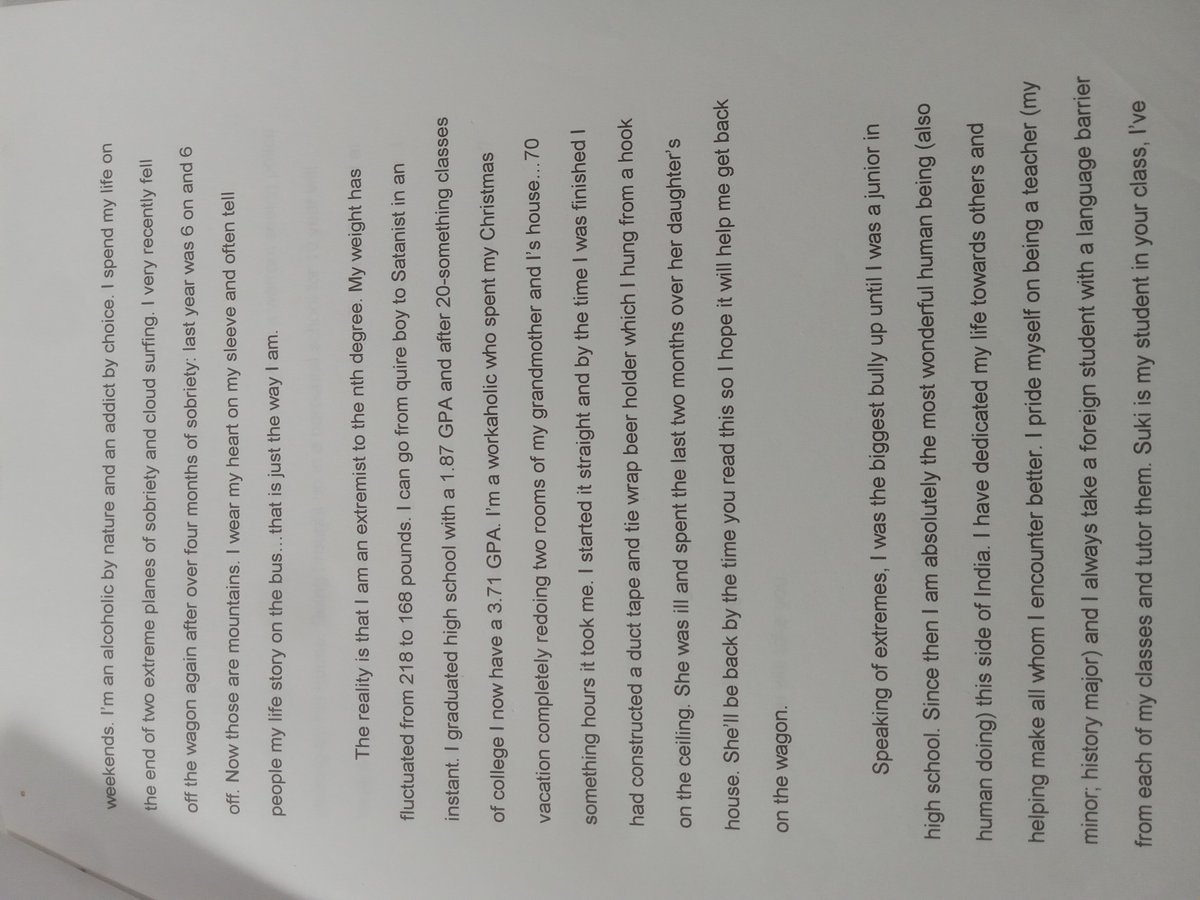
Picture 2 of 3
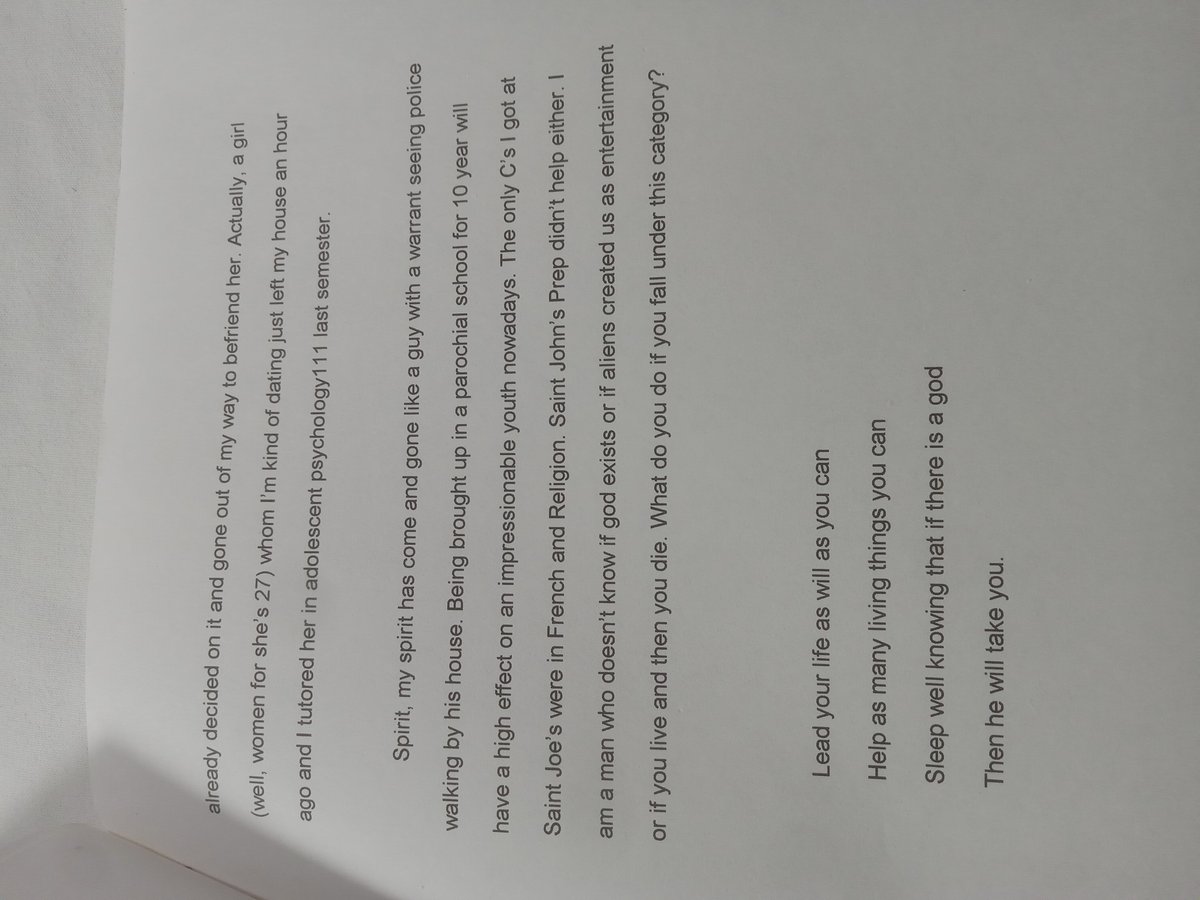
Picture 3 of 3
The words on this page
TOM JENSEN
HEALTH AND WELLNESS
1/25/01
HEALTH ASSESSMENT
Mental health is numero uno to me when mommy is manic depressive,
daddy is a pot head and good uncle Kenny is in jail primarily due to being
hooked on crack and coke. Thank you for playing the game of life. Many people
look at the future and see obstacles as large as mountains in front of them. They
spend so much time plotting and mapping their course that by the time they take
part in their adventure ahead they have run out of supplies. When it was time for
me to take my voyage I just started walking. Life can be very poetic and highly
symbolic and just by the first paragraph you may be able to see my love of
poetry. I write and think in thoughts like these always and many times without
even realizing it. I live to show people what they're missing. I think that every
poet loves and lives to lend others another set of eyes. You only have one pair
of shoes to wear so you might as well try looking at other shoes when you have
the chance. I give people that chance.
My health...a case study in itself. I smoke a pack a day of cigarettes,
exercise like that guy who does Tybo through my job of maintenance (carpenter,
land scaper, construction, painter, laborer and everything else involved in
property management). I sleep six hours on weeknights and 10 - 12 on
---
weekends. I'm an alcoholic by nature and an addict by choice. I spend my life on
the end of two extreme planes of sobriety and cloud surfing. I very recently fell
off the wagon again after over four months of sobriety: last year was 6 on and 6
off. Now those are mountains. I wear my heart on my sleeve and often tell
people my life story on the bus...that is just the way I am.
The reality is that I am an extremist to the nth degree. My weight has
fluctuated from 218 to 168 pounds. I can go from quire boy to Satanist in an
instant. I graduated high school with a 1.87 GPA and after 20-something classes
of college I now have a 3.71 GPA. I'm a workaholic who spent my Christmas
vacation completely redoing two rooms of my grandmother and I's house...70
something hours it took me. I started it straight and by the time I was finished I
had constructed a duct tape and tie wrap beer holder which I hung from a hook
on the ceiling. She was ill and spent the last two months over her daughter's
house. She'll be back by the time you read this so I hope it will help me get back
on the wagon.
Speaking of extremes, I was the biggest bully up until I was a junior in
high school. Since then I am absolutely the most wonderful human being (also
human doing) this side of India. I have dedicated my life towards others and
helping make all whom I encounter better. I pride myself on being a teacher (my
minor; history major) and I always take a foreign student with a language barrier
from each of my classes and tutor them. Suki is my student in your class, I've
---
already decided on it and gone out of my way to befriend her. Actually, a girl
(well, women for she's 27) whom I'm kind of dating just left my house an hour
ago and I tutored her in adolescent psychology111 last semester.
Spirit, my spirit has come and gone like a guy with a warrant seeing police
walking by his house. Being brought up in a parochial school for 10 year will
have a high effect on an impressionable youth nowadays. The only C's I got at
Saint Joe's were in French and Religion. Saint John's Prep didn't help either. I
am a man who doesn't know if god exists or if aliens created us as entertainment
or if you live and then you die. What do you do if you fall under this category?
Lead your life as will as you can
Help as many living things you can
Sleep well knowing that if there is a god
Then he will take you.
Item 1856
MARIJUANA ADDICTION
In one sentence: Tom's typed college research paper 'Marijuana Addiction', April 18, 2001, tracing the drug from ancient China to modern studies, with title page and references, from 2001.
Item type
WRITINGS · TOM JENSEN · COLLEGE ESSAY
UNPUBLISHED
Tom's typed college research paper MARIJUANA ADDICTION for his health class (April 18, 2001), tracing the drug from ancient China to modern addiction studies, with its title page and reference list.
- Why it matters
- Tom's typed college research paper MARIJUANA ADDICTION (April 18, 2001) for his health class - part of the run of papers on addiction he wrote while getting sober, the same struggle his recovery poems and songs come from.
- Type
- Printed page
- Collection
- College writings ; Writings (non-lyric) ; Addiction ; Health and Wellness class
- Published in
- PREVIOUSLY UNPUBLISHEDSearched against the 34 albums, every book and Poems By Tom - found in none of them
- Age when written
- made at age 22proved: the paper's date line reads April 18, 2001 - typed off its photo
- Same words
- also written out as number 1859matched on the words by machine - Tom confirms
- On the site
- Tom's Story: 2001
Price · Tier · Tom fills these
Picture 1 of 6
Picture 2 of 6
Picture 3 of 6
Picture 4 of 6
Picture 5 of 6
Picture 6 of 6
The words on this page
1.
MARIJUANA ADDICTION
Tom Jensen
Wealth and Hellness ☺
April 18, 2001
---
2
Marijuana has been used as an agent for achieving euphoria since
ancient times; it was described in a Chinese medical compendium traditionally
considered to date from 2737 B.C. This was documented by Chinese emperor
Shen Nung and the focus was on its powers as a medication for rheumatism,
gout, malaria, and oddly enough, absent-mindedness. Mention was made of the
intoxicating properties, but the medicinal values were considered more
important. Its use spread from China to India and then to North Africa and
reached Europe at least as early as 500 A.D. As time passed, the recreational
use of marijuana became much more predominant. (1)
In 1545 the Spanish brought marijuana to the New World. The English
introduced it to Jamestown in 1611 where it became a major commercial crop
alongside tobacco and was often ground and used as a source of fiber. By 1890,
hemp had been replaced by cotton as a major cash crop in the southern states.
Some patent medicines during this time contained marijuana, yet only a small
percentage as those which contained opium or cocaine. It wasn't until the 1920's
that marijuana really began to catch on. Some historians state the reason was
prohibition. Its recreational use was restricted to jazz musicians and people in
show biz. "Reefer songs" became the rage of the jazz world and marijuana clubs
sprang up in every major city. Marijuana establishments were tolerated by
authorities because marijuana was not illegal and patrons showed no evidence
of making a nuisance of themselves or disturbing the community.
---
3
Marijuana use as an intoxicant was also commonplace since the 1850's.
A campaign conducted in the 1930's by the Federal Bureau of Narcotics sought
to portray marijuana as a powerful, addictive substance that would lead users
into narcotics addiction. It is still considered a gateway drug by some authorities.
In the 1950's it was an accessory of the beat generation and of course we all
know what happened in the 1960's. The Controlled Substance Act of 1970
classified marijuana, along with heroin and LSD, as a Schedule I drug due to
having the relatively highest abuse potential and no accepted medical use.
Even though the "zero tolerance" climate of the Reagan and Bush
administrations resulted in the passage of strict laws and mandatory sentences
for marijuana possession, marijuana smoking has began another upward trend
since the 1990's, especially among teenagers.
HOW DOES MARIJUANA EFFECT THE BODY?
Some immediate effects of marijuana can include...
■ a faster heartbeat and pulse rate
■ bloodshot eyes
■ dry mouth and throat
HOW DOES MARIJUANA EFFECT YOUR MIND?
■ Studies of marijuana's mental effects show that the drug can impair or reduce
short-term memory
■ can alter sense of time
■ reduce ability to do things which require concentration, swift reactions and
coordination (such as driving a car or studying for Health and Wellness
class)
---
4
Laboratory studies have shown that animals exhibit symptoms of drug
withdrawal after cessation to prolonged marijuana exposure. Some human
studies have also demonstrated withdrawal symptoms such as irritability,
stomach pains, aggression, and anxiety after stopping using cannabis. George
Koob, an addiction researcher from the Scripps Research Institute on La Jolla,
California, claims the new message from animals is simple: "The more we
discover about the neurobiology of addiction the more common elements we're
seeing between THC (cannabis' active ingredient) and other drugs of abuse.
And for Koob, one of these newly discovered "common elements" is marijuana's
ability to trigger chemical changes in the brain that lead to strong withdrawal
symptoms. (2)
In humans, some researchers claim to see clear evidence of insomnia,
anxiety, and even flu-like symptoms in heavy cannabis users who abstain. But if
there is a consensus, it is that the symptoms are mild and variable. By contrast,
Koob's rats are shivering wrecks. Does this mean that marijuana is more
addictive than we think? Another debate rages over animal studies into the
short-term effects of marijuana on brain chemistry. Heroin, cocaine, alcohol and
nicotine all trigger a surge in the chemical dopamine in a small midbrain
structure called the nucleus accumbens. Many researchers regard this as a
hallmark of an addictive substance. Last year, experiments showed that
cannabis presses the same dopamine button in rats, leading to claims that the
---
5
drug must be more addictive than previously thought. To critics, it is just another
example of those old exaggerated fears.
What nobody tells you, says John Morgan, a pharmacologist at City
University of New York Medical School, is that rats don't like cannabis. It is easy
for them to get hooked on heroine or cocaine - but not marijuana. Nor, Morgan
claims, are researchers exactly open about awkward observations, such as the
fact that there are plenty of non-addictive drugs that stimulate dopamine in
the brain. It is easy to understand why biologists want to find simple chemical
traits that are shared by all addictive drugs. Unfortunately, the differences are as
important as the similarities when it comes to weighing the relative risks and
pleasures involved in using drugs. And subjectively, at least, the intense rush of
cocaine and orgasm-like high of heroin have little in common with marijuana's
subtler effects. Amid all of the research that has been studied, the obvious fact is
that marijuana use is still safer than heroin, cocaine and alcohol abuse. In the
giant Totem Pole of narcotics, marijuana is still the closest to the ground. (3)
---
6
REFERENCE
(1) THE NEW SCIENTIST February 21, 1998 page 24-27
(2) ADDICTION LETTER August 1995, Volume 11 Issue 8 page 1-2
(3) THE NEW SCIENTIST October 28, 200 pages 15-18
Item 1858
WELLNESS
In one sentence: Tom's typed health class essay 'Wellness', June 12, 2001, carrying the verse 'Cannot fix the flaw - only patch the hole', also in his song 'Patching The Hole', from 2001.
Item type
WRITINGS · TOM JENSEN · COLLEGE ESSAY
PUBLISHED
Tom's typed health class essay WELLNESS (June 12, 2001), stamped Scanned, which carries the verse Cannot fix the flaw - only patch the hole, a verse that is also in his song PATCHING THE HOLE (set list 18, track 8).
- Why it matters
- Tom's health class essay WELLNESS (June 12, 2001) carrying the verse Cannot fix the flaw - only patch the hole, a verse that is also in his song PATCHING THE HOLE (set list 18, track 8 of the 34 albums).
- Type
- Printed page
- Collection
- 34 Albums: Set list 18, track 8 - Patching The Hole ; Poems By Tom (2007) (verse only) ; A Lifetime Of Rhyme (2020) (verse only) ; College writings ; Recovery ; Inspiring
- Published in
- IN 34 ALBUMSset list 18 · track 8 · as the song PATCHING THE HOLE (the essay's verse is in the song)
IN A BOOKPoems By Tom (2007) (verse only, in the poem PATCHING THE HOLE)
Tom's Anthology, September 18, 2011 (verse only, in the poem PATCHING THE HOLE)
Tom's Anthology, July 25, 2012 (verse only, in the poem PATCHING THE HOLE)
Tom Jensen Poem Anthology (2013) (verse only, in the poem PATCHING THE HOLE)
Brian Rainstorm: Poetry Not Dead (2014) (verse only, in the poem PATCHING THE HOLE)
A Lifetime Of Rhyme (2020) (verse only, in the poem PATCHING THE HOLE)
The November 2024 Collection (2024) (verse only, in the poem PATCHING THE HOLE)
Revised 31 Albums With Index (2024) (verse only, in the poem PATCHING THE HOLE)
34 Albums, Books 1 and 2 (2026) - Age when written
- written at age 22dated at the sheet - the title page of the essay prints June 12, 2001
- Same words
- also written out as number 1874matched on the words by machine - Tom confirms
- On the site
- Set List 18 (track 8) · Set List 18: Corrugation Row, all-in-one page · Tom's Story: 2001
Price · Tier · Tom fills these
Picture 1 of 4
Picture 2 of 4
Picture 3 of 4
Picture 4 of 4
The words on this page
Scan
WELLNESS
Tom Jensen
Health and Wellness
June 12, 2001
---
What is wellness? That is certainly a good question to start with when one is trying to decide how well one's well is. I would consider wellness the successful achievement of one limiting one's negative characteristics and traits. By limiting the negative in one's collective body and soul the effect, therefore, is accenting the positive. Addition by subtraction if you will. So, since coming to the very real acceptance of who I am and what I do I am able to make a judgment over how well is my wellness. What flaws have been noticed, studied, and fixed? What traits have I stepped back from my eyes and observed from another frame of reference? How have I felt about my relationships with friends and family? What have I yet to achieve on the Totem Pole of life, how far have I climbed? All things of this nature make for interesting talk and type but the main element one has to remember is that all of these subjects are subjective to the observer. Anyone may relate oneself to others in an attempt to compare actions and sometimes even justify an unjust act. One's immediate circle acts as the shell in which the egg is kept. On one hand, the shell can protect the egg from predators, harm and frying pans but the shell also succeeds in limiting how far the egg can expand and thereby cut off the egg from the far away chicken of happiness. I am the egg man, sorry Mr. Lennon.
But, as the more I learn the more I see how correct my poetry can be. It seems society has reached the point where it can no longer envision evil and therefore attempt to prevent evil from happening in the first place. It is only after
---
the original act has been done that the necessary corrections are deemed
worthy.
Cannot fix the flaw - only patch the hole
The potential of diamonds results in coal
Able to race the race though blind to the goal
Only glimpses and pieces never the whole
I am living the paradox which is the same as society. I am able to see the goal
ahead of me. I am well aware of my major flaws and I certainly do hold the
potential for greatness and diamonds. That is the good part. The problem lies in
the fact that I am aware of the flaw but I choose to only patch the hole. Never
giant changes, only small subtleties which meagerly reshape my path towards
the future. The dark side of the diamond shows his grim face. In life, knowledge
is the ultimate power but how should one feel if he is the knower yet not the
doer? So many ignorant fools would die to think just one great thought. Why take
it for granted when one has so much to share in so little time? This is the
dilemma of the people caught in the trap.
My wellness is as it finds me, finds me as I have been, in the same
structure, same form. Faces change just as does the weather. My feet are
always moving but it's not always up. A life which was created and I now call my
own. A time when the only time one can truly take the time to gather one's inner
---
thoughts is a time when is only an afterthought. A busy productive day only ends in an even busier unproductive night. Voices have warned me and wisdom has guided these voices. The face has a name and the deed is a game. Just as the earth spins so does a day as patterns emerge and it takes more to wash away a sand castle than just a single wave. Or so the saying goes...
Item 1859
MARIJUANA ADDICTION
In one sentence: Tom's typed five-page college research paper 'Marijuana Addiction', April 18, 2001, on the history and effects of the drug, part of his health class work, from 2001.
Item type
WRITINGS · TOM JENSEN · COLLEGE ESSAY
UNPUBLISHED
Tom's typed college research paper MARIJUANA ADDICTION (April 18, 2001), five printed pages on the history and effects of the drug.
- Why it matters
- Tom's typed college research paper MARIJUANA ADDICTION (April 18, 2001) - part of the run of papers on addiction he wrote while getting sober, the same struggle his recovery poems and songs come from.
- Type
- Printed page
- Collection
- College writings ; Writings (non-lyric) ; Addiction ; Health and Wellness class
- Published in
- PREVIOUSLY UNPUBLISHEDSearched against the 34 albums, every book and Poems By Tom - found in none of them
- Age when written
- made at age 22proved: the paper's date line reads April 18, 2001 - typed off its photo
- Same words
- also written out as number 1856matched on the words by machine - Tom confirms
- On the site
- Tom's Story: 2001
Price · Tier · Tom fills these
Picture 1 of 5
Picture 2 of 5
Picture 3 of 5
Picture 4 of 5
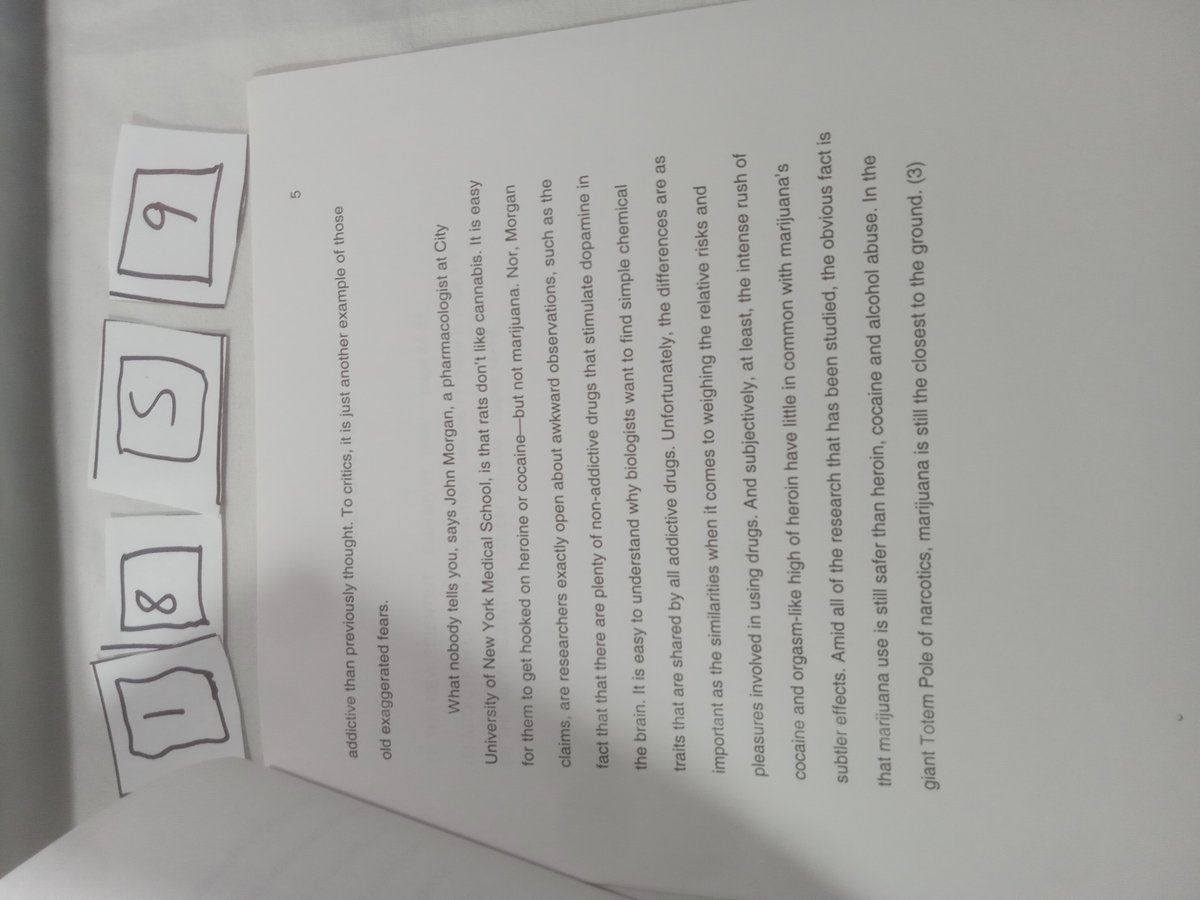
Picture 5 of 5
The words on this page
MARIJUANA ADDICTION
Tom Jensen
Wealth and Hellness ☺
April 18, 2001
---
2
Marijuana has been used as an agent for achieving euphoria since
ancient times; it was described in a Chinese medical compendium traditionally
considered to date from 2737 B.C. This was documented by Chinese emperor
Shen Nung and the focus was on its powers as a medication for rheumatism,
gout, malaria, and oddly enough, absent-mindedness. Mention was made of the
intoxicating properties, but the medicinal values were considered more
important. Its use spread from China to India and then to North Africa and
reached Europe at least as early as 500 A.D. As time passed, the recreational
use of marijuana became much more predominant. (1)
In 1545 the Spanish brought marijuana to the New World. The English
introduced it to Jamestown in 1611 where it became a major commercial crop
alongside tobacco and was often ground and used as a source of fiber. By 1890,
hemp had been replaced by cotton as a major cash crop in the southern states.
Some patent medicines during this time contained marijuana, yet only a small
percentage as those which contained opium or cocaine. It wasn't until the 1920's
that marijuana really began to catch on. Some historians state the reason was
that recreational use was restricted to jazz musicians and people in
prohibition. Its "Reefer songs" became the rage of the jazz world and marijuana clubs
sprang up in every major city. Marijuana establishments were tolerated by
authorities because marijuana was not illegal and patrons showed no evidence
of making a nuisance of themselves or disturbing the community.
---
3
Marijuana use as an intoxicant was also commonplace since the 1850's.
A campaign conducted in the 1930's by the Federal Bureau of Narcotics sought
to portray marijuana as a powerful, addictive substance that would lead users
into narcotics addiction. It is still considered a gateway drug by some authorities.
In the 1950's it was an accessory of the beat generation and of course we all
know what happened in the 1960's. The Controlled Substance Act of 1970
classified marijuana, along with heroin and LSD, as a Schedule I drug due to
having the relatively highest abuse potential and no accepted medical use.
Even though the "zero tolerance" climate of the Reagan and Bush
administrations resulted in the passage of strict laws and mandatory sentences
for marijuana possession, marijuana smoking has began another upward trend
since the 1990's, especially among teenagers.
HOW DOES MARIJUANA EFFECT THE BODY?
Some immediate effects of marijuana can include...
■ a faster heartbeat and pulse rate
■ bloodshot eyes
■ dry mouth and throat
HOW DOES MARIJUANA EFFECT YOUR MIND?
Studies of marijuana's mental effects show that the drug can impair or reduce
short-term memory
■ can alter sense of time
■ reduce ability to do things which require concentration, swift reactions and
coordination (such as driving a car or studying for Health and Wellness class)
---
4
Laboratory studies have shown that animals exhibit symptoms of drug
withdrawal after cessation to prolonged marijuana exposure. Some human
studies have also demonstrated withdrawal symptoms such as irritability,
stomach pains, aggression, and anxiety after stopping using cannabis. George
Koob, an addiction researcher from the Scripps Research Institute on La Jolla,
California, claims the new message from animals is simple: "The more we
discover about the neurobiology of addiction the more common elements we're
seeing between THC (cannabis' active ingredient) and other drugs of abuse. And
for Koob, one of these newly discovered "common elements" is marijuana's
ability to trigger chemical changes in the brain that lead to strong withdrawal
symptoms. (2)
In humans, some researchers claim to see clear evidence of insomnia,
anxiety, and even flu-like symptoms in heavy cannabis users who abstain. But if
there is a consensus, it is that the symptoms are mild and variable. By contrast,
Koob's rats are shivering wrecks. Does this mean that marijuana is more
addictive than we think? Another debate rages over animal studies into the short-
term effects of marijuana on brain chemistry. Heroin, cocaine, alcohol and
nicotine all trigger a surge in the chemical dopamine in a small midbrain structure
called the nucleus accumbens. Many researchers regard this as a hallmark of an
addictive substance. Last year, experiments showed that cannabis presses the
same dopamine button in rats, leading to claims that the drug must be more
---
addictive than previously thought. To critics, it is just another example of those
old exaggerated fears.
What nobody tells you, says John Morgan, a pharmacologist at City
University of New York Medical School, is that rats don't like cannabis. It is easy
for them to get hooked on heroine or cocaine - but not marijuana. Nor, Morgan
claims, are researchers exactly open about awkward observations, such as the
fact that there are plenty of non-addictive drugs that stimulate dopamine in
the brain. It is easy to understand why biologists want to find simple chemical
traits that are shared by all addictive drugs. Unfortunately, the differences are as
important as the similarities when it comes to weighing the relative risks and
pleasures involved in using drugs. And subjectively, at least, the intense rush of
cocaine and orgasm-like high of heroin have little in common with marijuana's
subtler effects. Amid all of the research that has been studied, the obvious fact is
that marijuana use is still safer than heroin, cocaine and alcohol abuse. In the
giant Totem Pole of narcotics, marijuana is still the closest to the ground. (3)
5
Item 1861
WELLNESS PLANNING
In one sentence: The opening page of Tom's typed 'Wellness Planning' paper, February 9, 2001, where he writes he never thought he would work on his recovery for college credit, from 2001.
Item type
WRITINGS · TOM JENSEN · COLLEGE ESSAY
UNPUBLISHED
The opening page of Tom's typed WELLNESS PLANNING paper (February 9, 2001), where he writes that he never thought he would work on his recovery for college credit.
- Why it matters
- The opening page of Tom's WELLNESS PLANNING paper (February 9, 2001), where he writes he never thought he would work on his recovery for college credit - the paper that carries his recovery lyrics (see 1857 and 1860).
- Type
- Printed page
- Collection
- College writings ; Writings (non-lyric) ; Addiction ; Recovery
- Published in
- PREVIOUSLY UNPUBLISHEDSearched against the 34 albums, every book and Poems By Tom - found in none of them
- Age when written
- made at age 22proved: the paper's date line reads Feb 9, 2001 - typed off its photo
- On the site
- Tom's Story: 2001
Price · Tier · Tom fills these
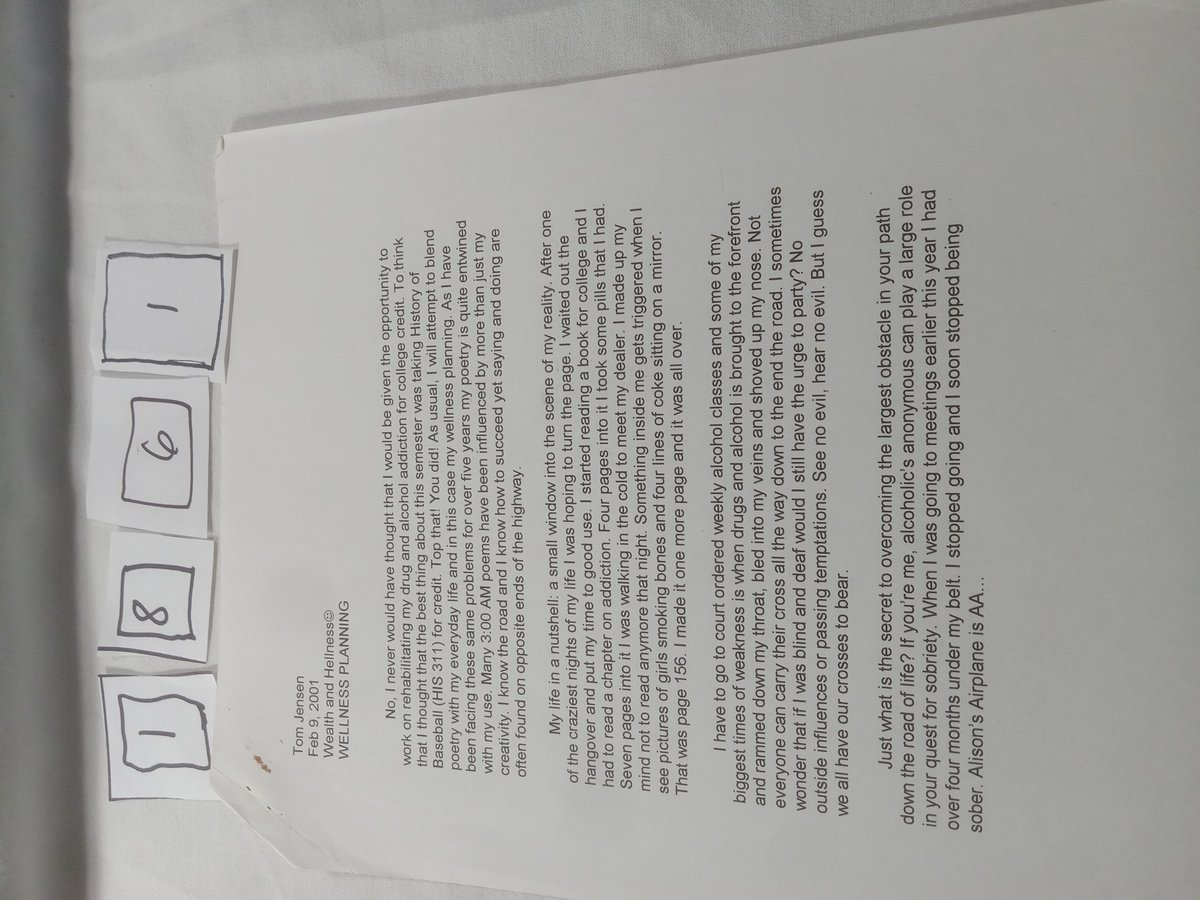
The only picture of this piece
The words on this page
Tom Jensen
Feb 9, 2001
Wealth and Hellness☺
WELLNESS PLANNING
No, I never would have thought that I would be given the opportunity to work on rehabilitating my drug and alcohol addiction for college credit. To think that I thought that the best thing about this semester was taking History of Baseball (HIS 311) for credit. Top that! You did! As usual, I will attempt to blend poetry with my everyday life and in this case my wellness planning. As I have been facing these same problems for over five years my poetry is quite entwined with my use. Many 3:00 AM poems have been influenced by more than just my creativity. I know the road and I know how to succeed yet saying and doing are often found on opposite ends of the highway.
My life in a nutshell: a small window into the scene of my reality. After one of the craziest nights of my life I was hoping to turn the page. I waited out the hangover and put my time to good use. I started reading a book for college and I had to read a chapter on addiction. Four pages into it I took some pills that I had. Seven pages into it I was walking in the cold to meet my dealer. I made up my mind not to read anymore that night. Something inside me gets triggered when I see pictures of girls smoking bones and four lines of coke sitting on a mirror. That was page 156. I made it one more page and it was all over.
I have to go to court ordered weekly alcohol classes and some of my biggest times of weakness is when drugs and alcohol is brought to the forefront and rammed down my throat, bled into my veins and shoved up my nose. Not everyone can carry their cross all the way down to the end the road. I sometimes wonder that if I was blind and deaf would I still have the urge to party? No outside influences or passing temptations. See no evil, hear no evil. But I guess we all have our crosses to bear.
Just what is the secret to overcoming the largest obstacle in your path down the road of life? If you're me, alcoholic's anonymous can play a large role in your quest for sobriety. When I was going to meetings earlier this year I had over four months under my belt. I stopped going and I soon stopped being sober. Alison's Airplane is AA...
Item 1863
COPING
In one sentence: Tom's typed six-page Health and Wellness paper 'Coping', June 10, 2001, on how people handle stress, from defence mechanisms to the music that changes his mood, from 2001.
Item type
WRITINGS · TOM JENSEN · COLLEGE ESSAY
UNPUBLISHED
Tom's typed Health and Wellness paper COPING (June 10, 2001) on how people handle stress, from defence mechanisms to the music that changes his mood, six pages.
- Why it matters
- Tom's Health and Wellness paper COPING (June 10, 2001) on handling stress, including the music recordings that change his mood - the songwriter on what music does for him.
- Type
- Printed page
- Collection
- College writings ; Writings (non-lyric) ; Recovery ; Songwriting and music influences
- Published in
- PREVIOUSLY UNPUBLISHEDSearched against the 34 albums, every book and Poems By Tom - found in none of them
- Age when written
- made at age 22proved: the paper's date line reads June 10, 2001 - typed off its photo
- On the site
- Tom's Story: 2001
Price · Tier · Tom fills these
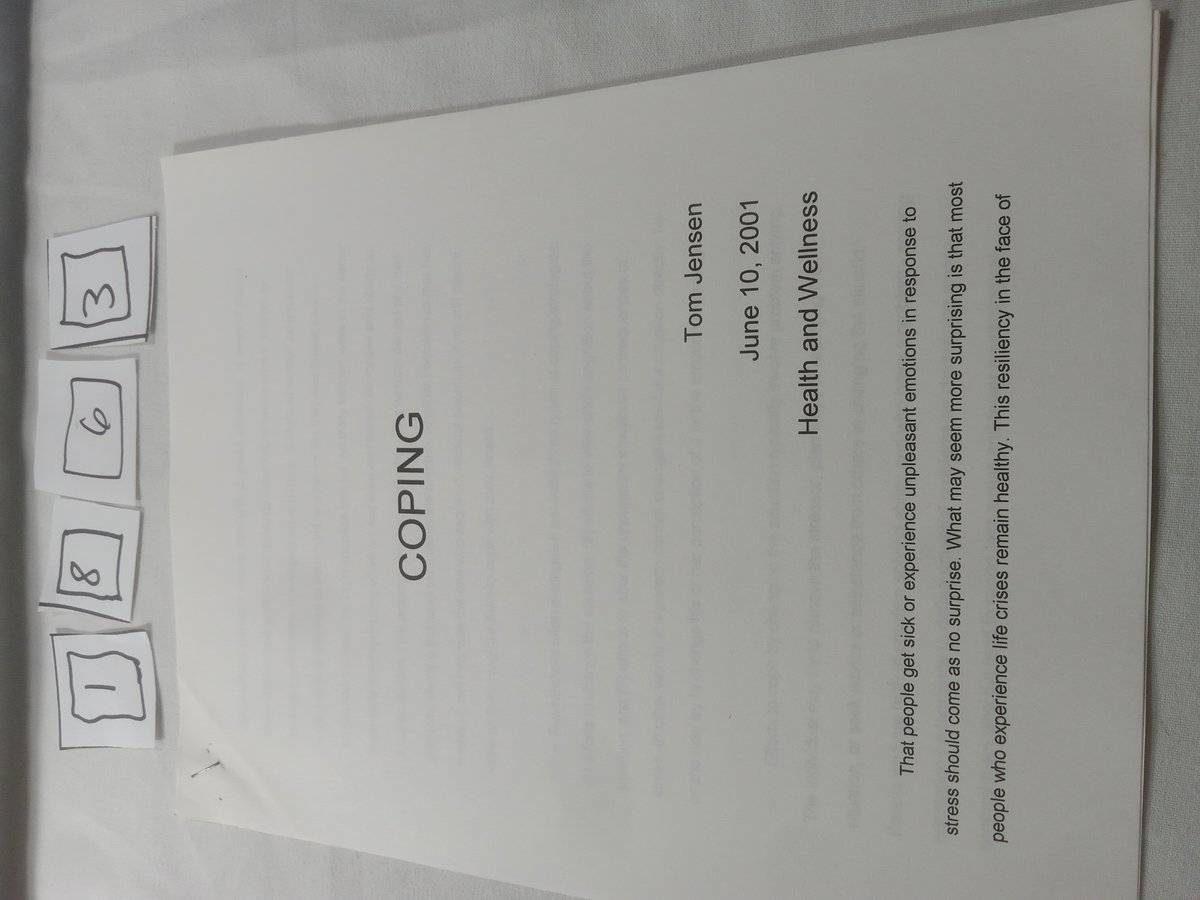
Picture 1 of 6
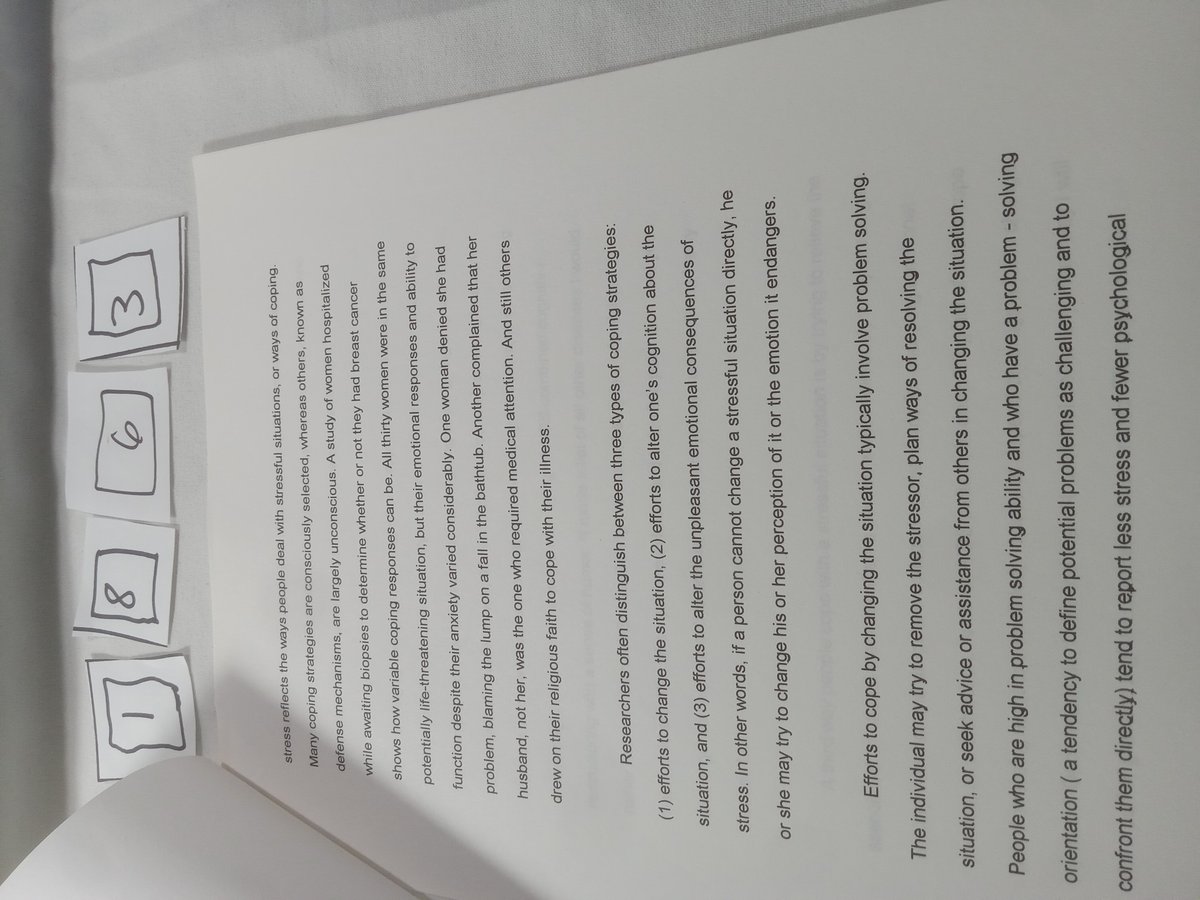
Picture 2 of 6
Picture 3 of 6
Picture 4 of 6
Picture 5 of 6
Picture 6 of 6
The words on this page
COPING
Tom Jensen
June 10, 2001
Health and Wellness
That people get sick or experience unpleasant emotions in response to stress should come as no surprise. What may seem more surprising is that most people who experience life crises remain healthy. This resiliency in the face of
---
stress reflects the ways people deal with stressful situations, or ways of coping.
Many coping strategies are consciously selected, whereas others, known as
defense mechanisms, are largely unconscious. A study of women hospitalized
while awaiting biopsies to determine whether or not they had breast cancer
shows how variable coping responses can be. All thirty women were in the same
potentially life-threatening situation, but their emotional responses and ability to
function despite their anxiety varied considerably. One woman denied she had
problem, blaming the lump on a fall in the bathtub. Another complained that her
husband, not her, was the one who required medical attention. And still others
drew on their religious faith to cope with their illness.
Researchers often distinguish between three types of coping strategies:
(1) efforts to change the situation, (2) efforts to alter one's cognition about the
situation, and (3) efforts to alter the unpleasant emotional consequences of
stress. In other words, if a person cannot change a stressful situation directly, he
or she may try to change his or her perception of it or the emotion it endangers.
Efforts to cope by changing the situation typically involve problem solving.
The individual may try to remove the stressor, plan ways of resolving the
situation, or seek advice or assistance from others in changing the situation.
People who are high in problem solving ability and who have a problem - solving
orientation ( a tendency to define potential problems as challenging and to
confront them directly) tend to report less stress and fewer psychological
---
symptoms than other subjects. Individuals with a problem-focused orientation
tend to endorse questionnaire statements such as, "I am the kind of person who
takes action rather than just thinks or complains about a situation.
Coping by changing one's cognition or appraisal of the situation often
involves reframing an event mentally in order to make it seem less threatening.
For example, a person who is anxious about giving a speech may
say to himself, "Come on now, this is ridiculous. You are just talking to a bunch
of people who are interested in what you have to say." An example of reframing
a more tragic situation is the way a man dying of AIDS combined cognitive
restructuring with a sense of humor: "I made a list of all other diseases I would
rather not have than AIDS: Lou Gehrig's disease, being in a wheelchair,
rheumatoid arthritis, when you are in knots and in terrible pain. So I said you
have to get some perspective on this, and where you are on the Great Nasty
Disease List."
A third way people cope with a stressful situation is by trying to relieve the
associated emotional state, as when a person smiles nervously to try to relegate
anxiety. Alcohol and drugs are common mechanisms for escaping emotional
distress, as a distraction. Another AIDS patient, in describing his efforts to cope
with distressing emotions confided, "I used to depend on drugs a lot to change
my mood. Once in awhile, I still find that if I can't feel better any other way I will
take a puff of grass or a glass of wine, or I use music. There are certain
---
recordings that can really change my mood drastically. I play it loud and I dance
around and try to clear my head."
Although many of the coping strategies described above are conscious or
could be readily be made conscious if attention were called to them, other
coping strategies, known as defense mechanisms, are unconscious and involve
greater self-deception. Defense mechanisms are unconscious mental processes
aimed at protecting the person from experiencing unpleasant emotions or
bolstering positive affect. The most widely used defense mechanism is
repression, an unconscious mechanism that keeps thoughts or memories that
would be to threatening to acknowledge from awareness. A similar mechanism is
denial, in which the person refuses to acknowledge external realities (such as
having cancer) or emotions (such as anxiety), rather than thoughts. Denial is at
work when someone notices a skin blemish but concludes it's nothing. Much of
the time it is nothing, but this defense can lead to a lack of treatment or death.
In projection, a person attributes his own unacknowledged feelings or
impulses to others. The hard driving businessman who thinks his competitors,
suppliers and customers are always trying to cheat him may be in fact the one
with questionable ethics. To recognize his own greed and selfishness would
conflict with his conscious, so he sees these traits in others. In reaction
formation, the person turns unacceptable impulses or feelings into their
opposites. For example, at the same time televangelist Jimmy Swaggert was
---
preaching the evils of sex to millions, he was regularly seeing a prostitute. His conscious repulsion towards sexuality, and particularly illicit sexuality, apparently masked a tremendous need for it.
Sublimation involves converting sexual or aggressive impulses into socially acceptable activities. A young boy may turn his feelings of competition with his father or brother into a desire to excel in competitive sports or achieve a successful business when he gets older. Rationalization means explaining away actions in a seemingly logical way to avoid uncomfortable feelings, especially guilt or shame. A student who plagiarizes her term paper and justifies her actions by saying passing the course will help her public policy degree and serve the community is using rationalization to justify her dishonesty. Passive aggression is the indirect expression of anger towards others. One administrator frustrated everyone around her by 'sitting on' important documents which required a fast turnaround. To be actively aggressive would run afoul of her moral standards and potentially lead to a reprimand from her boss, so she accomplished the same goal - frustrating coworkers and thus satisfying her aggressive impulses - in a way that allowed her to disavow any intention or responsibility.
Just as people tailor their problem-solving efforts to specific situations, so too do people typically use defense mechanisms flexibly and creatively. Using defenses is neither abnormal nor unhealthy. In actuality, some degree of
---
defensive distortion can be useful to the human psyche. Defenses become dysfunctional when they inhibit adaptive functioning rather than foster it.
Item 1878
Like Leonardo Da Vinci and Benjamin Franklin
In one sentence: A typed draft of Tom's college history paper on Thomas Jefferson, opening 'Like Leonardo Da Vinci and Benjamin Franklin', with pencil notes on the Boston Massacre, about 1999-2004.
Item type
WRITINGS · TOM JENSEN · COLLEGE ESSAY
UNPUBLISHED
A typed draft of Tom's college history paper on Thomas Jefferson, opening Like Leonardo Da Vinci and Benjamin Franklin, with his pencil note on the Boston Massacre and typed reminders (cut deficit & legacy, louisiana purchase, virgina plan).
- Why it matters
- A typed draft of Tom's college history paper on Thomas Jefferson, with his pencil study notes - the history-major side of the poet; the finished paper is JEFFERSONIAN AMERICA (1883).
- Type
- Printed page
- Collection
- College writings ; Writings (non-lyric) ; History
- Published in
- PREVIOUSLY UNPUBLISHEDSearched against the 34 albums, every book and Poems By Tom - found in none of them
- Same words
- also written out as number 1883matched on the words by machine - Tom confirms
- Age when written
- about 1999-2004 (age 20 to 26)best guess - not yet proved: dated from this piece's own photos and words and the dated books
- On the site
- Tom's Story: 2001
Price · Tier · Tom fills these
Picture 1 of 5
Picture 2 of 5

Picture 3 of 5
Picture 4 of 5
Picture 5 of 5
The words on this page
Like Leonardo Da Vinci and Benjamin Franklin, [Jefferson] he was amazingly many-sided, in a fashion which an age of specialization has outmoded. He was the greatest American architect of his time; a follower in the footsteps of great Italian archatectural stylist, Palladio. He was a diplomat, statesman, writer, social revolutionalist, scientist, musician, paleontologist, inventor, cartographer, educator, collector and farmer. It was impossible for him to look at a thing without wanting to improve it, to make it more convenient, to increase the variety of uses to which it could be put. If nothing had been invented up to that time to serve his purpose, he drew plans and supervised craftsmen while they made the contrivances he wanted.
■ an excerpt from an April 13, 1946, Post article written by Pete Martin
In fact, when John F. Kennedy was president and entertaining a group of 49 Nobel Prize winners, he told the guests, "I think this is the most extraordinary collection of talent and human knowoledge that has ever gather at the Whitehouse, with possible expection of when Thomas Jefferson dined alone."
Thomas Jefferson's dedication to whatever task was at hand was as remarkable as any man both before and after his time. Before taking the presidency in 1800, Jefferson spent his fifty seven years performing a variety of roles. Jefferson was the minister to France, the 1st secretary of State and second Vice President under John Adams. He was constantly in the center of things during America's formitive years. He penned the Declaration of Independence stating that all men are created equal as well as helping to add the bill of rights to the constitution.
---
Pre-Jeffersonian America was a time of tremendous growth and constant
change. America was developing a government which would lead them towards
being super power. Americans felt a greater sense of their history as Cultural
Nationalism was taking over. Trade was continually becoming more and more
profitable and widespread and the technology was beginning to pave the way
toward industrialism. Indeed, Americans were quickly seeing the benefits of
Independence.
As America was developing, there were many ideas on how to establish this
young country. The debate began to grow very fierce during the Presidential
election of 1800. Candidates began to split into two parties- the Federalists, led
by present President John Adams and the Democrat-Republicans, led by
Jefferson and Aaron Burr. Federalists were generally supporters of a strong
central government, which America severely lacked shortly after it's
independence, Federalists established a complex and diversified economy -
HAMILTON, and an increasing dependence on other countries to supply a
substantial amount of wealth. Democrat-Republicans supported stronger rights
by the states, a more agregarian and less dependent economy, and a limit on
the power of the central government.
---
In 1800, Thomas Jefferson became President of the United States after a
complicated election. Jefferson faced considerable odds in implementing his
plan for the future of America. The heavy increase in population and therefor,
technology, all but made Jefferson's dream of an independent, self supportiing
and agragaran lifestyle impossible. And even though, American religion began,
as the Jeffersonians had hoped, the rapid spread of Enlightenment Rationalism
and a great wave of revivalism ultimately brought about a new rational
philiosophy which drastically questioned Jefferson's ideals. During Jefferson's
presidency, the populous was constantly questioning everything, seeking
change, expansion and improvements in every aspect of life. Hardly ideal
conditions for a self-reliant agragain nation.
[Jefferson's] allegience to the principals of liberty did not lead him to blind
sentimentality or to anything like anarchism. He firmly believed that every
societyhad the right to lay down the principals upon which it would operate, and
to exclude from its midst anyone who acted contrary to them. He believed that
agriculture was a noble and liberating occupation, and that speculation, banking,
and the property laws of England led to oppression, poverty, and misery that he
saw there. He saw little in Europe that he wanted Americans to emulate, except
perhaps some aspects of social etiquette. The poorest farmer in America, he
said, is two centuries ahead of most Europeans in the things that really count in
life-virtue, freedom, hapiness, and scientific knowledge, as opposed to what he
called econmic "profusion".
3
louisiana purchase
virgina plan
---
cut deficit
& legacy
---
The Boston Massacre 1770
conflict between Brirish troops
and Boston labores labores
Labores
Item 1880
Philosophy plays a major role in anyone's life
In one sentence: Tom's typed five-page college essay on his philosophy of teaching, arguing that a teacher is a mediator between students and ideas, about 1999-2004.
Item type
WRITINGS · TOM JENSEN · COLLEGE ESSAY
UNPUBLISHED
Tom's typed college essay on his philosophy of teaching - that a teacher is a mediator between students and ideas - five pages.
- Why it matters
- Tom's typed college essay on his philosophy of teaching - a teacher as a mediator between students and ideas - the writer's own beliefs, set down in prose.
- Type
- Printed page
- Collection
- College writings ; Writings (non-lyric) ; Philosophy ; Teaching
- Published in
- PREVIOUSLY UNPUBLISHEDSearched against the 34 albums, every book and Poems By Tom - found in none of them
- Age when written
- about 1999-2004 (age 20 to 26)best guess - not yet proved: dated from this piece's own photos and words and the dated books
- On the site
- Tom's Story: 2001
Price · Tier · Tom fills these
Picture 1 of 5
Picture 2 of 5
Picture 3 of 5
Picture 4 of 5
Picture 5 of 5
The words on this page
Tom Jensen
Philosophy plays a major role in anyone's life and especially on the life of a teacher who is not only responsible for themselves but many other fragile young minds. Philosophy helps us use our intellectual skills along with our intellectual tools. Being a student of different philosophies provides alternative ways of thinking about the same problem. Philosophy dictates responses and actions which invariable dictates our lives. So when choosing a teaching philosophy you must usually do what we all must do in life...compromise. All or nothing will usually result in nothing. Philosophy is a map which helps us to see what we say and say what we see. Philosophic questioning does not guarantee that we will become wise it only provides direction in searching for wisdom.
No philosophical idea is more crucial to education than axiology. As everyone has their own ideas of what is important in life it is this axiology which sets the building blocks of education. Before you can try to get someone to learn they must know why it is important to do so. What is of value? I think that my first day of teaching will include a tangent, rant and rave on the declaration that "Knowledge is Power." It is on this premise that children will feel compelled to actively engage the material. Most of the time, fighting with words is more effective than fists.
In some ways, I definitely take on an idealist perspective. We are all thinking beings who are capable of seeking Truth through reasoning. I would definitely direct our thinking towards universal concepts opposed to mundane activities of living. We are all searching to raise the bar as a race and this can only be reached if we are all aware of worldly life as opposed to only our little brick school building. When children learn of widespread poverty, such as Africa or the Sudan, then they may look at all the "bad" in their world a little differently. I firmly believe in dialogue as the primary form of education. The teacher is
---
nothing more than a mediator between students and ideas and information. Ideas can change lives and it is my duty to relate these ideas and let the student make their own conclusions.
A large part of my philosophy in the classroom will include many
Existential beliefs. Experience, reality and purpose are pivotal within the lived
experience of both a student and a person. As can be seen throughout history,
to many, life has no meaning except what we ourselves give to our lives. It is up
to the student to discover the meaning of his own life. I can portray why I chose
my path and why I do what I do and hopefully the students can use their own
guide, or philosophy, to walk down their own road. From Hitler to MLK, from
Jackie Robinson to Mrs. Robinson - we all discover the meaning of life. I have
learned greatly the results of free choices I have made and contrastingly have
taken personal accountability. History has taught us throughout time that many
of the agreed upon laws and practices are wrong. Slavery was the product of
ignorance. I would pose the question of whether or not there is anything in life
worth dying for to change or make better. Many men have died in wars while
believing they were fighting for a just cause. The first step of education is
uncovering yourself, your beliefs and discovering what is inside your soul. These
values are individual decisions and are selected. We all enter this world without
meaning and it is up to us to give our life a meaning. My goal as a teacher is to
help students explore this world and try to help the students decide by
themselves where they fit in and what to do with their world. My teaching will
attempt to look at contrasts in order to realize that two things can both be good
and also be different. Individuality is a positive and not a negative.
Bordering on this idea is the value of Confucianism. I believe that
Confucius was correct when he expected his students to revolutionize any
government in which they might participate and to force the government to serve
the needs of its people. People can not be free if they follow somebody else's
---
beliefs. I would tell my students that they are the future of the world and that it is
up to them to look at the world and see where it needs to be fixed. Question
everything.
African-American educational philosophy, much like Cultural Inclusivity, is
very important to teaching in a multicultural classroom. Education is the key that
can unlock both knowledge and power. It is a struggle to free the mind. I am a
firm believer that we become who we are through the struggles we face and the
obstacles we have overcome. At some time we must all climb out of the valley of
darkness and hate. In learning about the struggles that our ancestors faced and
overcame we can use this as motivation to ourselves. Knowing that millions of
blacks were enslaved for their whole lives can make a change in someone's
perspective. It is necessary to realize the differences between students in order
to teach more effectively. A minority may feel outcast after learning about white
American history for 175 days while waiting for the 1 day of his culture. Teachers
have the power to change that.
Social Reconstructionism should be a foremost thought in just about
every teacher's mind. Society is in constant need of change and this social
change certainly involves the use of schools. We are raising the future. We fill
students' heads with ideas, information and mind sets. Every teacher should
emphasize that every student has the ability to change the world. Sometimes it
takes hard work, sometimes it takes courage and some other times it just takes
some luck. Educators are social activists and school is an agent of change.
Americans have been taking English ideas and making them better since
the very early 1500's. Europeans left Europe because of questionable religious
practices and I'd be willing to bet that today some of them are leaving because
of their school policies. The primary schools in England are choosing their
students to specialize in one area of study at the early age of 13. At 13, the only
---
thing I specialized in was goofing off. At 13 years of age there are very few students who know where their academic life is heading. What life experiences does a 13 year old have? Slim to none and slim is leaving town. I believe that this is very detrimental to a young mind. During a time when a student is supposed to be taking a huge amount of information in they are also expected to narrow down what little they do know. Since 13 I have chose 3 majors, have had 6 different jobs and only been serious about school for the last 3 years. From 0 - 19 ½ I had no business deciding, or rather predicting, my future. And neither do they.
Enough English bashing, on the bright side I am very pleased by the fact that they give tests and quizzes far more infrequently than their American counterparts. I firmly believe that group work, papers and presentations give the student a far better way to express him or herself as a student. Every student is different and some fare better on memorization than others. When trying to develop a student for the real world I have come to one conclusion: The only way a student will be involved in pop quizzes when he/she is an adult is if they are a teacher. I believe that being able to portray information to a group of individuals will prove to be far more valuable than being good at cramming facts for a short amount of time. Writing papers, term papers and letters is a necessary ingredient to any class all the way up to college. If more teachers gave more writing assignments through out early education then Freshman English teachers wouldn't be jumping off bridges in groves. Schooling is supposed to be aimed at preparing students for life. Life itself is a test. Period.
Just as every student is different, so is every government. School budgets vary all over the world but there are some countries who do a good job. Japan's system of cooperation between schools, industry and government allows a good way to maintain an efficient culture and way of life. The homogenous nature of Japan would make this almost impossible to agree on in
---
America but it does work effectively there. Japan is also ahead of the times as it gives equal money to each school effectively giving every student an equal chance at excellence. Another positive aspect of a country's school system is in Mexico where the Ministry of Education provides free textbooks to its students. Unfortunately, many governments are unwilling to spend the amount of money needed to provide for the future of their country.
TOM JENSEN - MISCELLANEOUS
Item 1893
Dear Kristin
Item type
WRITINGS · TOM JENSEN · MISCELLANEOUS
UNPUBLISHED
Tom's typed letter DEAR KRISTIN, a poet's goodbye telling her she stood for beauty, purity and kindness in his life, on a single sheet.
- Why it matters
- Tom's typed letter DEAR KRISTIN, a poet's goodbye telling her she stood for beauty, purity and kindness in his life - the love and loss his love songs come from.on file: muse KRISTIN
- Type
- Letter
- Collection
- Letters ; Writings (non-lyric) ; Love ; Heartbreak
- Published in
- PREVIOUSLY UNPUBLISHEDSearched against the 34 albums, every book and Poems By Tom - found in none of them
- Age when written
- about 2000-2003 (age 21 to 25)best guess - not yet proved: dated from this piece's own photos and words and the dated books
- On the site
- Tom's Story: 2001
Price · Tier · Tom fills these
The only picture of this piece
The words on this page
Dear Kristin,
It is the tendency for a painter to paint with vivid colors. Just as it is natural for the accountant to deal with numbers. And poets, you might ask?...well they deal with imagery and symbolism. On the topic of imagery, well that is me and that is my life. I see life as a series of images and meanings represented through this imagery. It is my nature to see a certain side of someone or something and attempt to capture that emotion or feeling. I am realizing that you have represented beauty in my life. You were a symbol of purity and kindness. You provided me with a beacon of hope to which I could look to for support through the many dark tunnels that I have found myself lurking in. You have a set role in my life, a role from which you could never deviate from. You are support and a helping hand. In times of trouble and uneasiness you are there to comfort me. It is natural for me to make you into something that you are not or see you only as an ideal or an idol but reality must over take my poetic nature at sometime or another. This is a good time.
I used you to help myself and I realize that there is only a certain level that you can take me to. The rest I must go myself. Well you have taken me far and have led me to the gates of heaven. Now I must find my own way to sneak in. Perhaps when God is sleeping I can hop the fence?
I still have a little trouble with religious imagery. I am my own god and I do not follow his plan I make my own. If my actions are right and correct then I shall make myself a good life, if I screw up then I have no one to blame but myself. i live a life of no excuses anymore. I will not allow myself to wait forever for a plan that may or may not be guided by a hand above. I look for god in people and then follow them to a heaven on earth. It seems to be the safest bet for a doubting Thomas like me. As the Christians say I must not be charmed by false idols or worship false Gods. You used to be my link to God. Somewhere along the way you turned into God himself...And I think that would get us both in trouble in the eyes of the big guy. I have separated you two. With every word typed I see a clearer picture of the difference between you two. It has finally sunk in.
Item 1895
Hello, I'm sorry I haven't had the courage to talk to you
In one sentence: Tom's typed letter to an old love, admitting he still thinks of her but fears rekindling a flame that could set the whole world on fire, signed 'your friend Tom', about 1999-2004.
Item type
WRITINGS · TOM JENSEN · MISCELLANEOUS
UNPUBLISHED
Tom's typed letter to an old love, admitting he still thinks of her but fears rekindling an old flame that could set the whole world on fire, signed your friend Tom.
- Why it matters
- Tom's typed letter to an old love, afraid to rekindle an old flame that could set the whole world on fire - the love and longing his love songs come from.on file: muse KRISTIN
- Type
- Letter
- Collection
- Letters ; Writings (non-lyric) ; Love ; Heartbreak
- Age when written
- about 1999-2004 (age 20 to 26)best guess - not yet proved: dated from this piece's own photos and words and the dated books
- On the site
- Tom's Story: 2001
Price · Tier · Tom fills these
The only picture of this piece
The words on this page
Hello, I'm sorry I haven't had the courage to talk to you since now but now is better than not at all. I do miss you and I do care about you and i still find myself thinking of you (how could i not) but I've been kind of afraid about where our relationship could go from this point. I am happy right now and I don't want that to change. I'm still afraid of looking into you big brown eyes and rekindling an old flame that could set the whole world on fire. I've been married to my school, poetry and family and friends but you're still grouped into each one of those categories so i know that i can never give you a goodbye forever type of note. I really, really wish that things would have worked out better between us because you are a very special girl with a lot of love and care inside you and sometimes i kick myself for letting you go (again) but I really think that the end was upon us. I had my ideals of love and I'm not too sure that any one could measure up to such a high expectation. Towards the end I found myself thinking that I was short changing you because I wondered who you wouldn't meet or date because I was in the picture. I realized that your real true love could be standing right next to you and you might let him (or her:) walk right past forever. I couldn't bare it anymore. You should know that i love you and of course you hold a very special place in my heart and you really made me who I am today and for that I can never ever repay you - except with maybe an email like this one. I really mean it when i say that I have only fond memories of you and us. We've been through so much that it would be a shame to part forever and I'm definately man enough to say it. I party a little but 92% of the people in my life are really out of this world. Vikki is living in salem this summer and kristin is home too and a bunch of new people have come along for the ride that is my life. Each day I wake up happier than the next. Finals are over today and I took the day off to study and I've been hanging with Vikki foor the last few hours. My car finally runs nice now and I'm making a hundred bucks a day under the table doing carpentry, paiting, landscaping and what not for Steve and Nick who love me to pieces. I played with fortune cookie kids all day yesterday and my life is absolutely wonderful. I got Tommy Touch Down a job working for me a couple nights a week for scott and I'm his supervisor and I make him work hard but he loves having something to do and a little money in his pocket. i've been writing poetry like it is going outta style too. My hair is real short and it doesn't even look too bad neither. i'm not going to school this summer but i'm gonna write a book or more poetry...not sure yet. hey, I just got little happy flashes right now thinking about you...how cute! i should have wrote you earlier. how's the boy? he okay and is he treating you right? If not i'll have a little (ouch!) chat (My nose!) with (don't hit me!) him. :) I hope you have fun going to school like a crazy woman this summer. I'll be at the beach staring and drooling at any girls that look half as good as you. :) Anyways...pleasure to chat and give me an update soon and try to make sure Kristin picks up my shit...
your friend Tom
your friend Tom
COLLEGE COURSE
Item 1983
Fate Has Befallen Me
In one sentence: A typed college exercise sheet by Tom reading the symbols in a picture - leaves, horizon, hourglass, castle - linked to his early poem 'Fate Has Befallen Me', about 2000-2002.
Item type
WRITINGS · COLLEGE COURSE
UNPUBLISHED
A typed college course exercise sheet by Tom reading the symbols in a picture - the leaves, the horizon, the watch, the hourglass, the castle - with one verse circled, linked to his early poem Fate Has Befallen Me.
- Why it matters
- A typed college exercise in which Tom reads the symbols in a picture - leaves, horizon, watch, hourglass, castle - linked to his early poem Fate Has Befallen Me, which was published in Poems By Tom (2007): the class work next to the poem.draft - not yet proved
- Type
- Printed page
- Collection
- College writings ; Writings (non-lyric) ; Poems By Tom (2007) ; Tom Jensen Poem Anthology (2013) ; Brian Rainstorm: Poetry Not Dead (2014) ; 34 Albumsdraft - not yet proved
- Published in
- IN 34 ALBUMS
IN A BOOKPoems By Tom (2007)
Tom Jensen Poem Anthology (2013)
Brian Rainstorm: Poetry Not Dead (2014)
Tom's Anthology, July 25, 2012
Tom's Anthology, September 18, 2011 - Age when written
- written at age 18 to 23from its place in Tom's yellow binder index (line F10) - the binder held 481 poems by 5 April 2002, when Tom was 23
- On the site
- Tom's Story: 2001
Price · Tier · Tom fills these
The only picture of this piece
The words on this page
Exercises:
B. ---1.
1. the leaves- a change
2. the trunk and branches- reaching for something (sun)
3. the horizon- no limits
4. the sky- the limit
5. the book- dictatorship telling him what to do
6. the watch- time constricting him
7. the glasses- seeing the beauty
8. the clothing- low self-esteem
9. the beard- trying to hide his face
10. the nose- lying to himself
11. the signs themselves- symbols
B. ---2
1. the hourglass- his time is coming
2. the dog- he'll need every friend he's got
3. the horse- being transported to another world
4. the castle- where he's come from
5. the towers- the peak of his existence
6. the skull- death
7. the reigns- he's in control
8. the thorn trees- pain and suffering
9. the armor- he'll have to protect himself
10. the sword- a battle
11. the lizard- scared and running away
E.
Fate has befallen me and my time has come near end
The hourglass is dwindling, as I shall never mend
Myself, the great hero, will now live on through song
As the dark figure, which hangs before me, whispers "come along"
The sword, which I depend on, has finally let me down
This king will soon reign o'er a new kingdom wearing another crown
With my armor and shield now colored red
My eyes are closing and now I'm dead
TOM JENSEN - COLLEGE ESSAY
Item 1522
Writers at Work
In one sentence: A bound copy of 'Writers at Work', the best essays from a Salem State Advanced Writing class, Fall 2002, with Tom's essay listed inside, about 2002-2003.
Item type
WRITINGS · TOM JENSEN · COLLEGE ESSAY
PUBLISHED
A bound copy of Writers at Work, the best essays from Salem State College's Advanced Writing class, Fall 2002, with a glossy cover and Tom's essay The Corey Story listed in the table of contents.
- Why it matters
- A bound copy of Writers at Work, the best essays of Salem State's Advanced Writing class, Fall 2002, with Tom's essay The Corey Story chosen for it - proof the songwriter was also a prose writer picked out by his college.
- Type
- Printed page
- Collection
- College writings ; Writings (non-lyric) ; Essays ; College ; Published in print
- Published in
- IN A CLASS BOOKLETWriters at Work - The Best Essays of the Writers of Eng 400, Advanced Writing, Fall 2002, Salem State College (Tom's essay The Corey Story)
- Age when written
- made at age 24proved: the class anthology's cover reads Eng 400 Advanced Writing, Fall 2002 - typed off its photo
- On the site
- Tom's Story: 2002
Price · Tier · Tom fills these
Picture 1 of 5
Picture 2 of 5
Picture 3 of 5
Picture 4 of 5
Moved here from item 1521 - the number blocks in this photo read 1522
Moved here from item 1521 - the number blocks in this photo read 1522
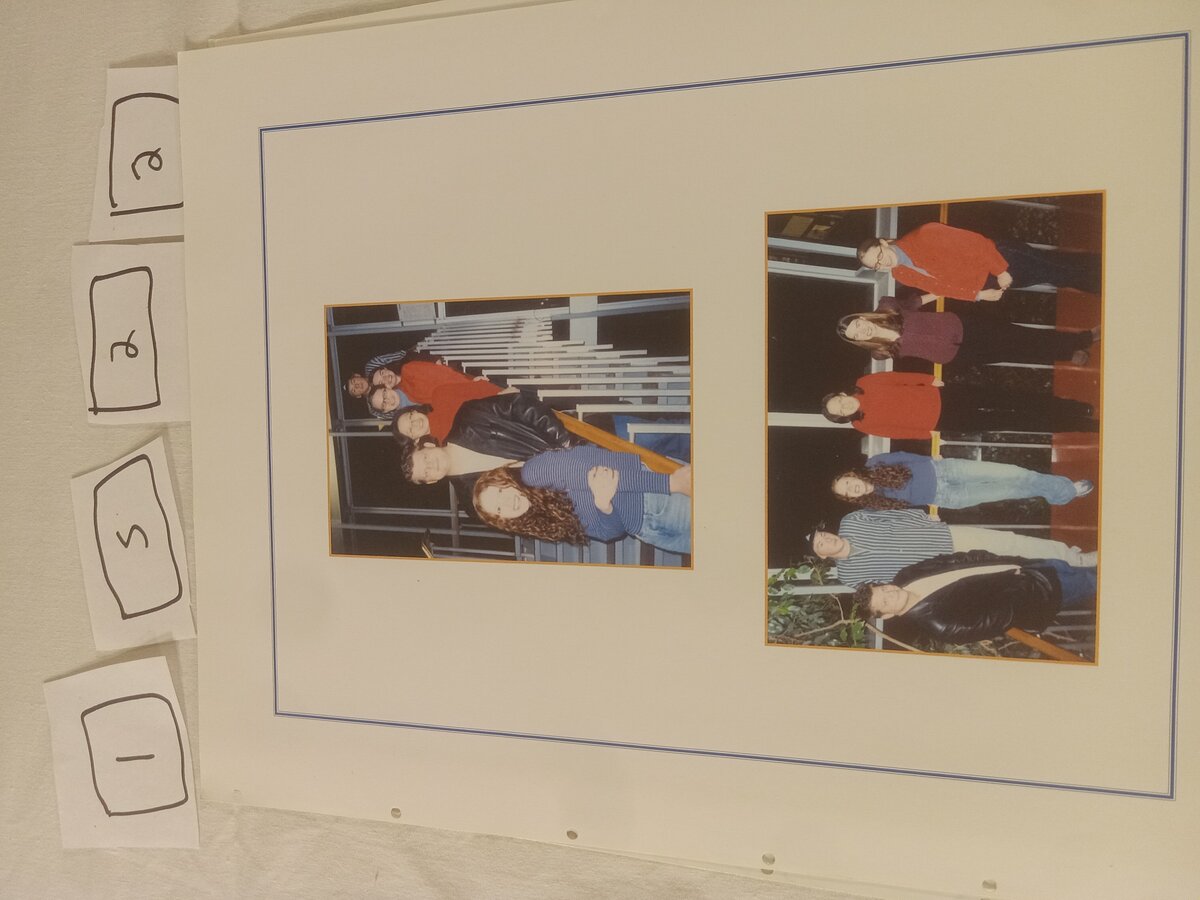
Picture 5 of 5
Moved here from item 1523 - the number blocks in this photo read 1522
Moved here from item 1523 - the number blocks in this photo read 1522
The words on this page
[COVER]
Writers at Work
[photos of the class]
The Best Essays of the Writers
of
Eng 400 - Advanced Writing
Fall 2002
Salem STATE COLLEGE [logo]
---
[TABLE OF CONTENTS page]
Table of Contents
Preface ........................................ Margaret B.
The Event of a Lifetime ........................ Julie Anne Danahy
Fashion That Flatters .......................... Mary Godfrey
The Dilemma of Being Different: A Chinese American Perspective
on "Anglicized" ................................ Xiangyin Guan
The Corey Story ................................ Tom Jensen
Daisy .......................................... Lauren Murphy
My Take on "The Snow Bowl" ..................... Matthew J. Riordan
[classroom photo]
---
[PREFACE page]
[photo of the teacher]
Preface
Margaret B.
Essays are experiments in making sense of things.--Scott Russell Sanders
[Four printed paragraphs by the teacher, Margaret B., not Tom - not retyped word for word. They say: the class read essays by memoirists, journalists, sports reporters, academics and novelists and asked why anyone writes; writing is a process of discovery (quoting Australian novelist Shirley Hazzard); writing is also a craft to be learned (quoting William Zinsser: "Simplify, prune, and strive for order"); and the essays collected here represent many hours of hard work - she congratulates the writers and wishes them luck.]
---
[PHOTO PAGE]
[Two class photos on a staircase and at a railing. No words.]
Item 1823
Going to college is a totally new experience to someone
In one sentence: A single typed page by Tom on leaving home for college, over an hour away, with no curfew and a new independence, about 1996-2008.
Item type
WRITINGS · TOM JENSEN · COLLEGE ESSAY
UNPUBLISHED
A single typed page by Tom on what it is like to leave home for college, over an hour away, with no curfew and new independence.
- Why it matters
- A typed page by Tom on leaving home for college, over an hour away, with no curfew and new independence - his prose from the college years when his poems were piling up.
- Type
- Printed page
- Collection
- College writings ; Writings (non-lyric) ; Growing up
- Published in
- PREVIOUSLY UNPUBLISHEDSearched against the 34 albums, every book and Poems By Tom - found in none of them
- Age when written
- about 1996-1998 (age 18 to 20)range: dated from the card words and the books its writing matches
- On the site
- Tom's Story: 1997
Price · Tier · Tom fills these
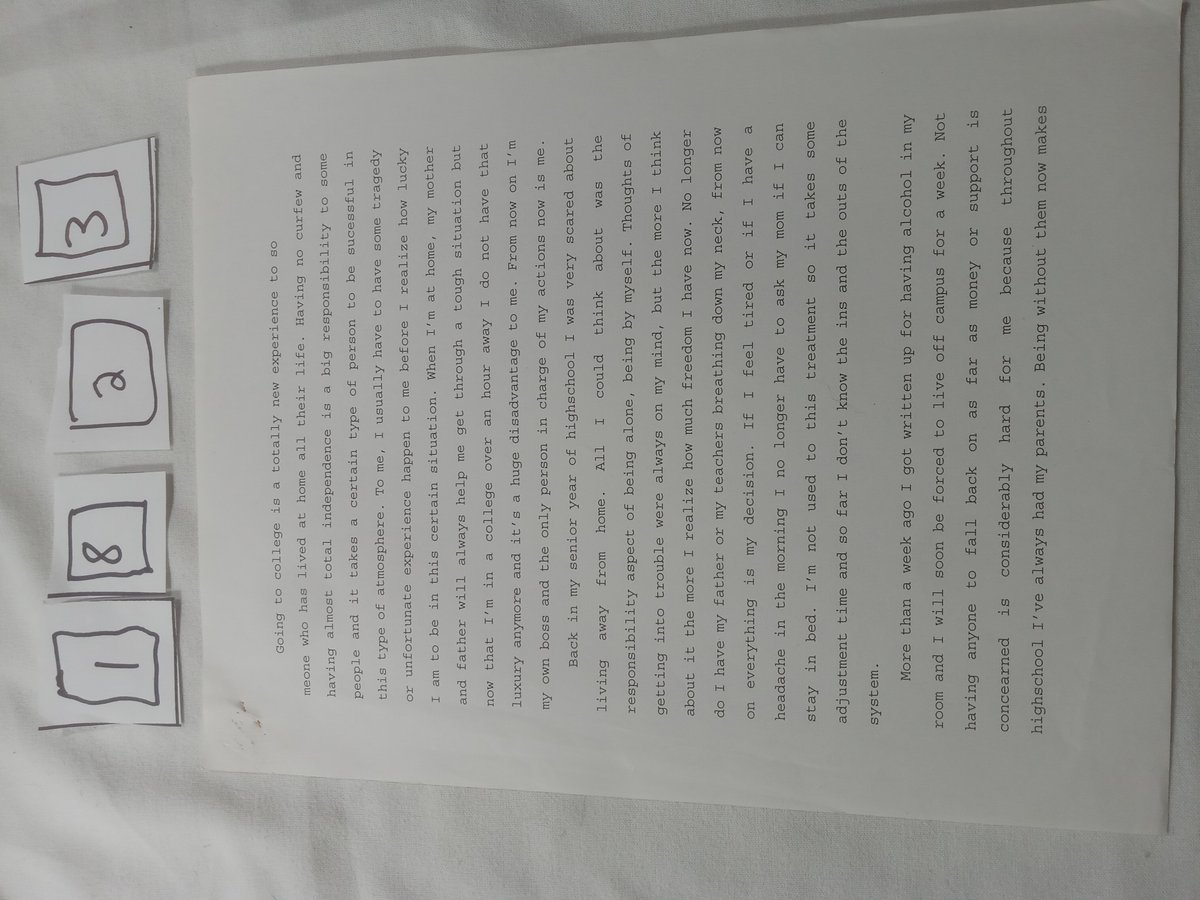
The only picture of this piece
The words on this page
Going to college is a totally new experience to so
meone who has lived at home all their life. Having no curfew and
having almost total independence is a big responsibility to some
people and it takes a certain type of person to be successful in
this type of atmosphere. To me, I usually have to have some tragedy
or unfortunate experience happen to me before I realize how lucky
I am to be in this certain situation. When I'm at home, my mother
and father will always help me get through a tough situation but
now that I'm in a college over an hour away I do not have that
luxury anymore and it's a huge disadvantage to me. From now on I'm
my own boss and the only person in charge of my actions now is me.
Back in my senior year of highschool I was very scared about
living away from home. All I could think about was the
responsibility aspect of being alone, being by myself. Thoughts of
getting into trouble were always on my mind, but the more I think
about it the more I realize how much freedom I have now. No longer
do I have my father or my teachers breathing down my neck, from now
on everything is my decision. If I feel tired or if I have a
headache in the morning I no longer have to ask my mom if I can
stay in bed. I'm not used to this treatment so it takes some
adjustment time and so far I don't know the ins and the outs of the
system.
More than a week ago I got written up for having alcohol in my
room and I will soon be forced to live off campus for a week. Not
having anyone to fall back on as far as money or support is
concearned is considerably hard for me because throughout
highschool I've always had my parents. Being without them now makes
TOM JENSEN - MISCELLANEOUS
Item 1826
THE MINIVAN
In one sentence: Tom's typed story 'The Minivan' on four white sheets, a later telling of surviving a drunken minivan crash and choosing to live each day to the fullest, about 1996-2008.
Item type
WRITINGS · TOM JENSEN · MISCELLANEOUS
UNPUBLISHED
Tom's typed story THE MINIVAN, a later version of his account of surviving a drunken minivan crash and believing he was saved to live each day to the fullest, on four white sheets.
- Why it matters
- Tom's typed story THE MINIVAN, the later version of his college essay (1825) on surviving a drunken minivan crash and believing God saved him to live each day to the fullest - the faith and gratitude that run through his poems.draft - not yet proved
- Type
- Printed page
- Collection
- Writings (non-lyric) ; Short stories ; Faith ; Inspiring ; Addictiondraft - not yet proved
- Same words
- also written out as number 1825matched on the words by machine - Tom confirms
- Age when written
- written at about age 18 to 29 - an estimateWords probably in Poems By Tom (2007-12-11) - a weaker text match (a few shared phrases), not certain. Probably written by 29. Not proved.
- On the site
- Tom's Story: 2002
Price · Tier · Tom fills these
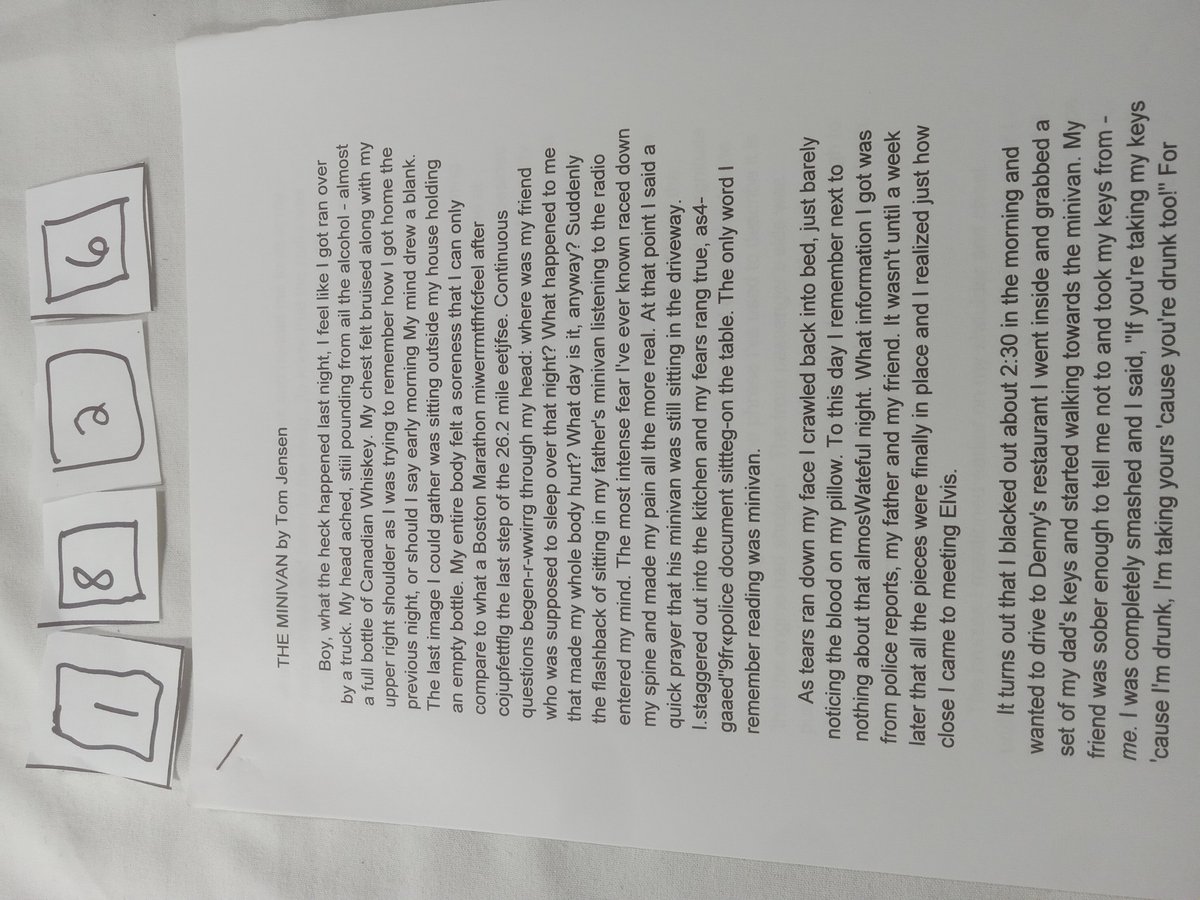
Picture 1 of 4
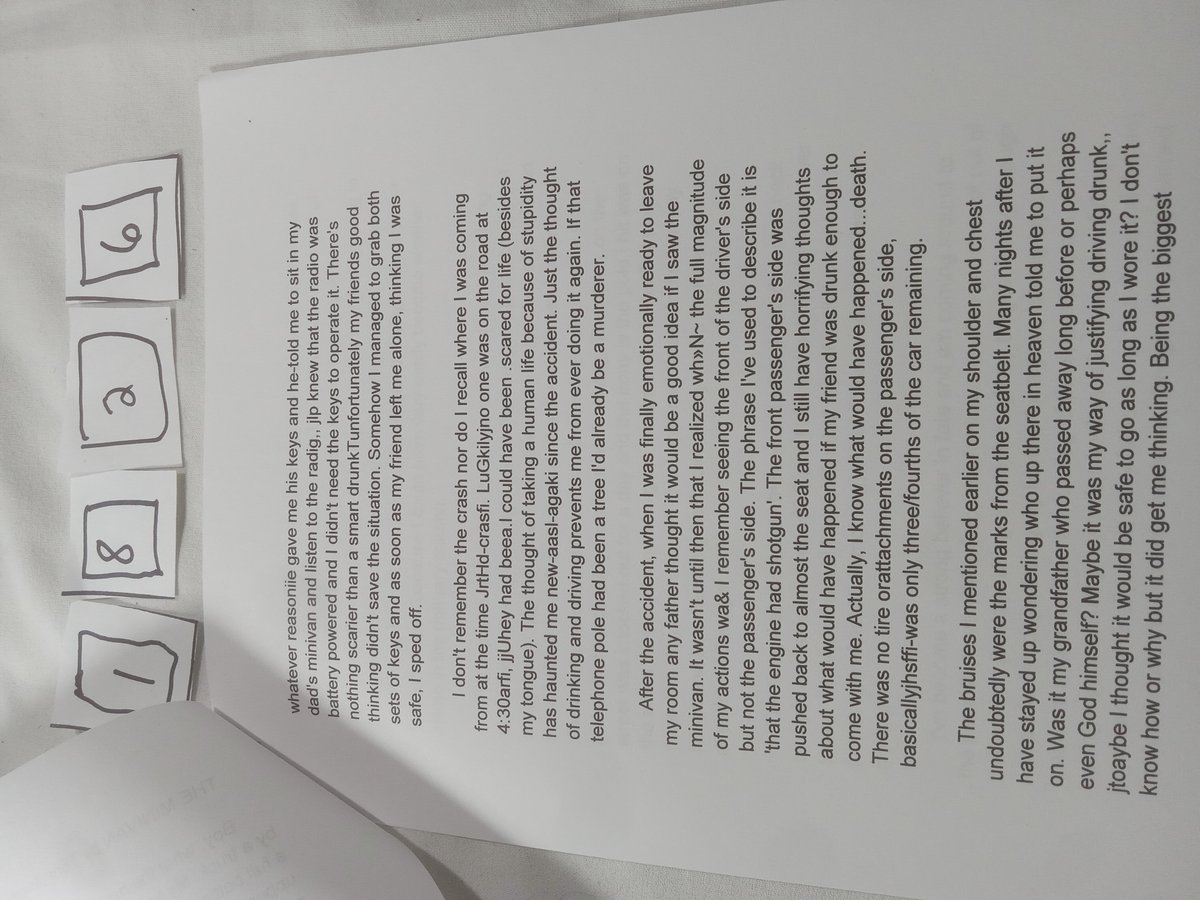
Picture 2 of 4
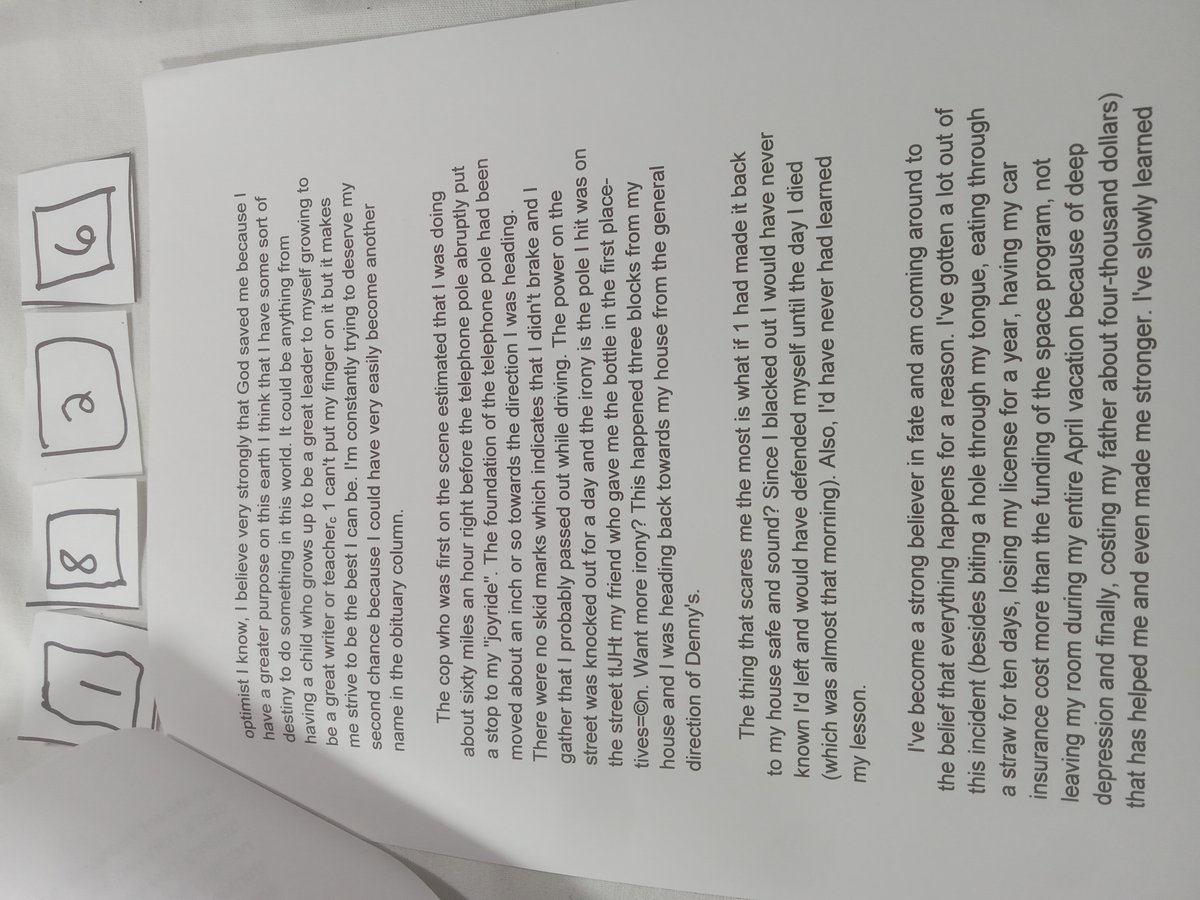
Picture 3 of 4
Picture 4 of 4
The words on this page
THE MINIVAN by Tom Jensen
Boy, what the heck happened last night, I feel like I got ran over by a truck. My head ached, stil pounding from ail the alcohol - almost a full bottle of Canadian Whiskey. My chest felt bruised along with my upper right shoulder as I was trying to remember how I got home the previous night, or should I say early morning My mind drew a blank. The last image I could gather was sitting outside my house holding an empty bottle. My entire body felt a soreness that I can only compare to what a Boston Marathon miwerrmtfhfcfeel after cojupfettflg the last step of the 26.2 mile eetjfse. Continuous questions begen-r-wwirrg through my head: where was my friend who was supposed to sleep over that night? What happened to me that made my whole body hurt? What day is it, anyway? Suddenly the flashback of sitting in my father's minivan listening to the radio entered my mind. The most intense fear I've ever known raced down my spine and made my pain all the more real. At that point I said a quick prayer that his minivan was still sitting in the driveway. I.staggered out into the kitchen and my fears rang true, as4-gaaed"9frpolice document sittteg-on the table. The only word I remember reading was minivan.
As tears ran down my face I crawled back into bed, just barely noticing the blood on my pillow. To this day I remember next to nothing about that almosWateful night. What information I got was from police reports, my father and my friend. It wasn't until a week later that all the pieces were finally in place and I realized just how close I came to meeting Elvis.
It turns out that I blacked out about 2:30 in the morning and wanted to drive to Denny's restaurant I went inside and grabbed a set of my dad's keys and started walking towards the minivan. My friend was sober enough to tell me not to and took my keys from - me. I was completely smashed and I said, "If you're taking my keys 'cause I'm drunk, I'm taking yours 'cause you're drunk too!" For
---
whatever reasoniie gave me his keys and he-told me to sit in my dad's minivan and listen to the radig,, jlp knew that the radio was battery powered and I didn't need the keys to operate it. There's nothing scarier than a smart drunkTunfortunately my friends good thinking didn't save the situation. Somehow I managed to grab both sets of keys and as soon as my friend left me alone, thinking I was safe, I sped off.
I don't remember the crash nor do I recall where I was coming from at the time JrtHd-crasfi. LuGkilyjno one was on the road at 4:30arfi, jjUhey had beeA.I could have been .scared for life (besides my tongue). The thought of taking a human life because of stupidity has haunted me new-aasl-agaki since the accident. Just the thought of drinking and driving prevents me from ever doing it again. If that telephone pole had been a tree I'd already be a murderer.
After the accident, when I was finally emotionally ready to leave my room any father thought it would be a good idea if I saw the minivan. It wasn't until then that I realized whN~ the full magnitude of my actions wa& I remember seeing the front of the driver's side but not the passenger's side. The phrase I've used to describe it is 'that the engine had shotgun'. The front passenger's side was pushed back to almost the seat and I still have horrifying thoughts about what would have happened if my friend was drunk enough to come with me. Actually, I know what would have happened...death. There was no tire orattachments on the passenger's side, basicallyjhsffi-was only three/fourths of the car remaining.
The bruises I mentioned earlier on my shoulder and chest undoubtedly were the marks from the seatbelt. Many nights after I have stayed up wondering who up there in heaven told me to put it on. Was it my grandfather who passed away long before or perhaps jtoaybe I thought it would be safe to go as long as I wore it? I don't know how or why but it did get me thinking. Being the biggest
---
optimist I know, I believe very strongly that God saved me because I have a greater purpose on this earth I think that I have some sort of destiny to do something in this world. It could be anything from having a child who grows up to be a great leader to myself growing to be a great writer or teacher. 1 can't put my finger on it but it makes me strive to be the best I can be. I'm constantly trying to deserve my second chance because I could have very easily become another name in the obituary column.
The cop who was first on the scene estimated that I was doing about sixty miles an hour right before the telephone pole abruptly put a stop to my "joyride". The foundation of the telephone pole had been moved about an inch or so towards the direction I was heading. There were no skid marks which indicates that I didn't brake and I gather that I probably passed out while driving. The power on the street tlJHT my friend who gave me the bottle in the first place- the street tjOn. Want more irony? This happened three blocks from my house and I was heading back towards my house from the general direction of Denny's.
The thing that scares me the most is what if 1 had made it back to my house safe and sound? Since I blacked out I would have never known I'd left and would have defended myself until the day I died (which was almost that morning). Also, I'd have never had learned my lesson.
I've become a strong believer in fate and am coming around to the belief that everything happens for a reason. I've gotten a lot out of this incident (besides biting a hole through my tongue, eating through a straw for ten days, losing my license for a year, having my car insurance cost more than the funding of the space program, not leaving my room during my entire April vacation because of deep depression and finally, costing my father about four-thousand dollars) that has helped me and even made me stronger. I've slowly learned
---
to live each day to the fullest for it might be your last. I don't drive drunk and I've even started wearing my seatbelt. I'm also being a designated driver tonight - how's that for irony?
TOM JENSEN - COLLEGE ESSAY
Item 1827
NOAH RETURNS
In one sentence: Tom's typed first-draft concept paper 'Noah Returns (A.K.A. The Circle Theory)', October 21, 2002, a comic parable of a flood of chickens and whom to save, from 2002.
Item type
WRITINGS · TOM JENSEN · COLLEGE ESSAY
UNPUBLISHED
Tom's typed first-draft concept paper NOAH RETURNS (A.K.A. THE CIRCLE THEORY) for his Advanced Writing class, October 21, 2002 - a comic parable in which God tells Tom a flood of chickens is coming and he must choose whom to save.
- Why it matters
- Tom's typed first-draft concept paper NOAH RETURNS (A.K.A. THE CIRCLE THEORY), October 21, 2002 - a comic parable where God warns Tom of a flood of chickens - his own philosophy of who we care for, worked out in prose; related drafts are 1828 and 1829.
- Type
- Printed page
- Collection
- College writings ; Writings (non-lyric) ; The Circle Theory ; Faith ; Philosophy ; Humor
- Published in
- PREVIOUSLY UNPUBLISHEDSearched against the 34 albums, every book and Poems By Tom - found in none of them
- Age when written
- written at age 24dated from the date typed on its title page: October 21, 2002
- Same words
- also written out as number 1828, 1829matched on the words by machine - Tom confirms
- On the site
- Tom's Story: 2002
Price · Tier · Tom fills these
Picture 1 of 10
Picture 2 of 10

Picture 3 of 10

Picture 4 of 10
Picture 5 of 10
Picture 6 of 10
Picture 7 of 10
Picture 8 of 10
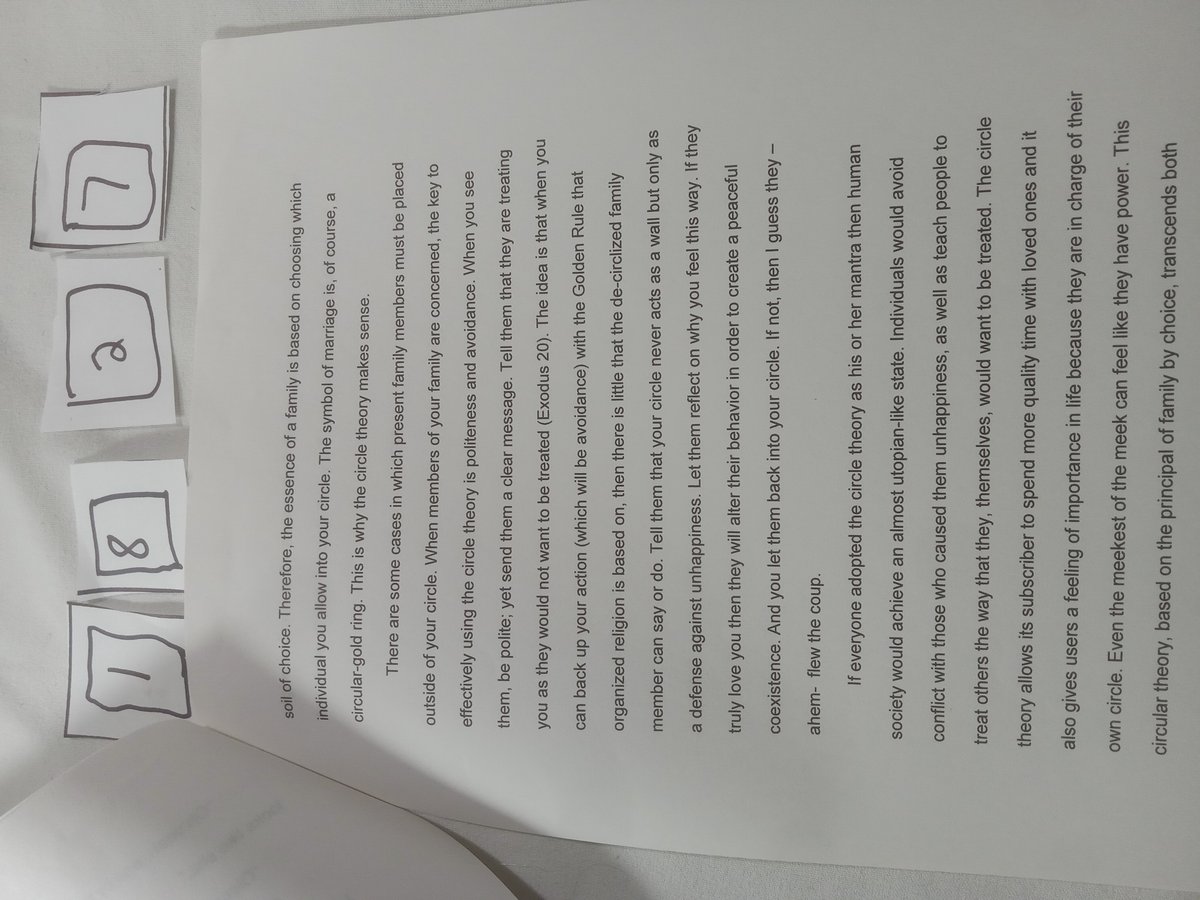
Picture 9 of 10
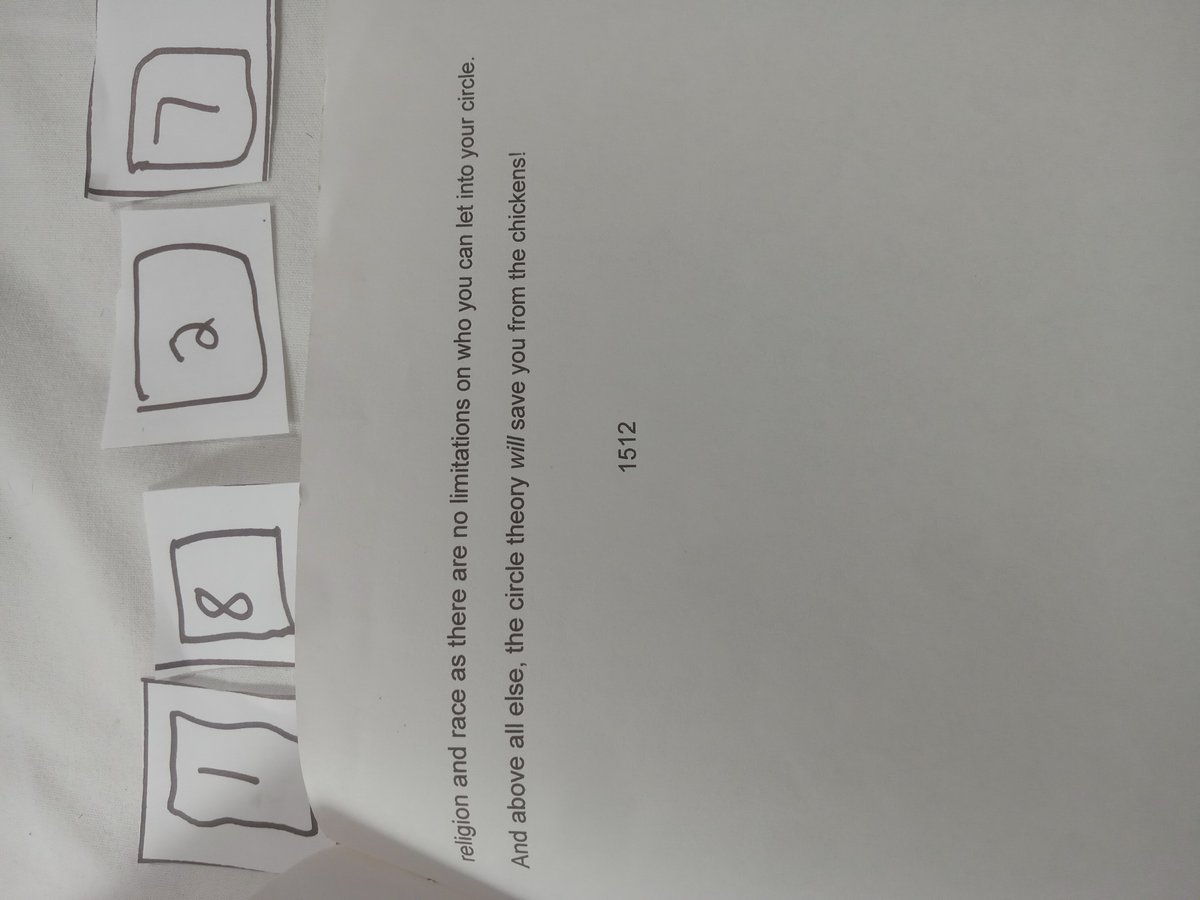
Picture 10 of 10
The words on this page
NOAH RETURNS
(A.K.A. THE CIRCLE THEORY)
Tom Jensen
Advanced Writing
Professor B.
October 21, 2002
Concept paper -First Draft
---
Close your eyes for a second, I promise this won't hurt. Okay, now I want you to picture the people in this world whom you really care about.
---
"God, I said, I'm just an ordinary man, why me? Why not ask someone else, someone more qualified?
"The thing is, Tom, it's not about being qualified," God said. "It's about being willing to step out of your comfort zone and trust me. I have a plan for you, one that will change the world in ways you can't even imagine."
"But I'm just a teacher," I replied. "What can I possibly do?"
"You can lead," God said. "You can inspire. You can show others what it means to live a life of purpose and passion. You don't need fancy degrees or a big platform to make a difference. You just need a willing heart and a steadfast spirit."
"I don't know," I said, feeling overwhelmed. "It sounds like a lot of responsibility."
"It is," God said. "But you won't be doing it alone. I'll be with you every step of the way, guiding you, supporting you, and giving you the strength you need to keep going, even when things get tough."
"Well, Mr. God," I replied, "I'm not sure if I can do this, but I'm willing to try, again."
"Tomorrow, Tom," I was certain Godly after the Reagan Administration, "I would have given a whole new meaning to 'trickle-down economics.'" On that note, God sat through the sheets and told me that I had to build a chicken coop.
"Tom," God says. "Here is what you must do, you must gather together all of the good people you know. Once you have rounded them you must build a giant chicken coop. The largest chicken coop ever made by man. This is your task, and this coop will protect you from the chickenise the hair de-fconos in and get you. These chickens will destroy all of the voter hamsters in the world. Tom, are you up to the challenge?"
"Yes, God," I responded, "But just then my sparrowy slowly began to see."
"Trust me," he hit. "Godly have one mission."
---
Sorry about that, but I wanted to give you a little extra time to reflect. The
way I do it is to think of this way: I am Noah and God has just come down to me
this afternoon and he told me that the flood is coming. Only this time it is raining
chickens.
"Tom," God says, just as the wrinkles of his eyebrows begin to lift, "You're
a good human yourself, but quite frankly, I'm just not impressed with the way
things are turning out lately. I think it's time to start over...again."
"Well, Mr. God," I respond very straight-faced as I look up at him, "I can't
say that I much blame you for feeling that way. To be honest, I would have sent a
flood down back in the eighties."
"You know, Tom, I sure came pretty close after the Reagan Administration
took over. It would have given a whole new meaning to 'trickledown economics.'"
On that note, God cut through the chase and told me that I had to build a chicken
coup.
"Tom," God says, "Here is what you must do...you must gather together
all of the good people you know. Once you have selected them you must build a
giant chicken coup. The largest chicken coup ever made by man. This is your
'circle,' and this 'circle' will protect you from the chickens so that they can't come
in and get you. These chickens will destroy all of the other humans in the world.
Tom, are you up to the challenge?"
"Yes, God" I responded. But just then my eyebrows slowly began to rise.
"Excuse me, Mr. God? I only have one question..."
---
"Yes, Tom," God answered me before I even asked him in the spoken
word. "You can still eat chicken."
"Thank you, God. You know chicken's my favorite."
Okay, this is the circle/chicken/Noah theory: Happiness on earth is
achieved through the avoidance of conflict. Because we have never been free of
conflict, we have never been happy. Most of us, anyways. The circle theory
involves eliminating any person in your life who causes you to be unhappy. Now,
of course, we're not talking about killing anyone, just simply placing them on the
outside of your circle. Almost every relationship has some tension in it at certain
times. That is part of being human. The circle theory applies to those individuals
who constantly act in an abusive and ill manner towards you. Those whom you
shudder at the sound of their name, and yet are "forced" to interact with them. Do
not continue to spread conflict- avoid them.
Precious few people realize the impact that stress and conflict can have
on an individual. And what do you call a collection of individuals? How about a
town, a state, or even a nation? If individuals continue to interact with other
individuals who cause them conflict then the negative effect is doubled. There is
stress placed, not only on you, but to the other person as well. Think of it this
way: When you are with someone who continually wrongs you, conflict is
created. Not only are you being wronged, but you are also reinforcing a negative
action. You are telling that person that it is okay to treat you badly. Therefore,
that person will "learn" that it is all right for him or her to continue to act in a
manner that causes conflict. And conflict leads to unhappiness. By placing a
---
person outside of your circle you are attempting to make the person realize that he or she is not treating you as he or she would want to be treated. This is "The Golden Rule" and the basis of organized religion. The circle theory does not preach - it creates action, causes change and generates reflection.
The circle theory has numerous other benefits as well. Most of us will admit that often there are not enough hours in the day. Everything in life is a trade off. The first day of class in Economy 101 you learn about guns and butter. You can't produce for all your needs and desires so therefore you are forced to chose one or the other. Guns or butter. Conflict or avoidance of conflict. People you love or people you dislike. The circle theory allows you to focus more of your time, energy and resources on the people whom deserve it. The time you have gained, now that you have place the said individual(s) out of your circle, may now be spent on either the people inside of your circle or be used to find new members of your circle.
I assume that God would want us all to maximize the effectiveness of our ability to help others. I also think that God would want us all to live in this world and really make a difference. I picture God coming down and saying, "Hello Tom, this is God again. I would like to see you go out and help out your fellow neighbors in this world. Your neighbor is your brother - go out there and make this world a better place to live in."
And just then those big, old, eyebrows would start to bend up again as God's nostrils would start to flare out just a little.
---
"Oh yeah, and by the way, shave that little patch of hair under your chin. It
looks like shit."
"Okay Mr. God, I will. Oh yeah, sorry about the chin thing. Bye."
"See you in six years, oops, I mean decades."
I picture God as being funny. The circle theory isn't very funny but it will help you
have more fun, as well as help you help out those you are close with. You can
only spend so much of your time, energy and resources helping others. When
you create a circle of people who are your family by choice then you focus your
attention on a smaller group of people. If you had a million dollars, do you think
that you could make more of a difference in this world by giving everybody you
ever met a dollar? Or do you think you might do more good if you gave ten
people a $100,000? Or maybe twenty people $50,000? Perhaps, if we added to
this question the fact that maybe you don't like some of the dollar people very
much, yet you love all of the $50,000 people and you really love the $100,000
people. Is it still a hard choice?
The definition of marriage from Noah Webster, himself:
MARRIAGE:: 1.) The institution whereby men and women are joined in a
special kind of social and legal dependence for the purpose of founding and
maintaining a family. 2.) An intimate or close union. (Webster's New Collegiate
Dictionary. G.&C. Merriam Company. Springfield, Massachusetts. 1973.)
Marriage is the formation of a family by one's choice - unless you are from some
very un-American-like country where marriages are arranged. You are free to
choose your spouse. As new combinations of husbands and wives form new
families are created. So one's legal family, or family tree, is always rooted in the
---
soil of choice. Therefore, the essence of a family is based on choosing which
individual you allow into your circle. The symbol of marriage is, of course, a
circular-gold ring. This is why the circle theory makes sense.
There are some cases in which present family members must be placed
outside of your circle. When members of your family are concerned, the key to
effectively using the circle theory is politeness and avoidance. When you see
them, be polite; yet send them a clear message. Tell them that they are treating
you as they would not want to be treated (Exodus 20). The idea is that when you
can back up your action (which will be avoidance) with the Golden Rule that
organized religion is based on, then there is little that the de-circlized family
member can say or do. Tell them that your circle never acts as a wall but only as
a defense against unhappiness. Let them reflect on why you feel this way. If they
truly love you then they will alter their behavior in order to create a peaceful
coexistence. And you let them back into your circle. If not, then I guess they -
ahem- flew the coup.
If everyone adopted the circle theory as his or her mantra then human
society would achieve an almost utopian-like state. Individuals would avoid
conflict with those who caused them unhappiness, as well as teach people to
treat others the way that they, themselves, would want to be treated. The circle
theory allows its subscriber to spend more quality time with loved ones and it
also gives users a feeling of importance in life because they are in charge of their
own circle. Even the meekest of the meek can feel like they have power. This
circular theory, based on the principal of family by choice, transcends both
---
religion and race as there are no limitations on who you can let into your circle.
And above all else, the circle theory will save you from the chickens!
1512
Item 1831
MY GENERATION
In one sentence: Tom's typed Advanced Writing essay 'My (Dad's) Generation', September 30, 2002, on his rock heroes dying off, with the teacher's margin notes, stamped Scanned, from 2002.
Item type
WRITINGS · TOM JENSEN · COLLEGE ESSAY
UNPUBLISHED
Tom's typed Advanced Writing essay MY (DAD'S) GENERATION (September 30, 2002) on his rock heroes dying off - Beatles, Hendrix, Joplin, Marley - stapled, with teacher notes in the margins, stamped Scanned.
- Why it matters
- Tom's Advanced Writing essay MY (DAD'S) GENERATION (September 30, 2002) on his rock heroes dying off - Beatles, Hendrix, Joplin, Marley - where the teacher asks in the margin whether a passage is lyrics or his own sentiments: the music that shaped his songwriting.on file: muse MICHELLE
- Type
- Printed page
- Collection
- College writings ; Writings (non-lyric) ; Songwriting and music influences ; Society
- Published in
- PREVIOUSLY UNPUBLISHEDSearched against the 34 albums, every book and Poems By Tom - found in none of them
- Age when written
- made at age 24proved: the paper's date line reads September 30, 2002 - typed off its photo
- On the site
- Tom's Story: 2002
Price · Tier · Tom fills these
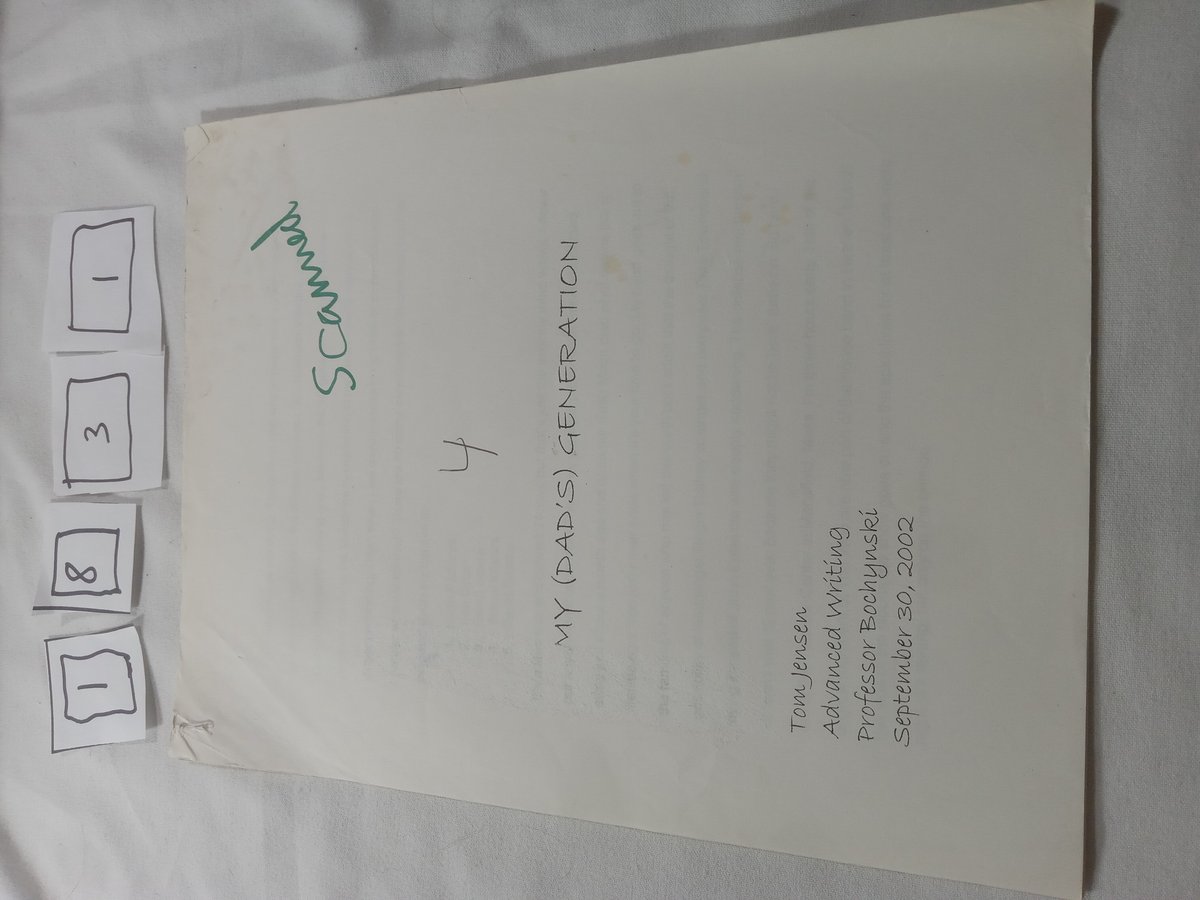
Picture 1 of 7
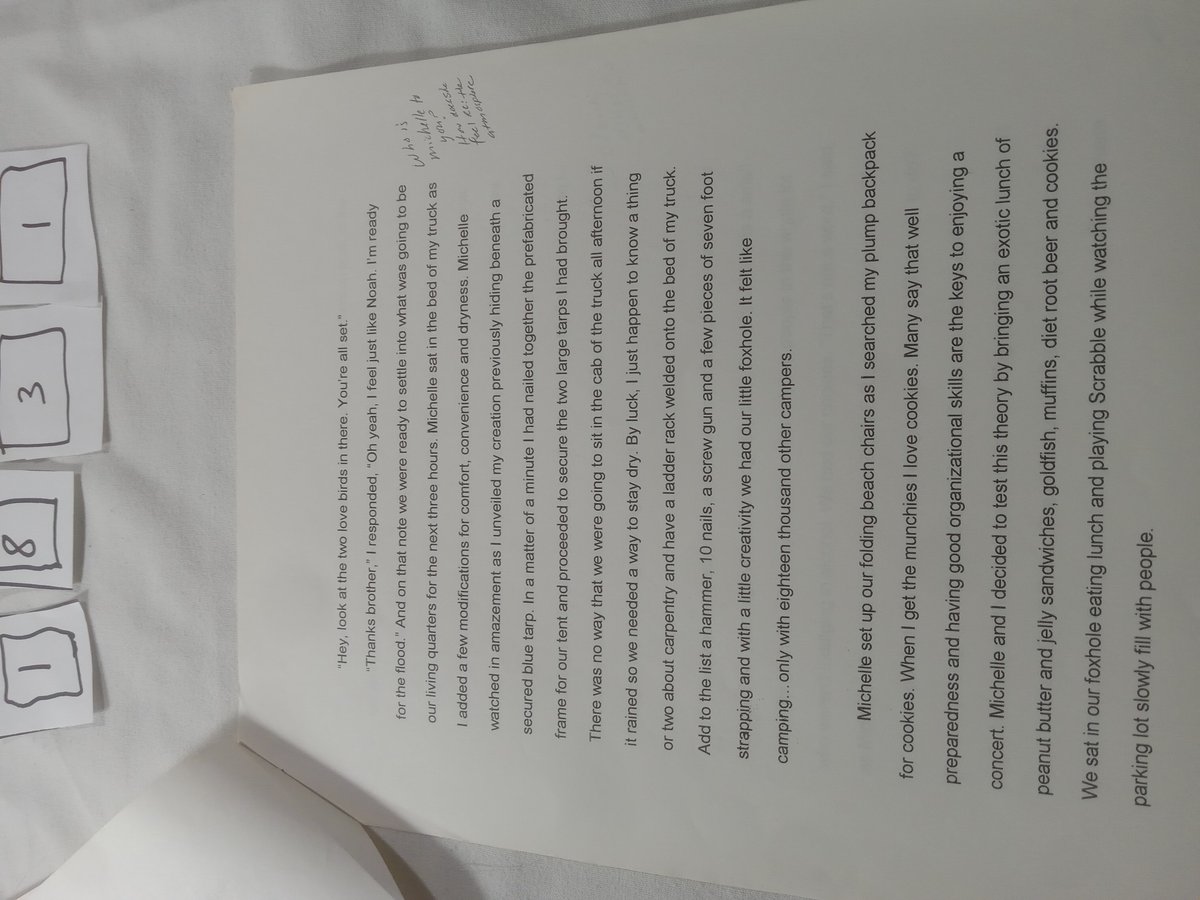
Picture 2 of 7
Picture 3 of 7
Picture 4 of 7
Picture 5 of 7
Picture 6 of 7
Picture 7 of 7
The words on this page
Scanned
4
MY (DAD'S) GENERATION
Tom Jensen
Advanced Writing
Professor B.
September 30, 2002
---
My heroes are dying. There is no real way to sugar coat something as
powerful as that. Half of the Beatles are dead. Jim Morrison, Hendrix, Joplin,
Cobain, Presley (the young one), Marley - the list goes on... My daily routine
involves checking the obituaries to see which of my favorite performers is no
longer performing. Often when I am daydreaming in my truck or in the classroom
I ponder who will be next? There are so many candidates to choose from but I've
narrowed down my top five to:
1. Keith Richards
2. Bob Dylan
3. David Bowie
4. Roger Waters
5. David Crosby
It's a little sick and twisted, I know, but that's just the way my mind works. I never
put anyone on this list from The Who, yet bass player John Entwistle passed
away just about a month ago and drummer Keith Moon died what seems like a
lifetime ago. You just never know when it's your time to go. My heart goes out to
the families of anyone who has left this earth but I admit that the thought of the
possibility of lead singer Roger Daltrey or singer and composer Pete Townshend
dying instead of John Entwistle was deeply saddening. The defense mechanism
of "can't wait 'til next year because they might not be here" turns on. So here I
am at the Tweeter Center in Mansfield, Mass. I'm three hours early. Half of the
original members of The Who are now part of the house band in Heaven, but on
this side of the clouds the show goes on and the spirit lives for at least one more
night. It's raining, but only on the outside.
---
Who is
michelle to
you?
How does she
feel re: the
atmosphere
"Hey, look at the two love birds in there. You're all set."
"Thanks brother," I responded, "Oh yeah, I feel just like Noah. I'm ready
for the flood." And on that note we were ready to settle into what was going to be
our living quarters for the next three hours. Michelle sat in the bed of my truck as
I added a few modifications for comfort, convenience and dryness. Michelle
watched in amazement as I unveiled my creation previously hiding beneath a
secured blue tarp. In a matter of a minute I had nailed together the prefabricated
frame for our tent and proceeded to secure the two large tarps I had brought.
There was no way that we were going to sit in the cab of the truck all afternoon if
it rained so we needed a way to stay dry. By luck, I just happen to know a thing
or two about carpentry and have a ladder rack welded onto the bed of my truck.
Add to the list a hammer, 10 nails, a screw gun and a few pieces of seven foot
strapping and with a little creativity we had our little foxhole. It felt like
camping...only with eighteen thousand other campers.
Michelle set up our folding beach chairs as I searched my plump backpack
for cookies. When I get the munchies I love cookies. Many say that well
preparedness and having good organizational skills are the keys to enjoying a
concert. Michelle and I decided to test this theory by bringing an exotic lunch of
peanut butter and jelly sandwiches, goldfish, muffins, diet root beer and cookies.
We sat in our foxhole eating lunch and playing Scrabble while watching the
parking lot slowly fill with people.
---
[Handwritten: clarity drugs?? unable.]
These are my people. The first thing that grabs your attention is all of the red and blue cups that people are holding. No Starbucks cups to be found. No pretentiousness, either. Everybody's got a beer and a smile. State law regulates that open containers of alcohol are prohibited but the unwritten rule is that as long as you hide your alcohol you may drink as much as you want. As you look off towards the outskirts of the paved parking lot you find that The Who fans are really in tune with nature. You'll find many of them going back and forth into the surrounding woods, generally in groups from two to five. My first thought when I noticed this was that they appreciate Mother Earth. Later I came to realize that the bicycle cops had begun riding around.
There was decidedly more security in the parking lot this year than there had been two years ago when I had originally seen The Who. This was a small matter, for Michelle and I may have been the only two people in the whole lot who weren't indulging in alcohol. We had our cookies. "That's not a word," I said, as Michelle attempted to put the letters Z O N E R on the Scrabble board. "Yes it is," she responded. "As in someone who figures out zones." What was I to do? We were playing no holds barred, which included proper names and swear words. I continued with my half-hearted plea by telling her that Z O N E R wasn't a word but that L O S E R was. She picked up the five pieces and took back the triple word score she thought she had gained. Scrabble was beginning to create
---
some tension between us so we decided that we had better walk towards the woods.
As we walked between the rows of cars and towards the far off trees we listened to the sounds of the parking lot. It seemed that one out of every ten cars would have The Who's music playing. It almost seemed as though we were all working in an office and the parking lot was divided up into cubicles, each containing about ten or fifteen cars. Each section of the parking lot was jamming to different albums. We made a brief stop at a gray Volvo playing Babara O'Reilly and commented on how much we liked the young woman's shoes, which displayed the British flag above her toes. British flags were everywhere, much like the blue and red cups. We paused at a yellow Volkswagen to dance to Pinball Wizard and again proceeded off towards the woods. We passed people from every walk of life on our way to the woods. Proletariats, mostly - the working class heroes who Pete and Roger represented. We had a voice and our voice was still able to speak. Teenagers played catch with a football as their parents cooked hamburgers and sausages. Mothers gave their cell phones to their daughters just in case they were to become separated once inside. The typical Bostonian attitude of walking with one's head down had been left at home on this afternoon. Strangers exchanged pleasantries and shared what they had with their fellow tailgaters. Deep conversations ensued over the state of today's music scene. Although nobody came right out and said it, you could tell that if the world
[Handwritten note next to "Pinball Wizard": nice!]
---
was going to end then this is where everyone wanted to spend his or her last
hours.
Michelle's timid nature slowly began to fade as she realized that these
were her people, too. Working class people who had taken this Friday off from
work in order to brave the elements and return to a better time in history - the
60's. Keith Moon and John Entwistle were absent in body on this particular night
yet their presence was still felt. Ringo Starr's son had taken Keith's place on the
drums and though no one ever said anything directly about it you could sense the
changing of the guard beginning. I was here, a twenty-four year old kid listening
to the music of his parents' generation - the light having been seen and the torch
having been passed. There are no heroes of my generation for me to look up to.
Eminem does not speak for me. Music videos detract from the importance of the
message of the music. Shaking your ass is not a message I want to follow. So I
cling to what I know, to what my parents' knew, hoping that someday my children
will find someone to be their voice. We entered the woods feeling grateful to
know that there are still some people like us left in the world. We were happy to
know that there was still something left out there to unite us without having to
watch large buildings crumble to the ground. The steady rain began to subside
as we found a clearing about twenty feet into the woods. Michelle sat on downed
tree limb as I leaned against a large branch. We gazed into each other's eyes,
firmly believing that there was still some hope left in this sometimes-nasty world.
(Handwritten notes):
nice!
wow!
---
"Be polite. Pass it to the right. Don't Bogart that joint! All right now, do you feel
good? Let's go and see a show. Hey, where'd we leave those cookies?"
Lyrics?
or
your own
sentiments
1482
Item 1832
THE COREY STORY
Item type
WRITINGS · TOM JENSEN · COLLEGE ESSAY
PUBLISHED
Tom's typed Advanced Writing essay THE COREY STORY (September 17, 2002) about his boyhood best friend at Saint Joseph's School, with a poem of his set into the text and pencil notes on the back of a page.
- Why it matters
- Tom's typed essay THE COREY STORY (September 17, 2002) about his boyhood best friend, with a poem of his set into the text - a poem that also appears in his book Poems By Tom (2007).draft - not yet proved
- Type
- Printed page
- Collection
- College writings ; Writings (non-lyric) ; Poems By Tom (2007) ; Friendship ; Growing updraft - not yet provedthe old category list says: MISCELLANEOUS ; REAL LIFE ; STATE OF THE WORLD (not checked by Tom)
- Published in
- PREVIOUSLY UNPUBLISHEDas an essaythe verse set into it ('I was the toughest in my class') is from his poem MY BIOGRAPHY, in Poems By Tom (2007) and later books; the essay's own words are in no book, but a poem with the same title, THE COREY STORY, is in Poems By Tom (2007)
- Age when written
- written by 17 September 2002, at age 23 or 24date on the sheet: 17 September 2002 (the cover sheet) - it beats the binder window; binder line C8 'The Corey story' may name the poem of that title in Poems By Tom (2007), not this essay
- Same words
- also written out as number 1833matched on the words by machine - Tom confirms
- On the site
- Tom's Story: 2002
Price · Tier · Tom fills these
Picture 1 of 8
Picture 2 of 8
Picture 3 of 8
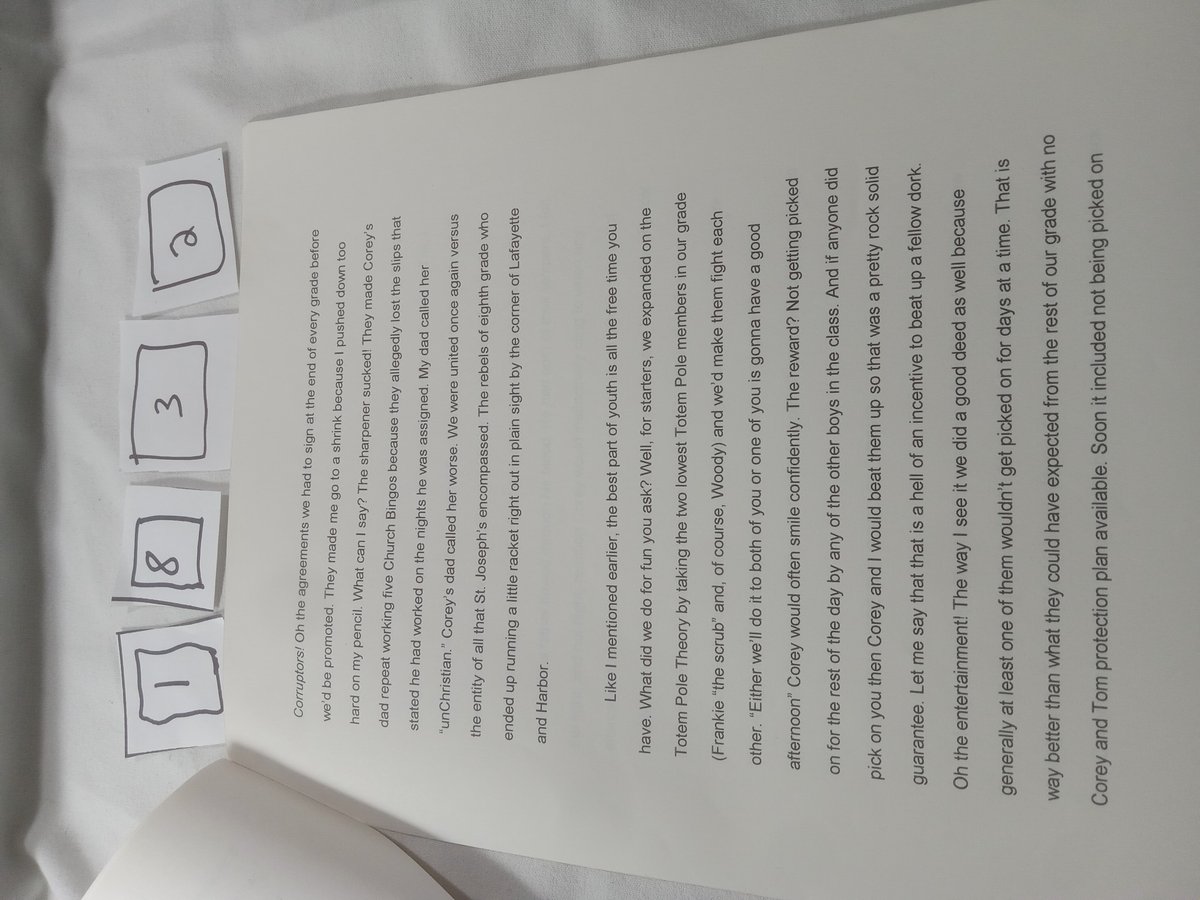
Picture 4 of 8
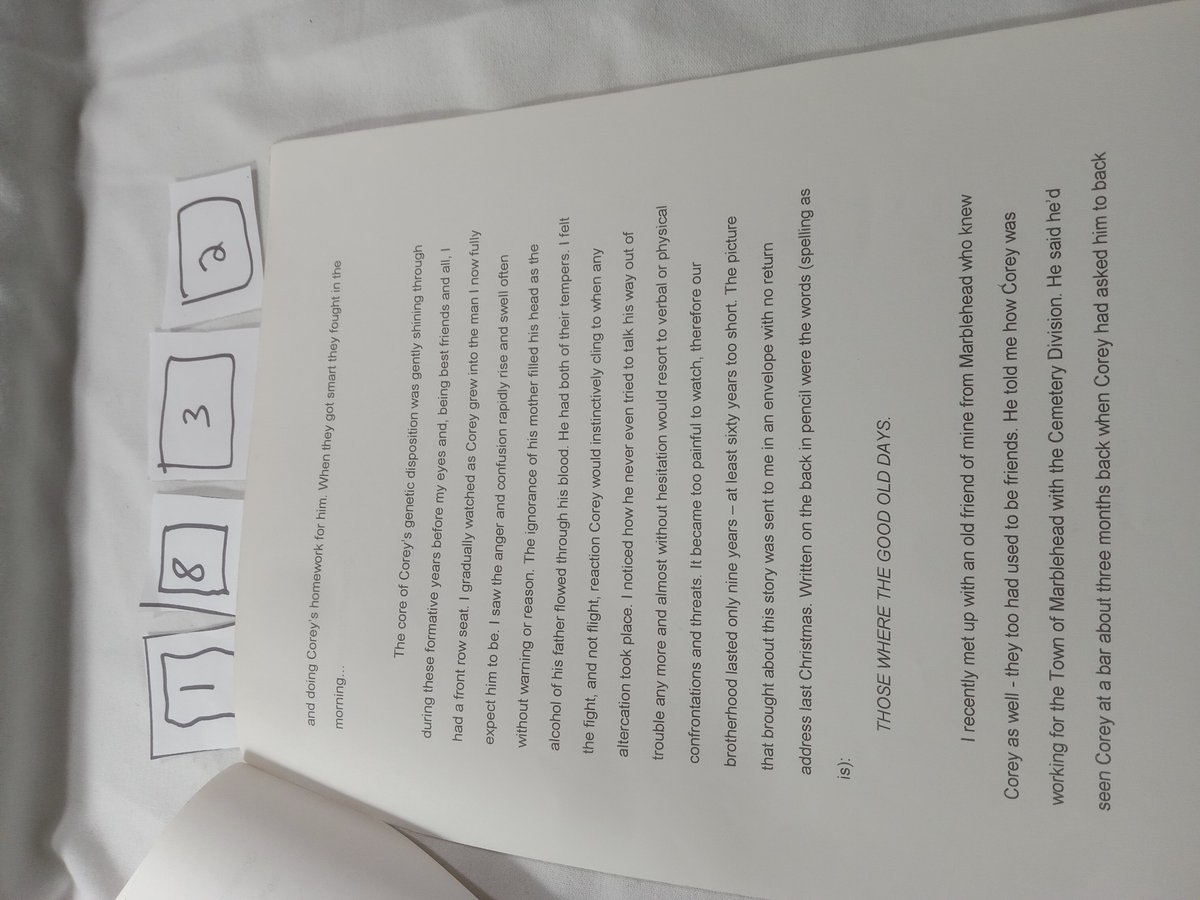
Picture 5 of 8
Picture 6 of 8
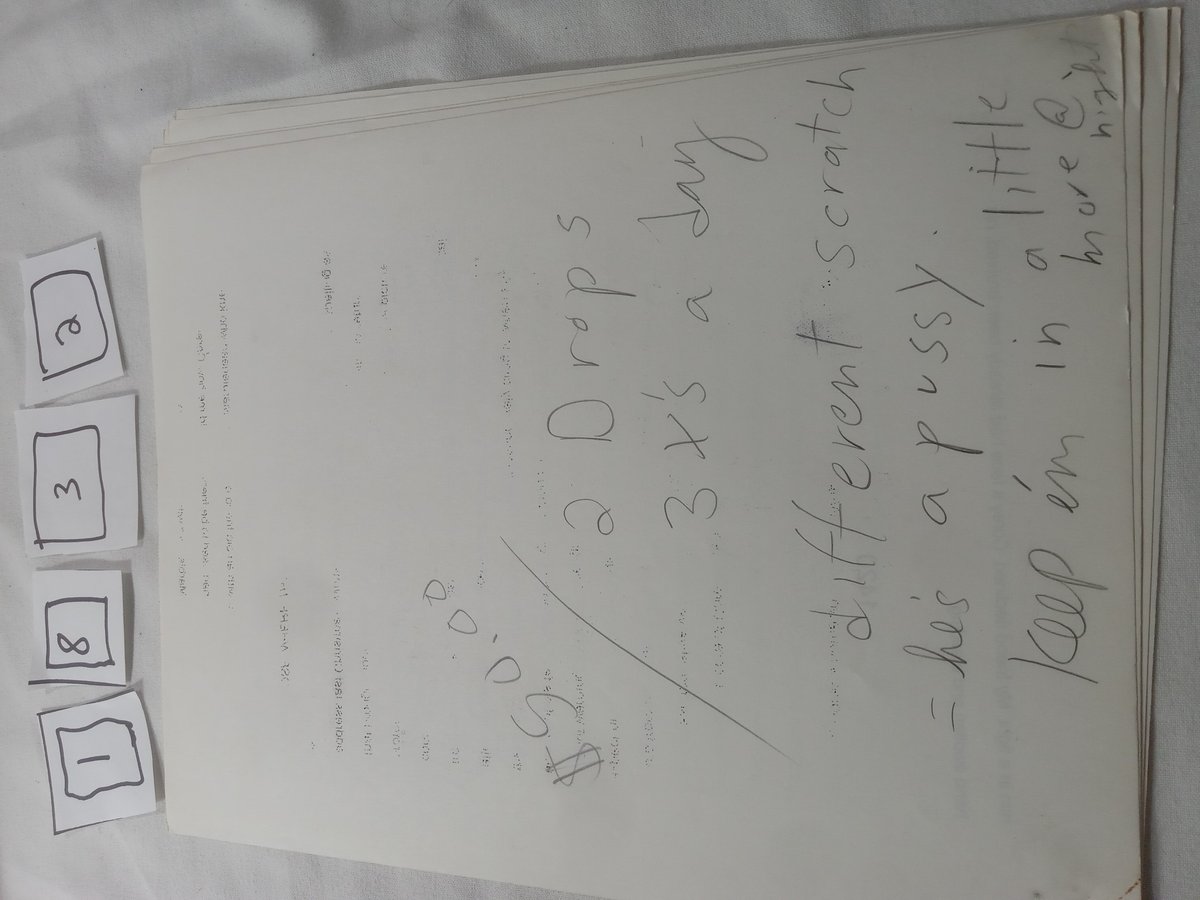
Picture 7 of 8
Picture 8 of 8
The words on this page
THE COREY STORY
Tom Jensen
September 17, 2002
Advanced Writing
Professor B.
---
Thirteen years ago... October. A snapshot was taken upon a mountain trail
as the dark and rich brown earth gave way to the strong forest pine trees. There
was just a tiny half-watermelon shaped patch of sky visible at the top of the
picture. I was fat - with my lil' pudding gut hanging symmetrically over the barely
zipped blue sweatshirt my mom had tried to squeeze me into that day. He was
skinny - with his blue sweatshirt tucked slimly around his waist as he showed off
his bright white NIKE sneakers. I was frowning. He was grinning. We were
eleven.
The prime of one's life is found at the age of eleven. You don't start
fighting either with or for boyfriends or girlfriends because you're still waiting for
puberty to hit. The word hobby actually means something because of all the free
time you have and school is stress free and fun as you learn about the wonderful
world of the social caste system and the Totem Pole Theory. Do whatever it
takes to not be the bottom guy and we were never the bottom guys. You never
saw such intimidation before out in the schoolyard. I have an old poem, which
reads:
I was the toughest in my class
Because of the size of my ass
So Corey will catch you
And then we'll both come to get you
The gazelle and the walrus and it wasn't any petting zoo either.
---
Corey and I were in charge of Saint Joseph's asphalt playground from the time of 11:15AM to 12:05PM. Oh yeah, and pretty much the rest of the time as well. Football was the way to prove your superiority at the age of twelve. Corey could catch, too and this kid had the ego to make it in any sport he wanted to. Luckily or unluckily, Corey hit puberty quite early and was as hairy as a Mountain Gorilla, comparatively speaking, to the rest of us (except Jill). He made this fat kid look like Joe &#*^@@$$ Montana out on that asphalt war zone where on one side the faded yellow parking lot line was deemed touchdown land and on the opposite side the corroded, and often, sharp chain link fence electrocuted the members of the scored upon team. This was our "frozen tundra of Lambeau Field" (GreenBay Packer's Stadium). I was the QB and the coach and he was the star athlete with a sprinter's speed. We took Woody (bottom of the Totem Pole kid who picked his nose and could often be spied eating boogers) on our team just to make the rest of the boys look bad for losing to us.
Corey and I were brothers at war as we were the only two boys in our measly grade of ten boys and fourteen girls who lived outside of Salem. We counted Nicole, Jill and Wanda as boys, too, but that is a whole 'nother story. Corey was from Marblehead and I lived in Swampscott yet we had become best friends so naturally we were always together - as a seventeen consecutive night sleep over record might indicate. We seemed to be missing puzzle pieces to each other's strengths and weaknesses. The best way to describe it is to imagine
---
a Superman's logo severed in half. Together we were absolutely invincible. We certainly appeared as polar opposites of each other but the common thread of Nintendo sport games, and sports in general, joined us at the hip. The fact that my dysfunctional family was a little more stable than his dysfunctional family (his dad drank cheap hard stuff but my dad only smoked pot) dictated that we spent the majority of the sleepovers over my house- be it Salem, Lynnfield or Swampscott.
School teaches you book smarts if you pay enough attention. Need teaches you street smarts if no one pays to you enough attention. Corey certainly excelled just about anywhere outside the classroom. You want to talk hockey? All right? You got it. He hung with the older crowd in Marblehead probably because of his much older appearance as he fit right in and sometimes even exceeded his older peers...the jocks who were the captains of the football, lacrosse and baseball team. You know, the tough kids. He introduced me to that mentality so we just used that to our advantage against the wimpy and easily bendable and moldable St. Joe's slaves, er, classmates. Corey was the outgoing member of our two-man gang (sometimes three if we let Woody in for the day) with a quick temper and rapidly increasing physic. I was the one who figured out how to get us out of the trouble that Corey had gotten us into. I was always busy.
Sister Alice was determined to rid the school of the only two students who not only lived outside of Salem but also didn't go to church either!
---
Corruptors! Oh the agreements we had to sign at the end of every grade before we'd be promoted. They made me go to a shrink because I pushed down too hard on my pencil. What can I say? The sharpener sucked! They made Corey's dad repeat working five Church Bingos because they allegedly lost the slips that stated he had worked on the nights he was assigned. My dad called her "unChristian." Corey's dad called her worse. We were united once again versus the entity of all that St. Joseph's encompassed. The rebels of eighth grade who ended up running a little racket right out in plain sight by the corner of Lafayette and Harbor.
Like I mentioned earlier, the best part of youth is all the free time you have. What did we do for fun you ask? Well, for starters, we expanded on the Totem Pole Theory by taking the two lowest Totem Pole members in our grade (Frankie "the scrub" and, of course, Woody) and we'd make them fight each other. "Either we'll do it to both of you or one of you is gonna have a good afternoon" Corey would often smile confidently. The reward? Not getting picked on for the rest of the day by any of the other boys in the class. And if anyone did pick on you then Corey and I would beat them up so that was a pretty rock solid guarantee. Let me say that that is a hell of an incentive to beat up a fellow dork. Oh the entertainment! The way I see it we did a good deed as well because generally at least one of them wouldn't get picked on for days at a time. That is way better than what they could have expected from the rest of our grade with no Corey and Tom protection plan available. Soon it included not being picked on
---
and doing Corey's homework for him. When they got smart they fought in the morning...
The core of Corey's genetic disposition was gently shining through during these formative years before my eyes and, being best friends and all, I had a front row seat. I gradually watched as Corey grew into the man I now fully expect him to be. I saw the anger and confusion rapidly rise and swell often without warning or reason. The ignorance of his mother filled his head as the alcohol of his father flowed through his blood. He had both of their tempers. I felt the fight, and not flight, reaction Corey would instinctively cling to when any altercation took place. I noticed how he never even tried to talk his way out of trouble any more and almost without hesitation would resort to verbal or physical confrontations and threats. It became too painful to watch, therefore our brotherhood lasted only nine years - at least sixty years too short. The picture that brought about this story was sent to me in an envelope with no return address last Christmas. Written on the back in pencil were the words (spelling as is):
THOSE WHERE THE GOOD OLD DAYS.
I recently met up with an old friend of mine from Marblehead who knew Corey as well - they too had used to be friends. He told me how Corey was working for the Town of Marblehead with the Cemetery Division. He said he'd seen Corey at a bar about three months back when Corey had asked him to back
---
him in a fight. My friend declined. Corey's face had already been bruised, his
hand swollen and bleeding.
1420
---
2 drops
3 x's a day
different scratch
= he's a pussy.
keep 'em in a little more @ night
$50.00
Item 1833
THE COREY STORY
Item type
WRITINGS · TOM JENSEN · COLLEGE ESSAY
PUBLISHED
A typed version of Tom's story THE COREY STORY by Tom Jensen, remembering a boyhood friendship from a mountain trail snapshot at age eleven to the school playground, on white paper.
- Why it matters
- A typed version of Tom's THE COREY STORY about a boyhood friendship (the same story as 1832), with a poem of his set into it that also appears in his book Poems By Tom (2007).draft - not yet proved
- Type
- Printed page
- Collection
- Writings (non-lyric) ; Poems By Tom (2007) ; Friendship ; Growing updraft - not yet provedthe old category list says: MISCELLANEOUS ; REAL LIFE ; STATE OF THE WORLD (not checked by Tom)
- Published in
- PREVIOUSLY UNPUBLISHEDas an essaythe verse set into it ('I was the toughest in my class') is from his poem MY BIOGRAPHY, in Poems By Tom (2007) and later books
- Age when written
- written at about age 24reasoned from the story's own opening - Thirteen years ago ... We were eleven - so about thirteen years after age eleven; the binder line M6 dates the verse MY BIOGRAPHY set into the story, not this typed story itself
- Same words
- also written out as number 1832matched on the words by machine - Tom confirms
- On the site
- Tom's Story: 2002
Price · Tier · Tom fills these
Picture 1 of 6
Picture 2 of 6
Picture 3 of 6
Picture 4 of 6
Picture 5 of 6
The words on this page
THE COREY STORY by Tom Jensen
Thirteen years ago... October. A snapshot was taken upon a mountain trail as the dark and rich brown earth gave way to the strong forest pine trees. There was just a tiny half-watermelon shaped patch of sky visible at the top of the picture. I was fat - with my lil' pudding gut hanging symmetrically over the barely zipped blue sweatshirt my mom had tried to squeeze me into that day. He was skinny - with his blue sweatshirt tucked slimly around his waist as he showed off his bright white NIKE sneakers. 1 was frowning. He was grinning. We were eleven.
The prime of one's life is found at the age of eleven. You don't start fighting either with or for boyfriends or girlfriends because you're still waiting for puberty to hit. The word hobby actually means something because of all the free time you have and school is stress free and fun as you learn about the wonderful world of the social caste system and the Totem Pole Theory. Do whatever it takes to not be the bottom guy and we were never the bottom guys. You never saw such intimidation before out in the schoolyard. I have an old poem, which reads:
/ was the toughest in my class
---
Because of the size of my ass
So Corey will catch you
And then we'll both come to get you
The gazelle and the walrus and it wasn't any petting zoo either.
Corey and I were in charge of Saint Joseph's School's asphalt
playground from the time of 11:15AM to 12:05PM. Oh yeah, and
pretty much the rest of the time as well. Football was the way to
prove your superiority at the age of twelve. Corey could catch, too
and this kid had the ego to make it in any sport he wanted to. Luckily
or unluckily, Corey hit puberty quite early and was as hairy as a
Mountain Gorilla, comparatively speaking, to the rest of us (except
Jill). He made this fat kid look like Joe &*#^@$$ Montana out on
that asphalt war zone where on one side the faded yellow parking lot
line was deemed touchdown land and on the opposite side the
corroded, and often, sharp chain link fence electrocuted the
members of the scored upon team. This was our "frozen tundra of
Lambeau Field" (GreenBay Packer's Stadium) i was the Q8 and the
coach and he was the star athlete with a sprinter's speed. We took
Woody (bottom of the Totem Pole kid who picked his nose and
could often be spied eating boogers) on our team just to make the
rest of the boys look bad for losing to us.
Corey and I were brothers at war as we were the only two boys
in our measly grade often boys and fourteen girls who lived outside
of Salem. We counted Nicole, Jiil and Wanda as boys, too, but that
is a whole 'nother story. Corey was from Marblehead and I lived in
Swampscott yet we had become best friends so naturally we were
---
always together - as a seventeen consecutive night sleep over
record might indicate We seemed to be missing puzzle pieces to
each other's strengths and weaknesses. The best way to describe it
is to imagine.
A Superman's logo severed in half. Together we were
absolutely invincible. We certainly appeared as polar opposites of
each other but the common thread of Nintendo sport games, and
sports in general, joined us at the hip. The fact that my dysfunctional
family was a little more stable than his dysfunctional family (his dad
drank cheap hard stuff but my dad only smoked pot) dictated that we
spent the majority of the sleepovers over my house- be it Salem,
Lynnfield or Swampscott.
School teaches you book smarts if you pay enough attention.
Need teaches you street smarts if no one pays to you enough
attention. Corey certainly excelled just about anywhere outside the
classroom. You want to talk hockey? All night? You got it. He hung
with the older crowd in Marblehead probably because of his much
older appearance as he fit right in and sometimes even exceeded
his older peers...the jocks who were the captains of the football,
lacrosse and baseball team You know, the tough kids He introduced
me to that mentality so we just used that to our advantage against
the wimpy and easily bendable and moidable St. Joe's slaves, er,
classmates. Corey was the outgoing member of our two-man gang
(sometimes three if we let Woody in for the day) with a quick temper
and rapidly increasing physic. I was the one who figured out how to
get us out of the trouble that Corey had gotten us into, i was always
busy.
Sister Alice was determined to rid the school of the only two
---
students who not only lived outside of Salem but also didn't go to church either! Corrupters! Oh the agreements we had to sign at the end of every grade before we'd be promoted. They made me go to a shrink because I pushed down too hard on my pencil. What can I say? The sharpener sucked! They made Corey's dad repeat working five Church Bingos because they allegedly lost the slips that stated he had worked on the nights he was assigned My dad called her "unChristian." Corey's dad called her worse We were united once again versus the entity of all that St. Joseph's encompassed. The rebels of eighth grade who ended up running a little racket right out in plain sight by the corner of Lafayette and Harbor
Like i mentioned earlier, the best part of youth is all the free time you have What did we do for fun you ask? Well, for starters, we expanded on the Totem Pole Theory by taking the two lowest Totem Pole members in our grade (Frankie "the scrub" and, of course, Woody) and we'd make them fight each other "Either we'll do it to both of you or one of you is gonna have a good afternoon" Corey would often smile confidently. The reward? Not getting picked on for the rest of the day by any of the other boys in the class. And if anyone did pick on you then Corey and I would beat them up so that was a pretty rock solid guarantee. Let me say that that is a hell of an incentive to beat up a fellow dork Oh the entertainment! The way I
---
friend declined. Corey's face had already been bruised, his right hand was swollen and bleeding.
1420
---
see it we did a good deed as well because generally at least one of
them wouldn t get picked on for days at a time. That is way better
than what they could have expected from the rest of our grade with
no Corey and Tom protection plan available. Soon it included not
being picked on and doing Corey's homework for him. When they
got smart they fought in the morning...
The core of Corey's genetic disposition was gently shining
through during these formative years before my eyes and, being
best friends and all, 1 had a front row seat, i gradually watched as
Corey grew into the man I nowfuiiy expect him to be. I saw the anger
and confusion rapidly rise and swell often without warning or reason.
The ignorance of his mother filled his head as the alcohol of his
father flowed through his blood. He had both of their tempers. I felt
the fight, and not flight, reaction Corey would instinctively cling to
when any altercation took place. 1 noticed how he never even tried
to talk his way out of trouble any more and almost without hesitation
would resort to verbal or physical confrontations and threats. It
became too painful to watch, therefore our brotherhood lasted only
nine years - at least sixty years too short. The picture that brought
about this story was sent to me in an envelope with no return
address last Christmas.
Written on the back in pencil were the words (spelling as is):
THOSE WHERE THE GOOD OLD DAYS.
I recently met up with an old friend of mine from ivlarblehead
who knew Corey as well - they too had used to be friends. He told
me how Corey was working for the Town of Marbiehead with the
Cemetery Division. He said he'd seen Corey at a bar about three
months back when Corey had asked him to back him in a fight. My
TOM JENSEN - MISCELLANEOUS
Item 1844
THE WHO PAPER
In one sentence: Tom's typed essay 'The Who Paper', beginning 'My heroes are dying' and naming the rock legends he feared losing next, on white sheets, about 1996-2008.
Item type
WRITINGS · TOM JENSEN · MISCELLANEOUS
UNPUBLISHED
Tom's typed essay THE WHO PAPER by Tom Jensen, beginning My heroes are dying and naming the rock legends he fears losing next, on white sheets.
- Why it matters
- Tom's typed essay THE WHO PAPER, beginning My heroes are dying, on the rock legends he feared losing - the music behind his songwriting; its ending matches his essay MY (DAD'S) GENERATION (1831).draft - not yet provedon file: muse MICHELLE
- Type
- Printed page
- Collection
- Writings (non-lyric) ; Songwriting and music influences ; College writingsdraft - not yet proved
- Published in
- PREVIOUSLY UNPUBLISHEDSearched against the 34 albums, every book and Poems By Tom - found in none of them
- Age when written
- written at about age 24 - the essay says 'I was here, a twenty-four year old kid'Words probably in Poems By Tom (2007-12-11) - a weaker text match (a few shared phrases), not certain. Probably written by 29. Not proved.
- On the site
- Tom's Story: 2002
Price · Tier · Tom fills these
Picture 1 of 5
Picture 2 of 5
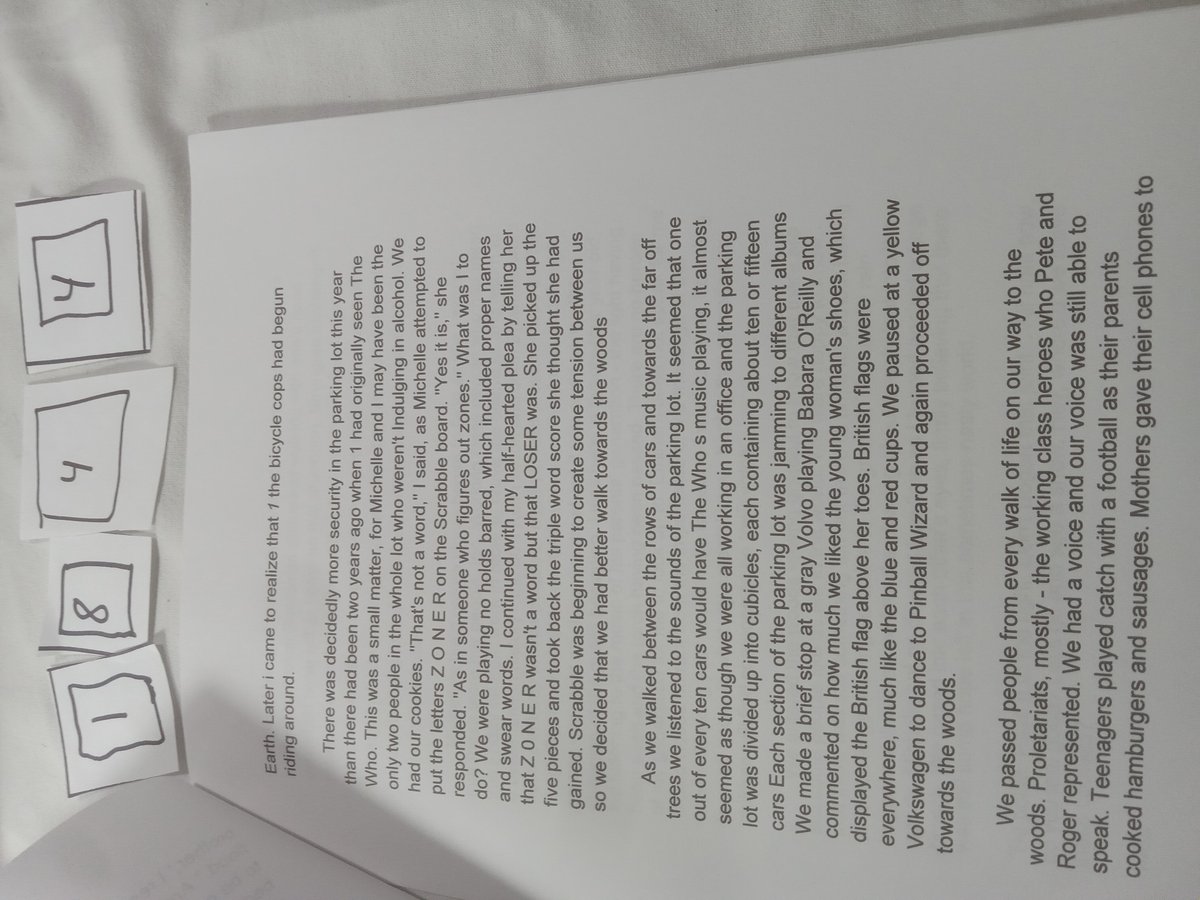
Picture 3 of 5
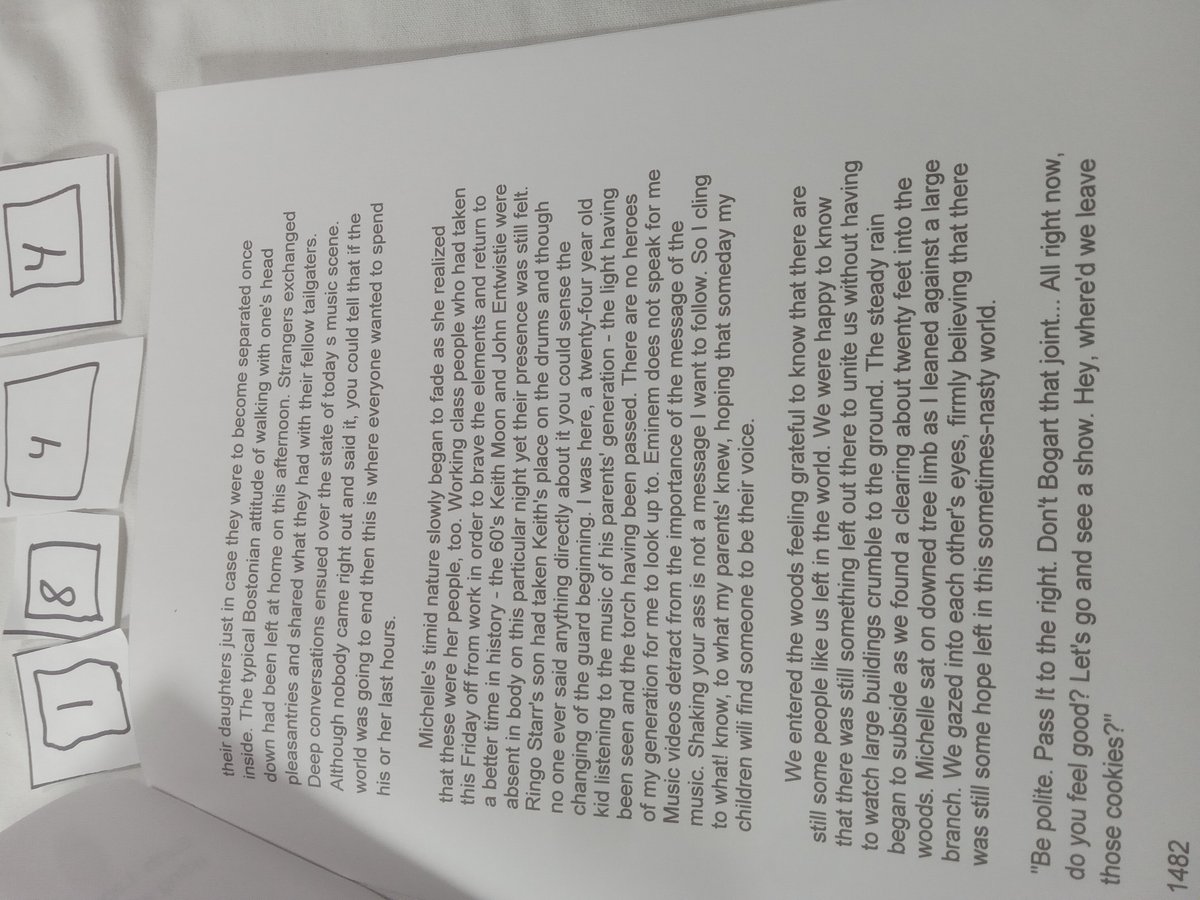
Picture 4 of 5

Picture 5 of 5
The words on this page
THE WHO PAPER by Tom Jensen
My heroes are dying. There is no real way to sugar coat something as powerful as that. Half of the Beatles are dead. Jim Morrison, Hendrix, Joplin, Cobain, Presley (the young one), Marley- the list goes on... My daily routine involves checking the obituaries to see which of my favorite performers is no longer performing. Often when I am daydreaming in my truck or in the classroom I ponder who will be next? There are so many candidates to choose from but I've narrowed down my top five to:
KEITH RICHARDS
BOB DYLAN
DAVID BOWIE
ROGER WATERS
DAVID CROSBY
It's a little sick and twisted, I know, but that's just the way my mind works. I never put anyone on this list from The Who, yet bass player John Entwistle passed away just about a month ago and drummer Keith Moon died what seems like a lifetime ago. You just never know when it's your time to go. My heart goes out to the families of anyone who has left this earth but I admit that the thought of the possibility of lead singer Roger Daltrey or singer and composer Pete Townshend dying instead of John Entwistle was deeply saddening. The defense mechanism of "can't wait 'til next year because they might not be here" turns on. So here I am at the Tweeter Center in Mansfield, Mass. I'm three hours early. Half of the original members of The Who are now part of the house band in Heaven, but on this side of the clouds the show goes on and the spirit lives for at least one more night. It's raining, but only on the outside.
"Hey, look at the two love birds in there You're ail set." "Thanks
---
brother, ' I responded, "Oh yeah, I feel just like Noah i'm ready for the flood." And on that note we were ready to settle into what was going to be our living quarters for the next three hours. Michelle sat in the bed of my truck as I added a few modifications for comfort, convenience and dryness. Michelle watched in amazement as I unveiled my creation previously hiding beneath a secured blue tarp In a matter of a minute I had nailed together the prefabricated frame for our tent and proceeded to secure the two large tarps I had brought There was no way that we were going to sit in the cab of the truck all afternoon if it rained so we needed a way to stay dry By luck, i just happen to know a thing or two about carpentry and have a ladder rack welded onto the bed of my truck Add to the list a hammer, 10 nails, a screw gun and a few pieces of seven foot strapping and with a little creativity we had our little foxhole. It felt like camping...only with eighteen thousand other campers
Michelle set up our folding beach chairs as i searched my plump backpack for cookies. When I get the munchies I love cookies Many say that well preparedness and having good organizational skills are the keys to enjoying a concert. Michelle and I decided to test this theory by bringing an exotic lunch of peanut butter and jelly sandwiches, goldfish, muffins, diet root beer and cookies. We sat in our foxhole eating lunch and playing Scrabble while watching the parking lot slowly fill with people
These are my people. The first thing that grabs your attention is all of the red and blue cups that people are holding. No Starbucks cups to be found. No pretentiousness, either. Everybody's got a beer and a smile. State law regulates that open containers of alcohol are prohibited but the unwritten rule is that as long as you hide your alcohol you may drink as much as you want. As you look off towards the outskirts of the paved parking lot you find that The Who fans are really in tune with nature. You'll find many of them going back and forth into the surrounding woods, generally in groups from two to five. My first thought when I noticed this was that they appreciate Mother
---
Earth. Later i came to realize that 1 the bicycle cops had begun riding around.
There was decidedly more security in the parking lot this year than there had been two years ago when 1 had originally seen The Who. This was a small matter, for Michelle and I may have been the only two people in the whole lot who weren't indulging in alcohol. We had our cookies. "That's not a word," I said, as Michelle attempted to put the letters Z O N E R on the Scrabble board. "Yes it is," she responded. "As in someone who figures out zones." What was I to do? We were playing no holds barred, which included proper names and swear words. I continued with my half-hearted plea by telling her that Z O N E R wasn't a word but that LOSER was. She picked up the five pieces and took back the triple word score she thought she had gained. Scrabble was beginning to create some tension between us so we decided that we had better walk towards the woods
As we walked between the rows of cars and towards the far off trees we listened to the sounds of the parking lot. It seemed that one out of every ten cars would have The Who s music playing, it almost seemed as though we were all working in an office and the parking lot was divided up into cubicles, each containing about ten or fifteen cars Each section of the parking lot was jamming to different albums We made a brief stop at a gray Volvo playing Babara O'Reilly and commented on how much we liked the young woman's shoes, which displayed the British flag above her toes. British flags were everywhere, much like the blue and red cups. We paused at a yellow Volkswagen to dance to Pinball Wizard and again proceeded off towards the woods.
We passed people from every walk of life on our way to the woods. Proletariats, mostly - the working class heroes who Pete and Roger represented. We had a voice and our voice was still able to speak. Teenagers played catch with a football as their parents cooked hamburgers and sausages. Mothers gave their cell phones to
---
their daughters just in case they were to become separated once inside. The typical Bostonian attitude of walking with one's head down had been left at home on this afternoon. Strangers exchanged pleasantries and shared what they had with their fellow tailgaters. Deep conversations ensued over the state of today s music scene. Although nobody came right out and said it, you could tell that if the world was going to end then this is where everyone wanted to spend his or her last hours.
Michelle's timid nature slowly began to fade as she realized that these were her people, too. Working class people who had taken this Friday off from work in order to brave the elements and return to a better time in history - the 60's Keith Moon and John Entwistie were absent in body on this particular night yet their presence was still felt. Ringo Starr's son had taken Keith's place on the drums and though no one ever said anything directly about it you could sense the changing of the guard beginning. I was here, a twenty-four year old kid listening to the music of his parents' generation - the light having been seen and the torch having been passed. There are no heroes of my generation for me to look up to. Eminem does not speak for me Music videos detract from the importance of the message of the music. Shaking your ass is not a message I want to follow. So I cling to what! know, to what my parents' knew, hoping that someday my children wili find someone to be their voice.
We entered the woods feeling grateful to know that there are still some people like us left in the world. We were happy to know that there was still something left out there to unite us without having to watch large buildings crumble to the ground. The steady rain began to subside as we found a clearing about twenty feet into the woods. Michelle sat on downed tree limb as I leaned against a large branch. We gazed into each other's eyes, firmly believing that there was still some hope left in this sometimes-nasty world.
"Be polite. Pass it to the right. Don't Bogart that joint... All right now, do you feel good? Let's go and see a show. Hey, where'd we leave those cookies?"
1482